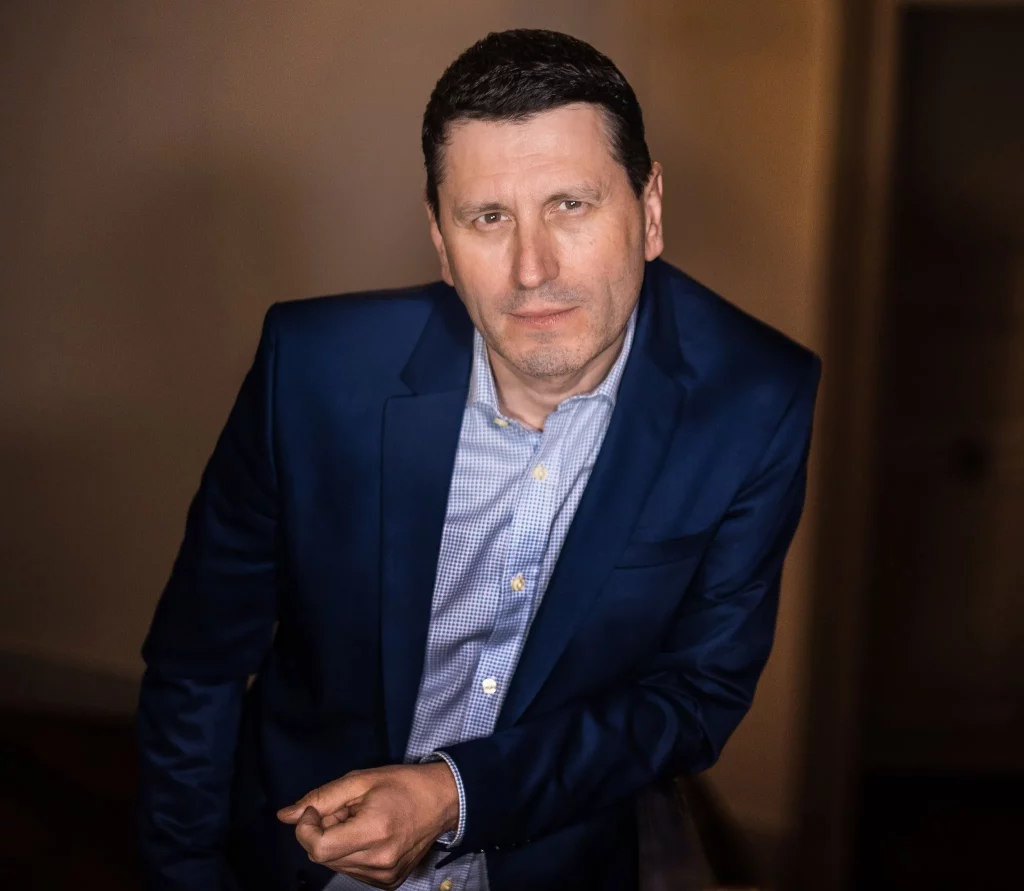
In a book of more than 600 pages, the journalist Frédéric Martel, host of the programme Softpower on France Culture, recounts his encounters with the intellectuals who think in opposition to the West.
It is a doorstopper. A defence of the West against its enemies, the authoritarian powers that, like China and Russia, stand against it. In opposition to the West, China offers one-party dictatorship and social control combined with a market economy. Russia, for its part, seeks to defend the West of yesterday, in a reactionary movement against historic emancipations from religion, from the patriarchal model and from liberalism. Religious fundamentalists have joined them in this anti-Western hatred of a Christian or secular society that defies the only law to which men should submit: that of the true God.
Although he sometimes digresses into detailed accounts of the history of Cuba, Venezuela or the Palestinians, Frédéric Martel, author of the book “Occidents, enquête sur nos ennemis” published by Plon, went to meet the thinkers (who are often graphomaniac hacks) behind all the ideologies that have made the West the enemy to be brought down.
Against colonisation and slavery
He also recounts several key episodes in this long-standing distrust of the West on the part of the Global South, a West with an unforgivable history of slavery and colonialism, such as the Bandung summit in 1955, while not omitting that other worlds have also been colonisers and slave-holders. The spirit of Bandung gave birth to the Non-Aligned Movement, formally founded at the Belgrade conference in 1961. The real brains behind Bandung, he writes, was Zhou Enlai, Mao’s prime minister for 26 years and, as such, jointly responsible for one of the greatest genocides in history (20 to 65 million dead according to the estimates of various historians). For this communist leader, Bandung was a means whose sole purpose was the official recognition of China at the United Nations by as many countries as possible. Certain anti-Western prejudices date back to Bandung, the author explains.
Indeed, this pro-Soviet or pro-Maoist conference would give rise to what is known as the Third Worldist left, which would lead so many countries “towards authoritarianism and economic ruin”. Moreover, some of the representatives of these non-aligned countries turned out to be colonisers themselves, such as Nasser with his designs on Syria, Lebanon and Jordan. Not to mention Mao and Zhou’s China, which instituted state racism against the peoples of Tibet and Xinjiang and challenged India militarily in the Himalayas. All of them also swiftly realigned themselves, casting aside democratic values. Stalin’s USSR, for its part, sent in tanks to crush any attempt by peoples to free themselves from its grip.
As for slavery, for which Western countries are rightly reproached, it was abolished in Mauritania only in 1981, in Oman in 1970, in Turkey in 1964 and in Yemen and Saudi Arabia in 1962, and it still persists in certain areas of Nigeria and Sudan, as well as within fundamentalist organisations such as Islamic State and the Afghan Taliban. Over 13 centuries, 12 to 17 million people were enslaved as victims of the Arab-Muslim slave trade – a slightly higher number, and over a longer period, than Western colonisation.
How former communists turned ultranationalist
The book opens with an interview with Steve Bannon, the inspiration behind Trump’s first term and the alt-right, which Frédéric Martel prefers to call the “hard right”. The former hippie has one obsession: the decline of the West. And he denounces “liberal fascism”, unaware that the expression had already been used before him by alter-globalisation activists, Subcomandante Marcos, Putin and Xi. This strange connection between the communist world and that of the nationalist far right will be one of the book’s common threads, and the crux of its thesis: communism was the breeding ground for reactionary nationalism. We shall return to this.
Bannon has a master: Gramsci, the Italian communist theorist who made cultural struggle (to put it briefly) the first and necessary stage of a revolutionary process. Another connection between the two worlds. Like the Russian Dugin or the Brazilian de Carvalho, he worries about the end of a Christian West. All of them denounce Europe’s “falsely universalist” ideas and declare themselves anti-Western. Some out of anti-Americanism, others out of anti-colonialism or anti-Zionism, and others still out of nationalism, an Asian tropism or communism.
Faced with Alexander Dugin, “the radioactive Russian intellectual, the fascist and criminal propagandist”, Martel describes a typical anti-Westerner who denounces “liberal fascism”. A Slavophile, Eurasianist, Orthodox Old Believer and Putinist, Dugin defines “liberal fascism” as a cocktail of wokeism and feminism, taking in the LGBT question and Black Lives Matter, among other things. He also takes up the Stalinist idea, “now Chinese and even Trumpian”, of dividing the world up between powers.
Dugin, the man nostalgic for the USSR who was active at the time in a small Nazi party infiltrated by the KGB, champions an “imperial zone of influence for Russia, outside international law”. Long before Putin attacked Ukraine, he was demanding its annexation. In his view, Russia must stir up “geopolitical disorder everywhere, all kinds of separatism, ethnic and racial conflict, and support every dissident, racist and sectarian movement in order to destabilise the United States and Europe”. And here we are! For him too, as for Curtis Yarvin and Nick Land, the neo-reactionary American influencers who have shaped the ideological direction of Donald Trump’s second term, the West is finished unless it turns the page on democracy, universalism and liberalism (he advocates, among other things, a bio-Leninism to restore a human hierarchy and regenerate the West).

The confrontation sought with the “collective West”, as Putin calls it, involves constantly exposing the vulnerabilities of Western countries, systematically criticising the European Union and championing every foreign sovereigntist. Seen from Moscow, democracy leads to chaos and to the collapse of the West, for which the globalised elites are to blame (George Soros and Klaus Schwab, founder of the Davos Forum, being emblematic figures pilloried as such), but so too are the Brussels bureaucracy, migrants and LGBT people. On Russian television, anti-Western conspiracy theories brainwash viewers daily. On social media, Medvedev and Solovyov call Westerners “bastards” or “degenerates”. And, along with others, they take offence at the decline of religion and the destruction of the family, as does Kirill, the Orthodox Christian patriarch, who preaches holy war against this corrupt West. Yet in Russia only 0.5% attend church each month, as in Europe. Meanwhile, Russia’s demographic decline has been a reality since the 1990s. Homophobia has also become the universal language of populists, writes the author of “Sodoma”, his previous book, which sold half a million copies worldwide.
The author also offers an interesting reading of populism and the rise of the far right in the East, described as “nostalgia for a past disguised as the future”, born of the disenchantment of citizens lost in a society adrift, stripped of both the reassuring framework and the infantilising straitjacket of Sovietism. The West and its intellectuals, for their part, often fascinated by Marxism, failed to perceive (or perceived far too late) the perverse mechanisms of this ideology. Behind the hatred of the West, for many, lies hatred of the bourgeois, a figure loathed by the communists and whose caricature is the Jew. Martel speaks of a great U-turn, the sharp swing of communist ideas towards the hard right. If one figure had to embody it, it would be Glenn Greenwald, who moved from the far left to the ultra-right, he writes
The Chinese promoters of hatred of the West
This critique of the West is illustrated by a speech delivered by the elderly Solzhenitsyn at Harvard in June 1978. In it, he attacks the American way of life, a “civilisation of comfort, a fair of commerce and boundless materialism” that leads to a “loss of virility and the end of courage”. There follows a ferocious critique of democracy, the multi-party system, freedom, the rule of law and human rights, which make people “forget the sense of God”.
Brazil, Hungary, Italy: Frédéric Martel meets the people who inspire the regimes of Bolsonaro, Orbán and Meloni. Among their sources of inspiration are writers such as Alain de Benoist, a French intellectual of the Nouvelle Droite who was likewise inspired by Gramsci, as well as the Mussolinian Julius Evola and the speeches of Charlie Kirk, a figure of the MAGA far right who was assassinated in 2025. He then introduces us to their lesser-known Chinese counterparts, such as Zhang Weiwei, author of “The China Wave” and “The China Horizon”, two bestsellers read and recommended by the new master of the Middle Kingdom, Xi. According to Zhang, this millennia-old civilisation can boast “undeniable characteristics, such as a singular rule of law, the role played by the Communist Party and its different economy”, and he is convinced that it will lead the world.
China therefore champions a democracy “with Chinese characteristics” and describes the United States as a plutocracy with six masters: monocracy, guncracy, whitecracy, militacracy and drugcracy. For these Chinese ideologues, Western democracy fails to select the best political leaders and concerns itself with human rights while not everyone can afford healthcare or housing. “A democracy that works”, Xi’s slogan, is in fact a kleptocracy that benefits Xi, his family and the party leadership, a form of “crony capitalism” that counts 430 billionaires, more than the United States and India combined. Jiang Shigong, for his part, advocates a second intellectual revolution: the first was carried out by Mao against bourgeois thought, while the second would consist of breaking free from Western influence.
Wang Huning, chief ideologue to the last three Chinese presidents, describes the United States as a divided and chaotic country, unequal, rich yet full of poor people, and one whose lack of a common good, democracy and religion of individualism will spell its decline. He interprets the colour revolutions in Eastern Europe as destabilisation orchestrated by the Western powers and regards the collapse of the USSR as the result of opening up to the West. He is credited with the slogans of Jiang Zemin’s “Three Represents”, Hu Jintao’s “harmonious society” and Xi’s “Chinese Dream”. He is also said to have played a role in the choice of the New Silk Roads. He is the author of Document No. 9, which warns party leaders against seven perils, essentially linked to the democratic model and to “so-called universal” values, and defends Asian values.
These are associated with the name of Lee Kuan New. The first is that human rights are not universal. Asian societies, “guided by a certain Confucianism, put the family before the individual, relegating personal rights to second place. Moreover, economic and social rights take precedence over civil and political liberties”. In his view, Asian values cannot be judged by criteria foreign to them, while the West is “paternalistic, issuing injunctions” described as “neocolonialism”. Lee Kuan New’s political model is “consensual democracy without free elections”, while “social life is built on neo-Confucian self-discipline”.
The war of the Arab Muslims
For Islamists, “no secularisation is possible within Islam, because it encompasses every aspect of life”. In the Middle East, Islamic Jihad and the Muslim Brotherhood – sometimes allied, sometimes opposed, sometimes intertwined, as in Gaza – are utterly radical and apply the ideas of Huntington’s Clash of Civilizations. It is not for the state to legislate on good and evil; that is God’s prerogative. The Koran alone lays down the law.
Like the Trotskyists, the Muslim Brotherhood practises entryism, under the very noses of tolerant secular regimes. For them, the West stands for progress, secularism, women’s rights and secularity (a synonym for democracy): everything they reject. In the Iran of the first Islamist revolution in 1979, that of the theocracy of the mullahs, freedom of conscience has been erased, atheism rejected, apostasy repressed, freedom of opinion and of the press curtailed or non-existent, and the very notion of sexual orientation banned. The West is seen as decadent and immoral. The regime denounces Westerners’ rampant hedonism, the end of norms, their sexuality and their narcissism. One of the Islamists’ mantras is revenge for the fate that the colonial West inflicted on Arabs and, more broadly, on Muslims. The author points out that, since 2000, the vast majority of Arabs who have been killed were killed by Arabs, not by Westerners.
Frédéric Martel also topples the statues of revolutionary Third Worldism: Fanon, a “propagandist of violence” who hated democrats, including those in the anti-colonialist camp. Che Guevara, the ultimate icon of Third Worldists and the far left, who “despised democracy because it was bourgeois, imperialist and Western”. In him, this radicalism went hand in hand with a hatred of moderates. His closest companions, interviewed by the author, attest to his cruelty and his sadistic fascination with violence. Appointed head of Castro’s tribunals, he made torture widespread, and the firing squads followed. He also turned terrorism into a legitimate weapon. As for Fidel, another icon, he was even crueller and lived in luxury. His fortune was estimated to be equivalent to that of the Queen of England.
He is astonished that French politicians such as Jean-Luc Mélenchon can be enthusiastic about Venezuela’s socialist experiment. Since the beginning of Chavismo, he writes, at least 38,000 people have been tortured by the regime, which has forced 8 million inhabitants into exile. There follows a series of questions about the regular trips to Caracas made by members of La France Insoumise, officials of ATTAC and Le Monde diplomatique. The far-left newspaper, which out of campism supported the national socialist Milošević and today supports Putin’s Russia, has figures linked to the KGB, writes Frédéric Martel, citing names.
A long section on Palestine follows. With some irony, the author points out that Israel was born of a decolonisation struggle against the British, a cause that ought to be dear to anti-colonialists. He recalls that Israel’s Jews were poor migrants who had left everything behind: Arabs, Russians, Europeans, Moroccans and Yemenis seeking refuge. They bear no comparison with the French in Algeria, the Belgians in the Congo or the Portuguese in Angola, because those had a state behind them, he writes. Most Israelis have no country to fall back on. Like many Palestinians, who have been rejected by most Arab countries.
In the face of all the West’s enemies, the author calls for an end to compromise on the universality of democratic values. Democracies account for 45% of the world’s population and 42% of its states, and therefore do not reflect purely Western values. He also rejects every euphemism applied to the Chinese and Russian regimes, such as “democracy with Chinese characteristics” or “authoritarian democracy” in Russia’s case. What kind of democracies are these? He adds that Marx’s critique of human rights led his readers to totalitarianism, as Claude Lefort and Hannah Arendt have written. He stresses that the revolutionaries of 1789 framed the Declaration of the Rights of Man for the whole of humanity, saying yes to the universality of values and no to the standardisation of cultures. Finally, his book is meant to lead Westerners to listen to the criticisms of these “enemies of the West”, but omits to highlight the lies, prejudices and excesses that have led them to hatred.
“Occidents. Enquête sur nos ennemis” by Frédéric Martel, Editions Plan, March 2026, 615 pages, 26 euros.
Translated from French. The French original prevails.