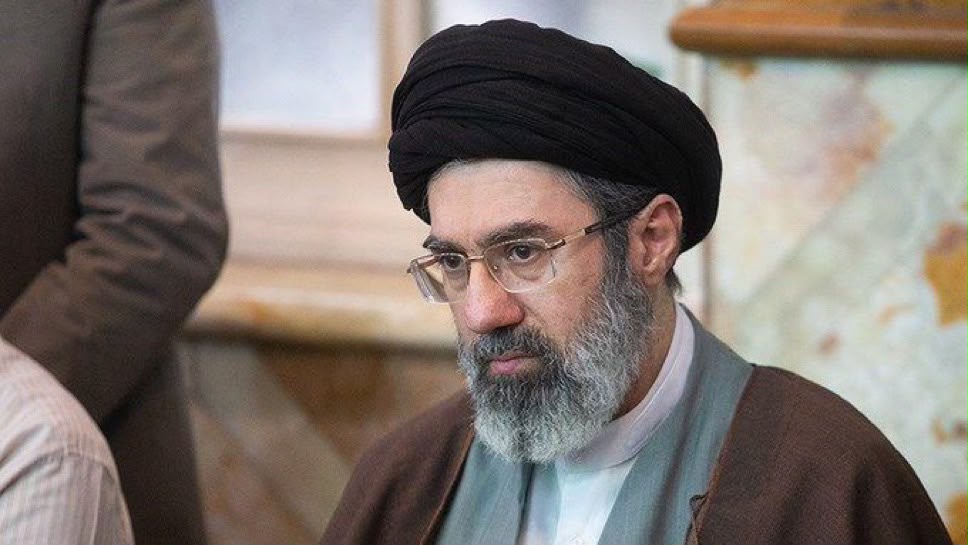
Montana Lhamenei (archive photo).
As negotiations over the war and the Strait of Hormuz enter a decisive phase, another question arises: who really holds the power to negotiate on Iran’s behalf? With a president who insists the war must end, an Islamic Revolutionary Guard Corps that refuses to give ground on its demands, an invisible Supreme Leader and a struggle over the Supreme National Security Council that has now spilled into the open, Iran’s chain of command is becoming ever harder to pin down.
The confusion over who leads Iran’s Supreme National Security Council might look like no more than the latest episode in the power struggles roiling Tehran. Yet it bears directly on the negotiations under way in an effort to end the war. Iranian media had initially reported that Mohsen Rezaei was replacing Mohammad Bagher Zolghadr at the head of the Council. The situation has since become clearer: Rezaei is not replacing Zolghadr as secretary, but is joining the Council as the Supreme Leader’s representative. A former commander-in-chief of the IRGC, he too belongs to the heart of the security establishment, even if he is often regarded as more pragmatic in how he handles the balance of power. This clarification is especially sensitive because the Council lies at the heart of Iranian decision-making on defence, diplomacy and national security.
And it is precisely as the United States and its intermediaries look for an interlocutor capable of striking a deal with Tehran that the various components of Iran’s power structure are sending out messages that are increasingly hard to reconcile.
Supreme Leader still out of sight
A video presented by the regime as recent, showing the Supreme Leader addressing students.
On top of this institutional fragmentation comes a still more structural uncertainty: the one hanging over the very top of the regime. Mojtaba Khamenei has not been seen in public since the attack of 28 February that killed his father and left him seriously injured. Reuters reported in April that he had suffered severe injuries to his face and legs, while adding, on the strength of sources close to his circle, that he was then still involved remotely in certain decisions. Since then, the opacity has persisted. Unconfirmed reports have variously described him as hospitalised, in a critical condition, or even unable to carry out his duties normally. The Iranian authorities, by contrast, insist that he continues to govern.
State media recently broadcast a video presented as showing the Supreme Leader addressing religious students. But the footage is undated, and its release immediately sparked controversy, with some Iranian internet users claiming that it came from old sessions in Qom. This claim has not been independently verified.
The footage therefore does not dispel all the questions. Mojtaba Khamenei appears seated, with very limited movement in his right arm, while his right leg remains hard to make out in the frame. These images obviously do not allow for any diagnosis. Nor are they enough to show that he has regained normal physical capacity after the serious injuries reported in the spring.
The political problem remains unresolved. The regime continues to grant the final say to a Supreme Leader whose physical condition and actual capacity to wield power on a day-to-day basis remain difficult to establish. In practice, the IRGC’s influence over the conduct of the war and strategic choices has grown even stronger. Yet its commander-in-chief, Ahmad Vahidi, continues to present Mojtaba Khamenei as the ultimate authority on major decisions. Pezeshkian himself acknowledges that the continuation of the war is a matter for the military leadership and, in the last resort, for the Supreme Leader.
The institutional paradox is considerable: the regime continues to refer to the Supreme Leader as the ultimate arbiter, while his real capacity to arbitrate remains impossible to gauge from the outside. If Mojtaba Khamenei’s state of health does in fact prevent him from fully exercising this role, one question becomes inevitable: who is wielding power in his name?
Pezeshkian wants out of the war, but admits he does not decide
President Masoud Pezeshkian no longer hides his concern at the prolongation of the conflict. His priority, he says, is no longer even a fresh American attack, but the deteriorating economic situation of the population. He acknowledges that it is becoming difficult to bring goods into Iran and that the country must find alternative supply routes. This situation sheds light on his growing insistence on a negotiated solution. But above all, Pezeshkian has just made a crucial admission about how power works in Iran: “The decision to wage war does not rest with the Iranian government.”
In his view, it is the military leadership that decides whether the country should continue fighting. The government must then comply with the decisions taken by the leadership and secure the supplies and equipment needed for the war effort. This statement goes straight to the question at the heart of the negotiations: if the Iranian president does not have the power to decide on war, does he have the power to decide on peace?
Pezeshkian went further, alluding in veiled terms to the divisions running through the regime. He said he had “a great deal to say” but could not say it without jeopardising “the unity of the home front”. In his view, Washington and Israel know that they cannot force Iran to capitulate with missiles, but might try to achieve that by sowing discord inside the country.
The warning is striking. Internal divisions are no longer merely denounced by the opposition or mentioned by anonymous sources. They are now acknowledged, albeit obliquely, by the Iranian president himself.
Pezeshkian may therefore want peace without having the power to impose it. The IRGC may want to pursue the confrontation without having to bear its economic cost directly. Between the two there ought to be an arbiter: the Supreme Leader. Yet it is precisely his actual authority that is now shrouded in uncertainty.
IRGC sets its own red lines
The IRGC, for its part, remains uncompromising. While the negotiations being conducted with Oman concern the conditions for reopening the Strait of Hormuz, the Guards maintain that a reopening does not depend solely on an agreement with Muscat, but on Washington’s acceptance of Iran’s demands. According to Reuters, Tehran is demanding, among other things, guarantees that US operations will end, the lifting of sanctions and compensation for the financial consequences of the war. The Guards therefore take the view that a maritime arrangement with Oman cannot, on its own, lead to the full reopening of the strait.
The message is clear: negotiating does not mean giving in. Control over Hormuz is one of the main strategic levers Tehran still has at its disposal. For the IRGC, giving it up without substantial concessions in return would amount to abandoning an instrument that allows it to exert direct pressure on Washington and the Gulf monarchies. Two narratives therefore coexist at the top of the state: that of a president seeking the conditions to bring the war to an end, and that of a military apparatus determined to preserve the gains won through confrontation.
Zolghadr hardens Supreme Council’s line
The confusion has finally partly cleared. Mohsen Rezaei is not replacing Mohammad Bagher Zolghadr as secretary of the Supreme National Security Council. The former commander-in-chief of the IRGC is joining the Council as the Supreme Leader’s representative, alongside Saeed Jalili. Zolghadr, for his part, remains secretary of the Council. Yet this clarification does nothing to reduce the questions about the chain of command. It heightens them. The arrival of Rezaei brings into the heart of the Council another figure from the historical top ranks of the IRGC, appointed directly in the name of a Supreme Leader whose day-to-day exercise of power remains difficult to establish.
Above all, Zolghadr set particularly harsh conditions for any reopening of the Strait of Hormuz. According to him, the United States must permanently end its threats against Iran, end the war against Iran and its regional allies, lift the naval blockade, withdraw its naval and air forces from the vicinity of Iran, pay compensation for the wars endured by the Islamic Republic, lift sanctions and unconditionally release frozen Iranian assets. The secretary of the Council also asserted that the institution “will never back down”, either in war or in negotiations. The wording is revealing. Negotiation is presented not as a space in which each side should be prepared to make compromises, but as the continuation of the power struggle by other means.
The contrast with Pezeshkian is becoming striking. The president argues that a negotiated way out must be sought, voices concern about the economic situation and acknowledges that his government does not decide on the war. At the same time, the secretary of the Supreme Council sets out the conditions under which the conflict and the lockdown of Hormuz could come to an end. Pezeshkian talks of compromise; Zolghadr hammers home his conditions. One bears the political burden of the economic cost of the war; the other defines the strategic demands for ending it.
This divergence lends fresh weight to questions about Iran’s decision-making process. The Supreme National Security Council is supposed precisely to arbitrate between the positions of the political leadership, the military and the Islamic Republic’s various centres of influence. Yet its secretary is publicly adopting a line that appears far closer to that of the IRGC than to the one championed by the president. The question, then, is no longer simply who runs the Supreme Council administratively. It is to determine which authority, within this fragmented architecture, truly holds the power to turn a negotiation into a decision binding on the entire regime.
Pezeshkian under attack even in religious circles
The tension is no longer confined to relations between the president and the military establishment. It is also spreading to religious institutions. The cleric Mohammad Bagher Kharazi has been summoned before the Special Court of the Clergy after publicly attacking Masoud Pezeshkian and questioning his competence. The controversy took on a further dimension when remarks attributed to Kharazi portrayed the Supreme Leader as being in favour of Pezeshkian’s resignation. The Supreme Leader’s office officially denied the claim, while the president himself released a video message insisting that he had no intention of resigning.
The episode might seem minor. It is not. When the Supreme Leader’s office has to step in to deny reports about the president’s departure in the middle of a war, the question of authority is no longer merely institutional: it becomes political. The affair comes on top of accusations of a “political coup” levelled by ultraconservatives against the president’s inner circle, uncertainty over the leadership of the Supreme National Security Council and statements by Pezeshkian himself acknowledging that he does not have the power to decide whether the war continues.
One question therefore returns with greater force: which authority today has the legitimacy required to commit the Islamic Republic as a whole to an agreement with Washington?
Negotiating with whom?
The paradox thus becomes almost a real-time demonstration: the Iranian president acknowledges that he does not decide on the war at the very moment that the secretary of the Supreme National Security Council is setting the harsh conditions on which it could end. And above them both remains a Supreme Leader still presented as the final arbiter, but whose actual exercise of power remains shrouded in uncertainty.
For Washington, Oman, Qatar or any other mediator, the question becomes crucial. We had already raised it in a previous article in La Tribune des Nations, “A Chinese puzzle: who to negotiate with in Iran?”. Today it arises with greater urgency: does an agreement negotiated with Pezeshkian genuinely bind the Revolutionary Guards? Will a concession obtained from the Iranian Ministry of Foreign Affairs be applied on the ground by the forces that control the missiles, the drones and part of the military apparatus around the Strait of Hormuz?
And conversely, when the IRGC publicly sets out its own conditions, is it expressing the definitive position of the Iranian state, or that of the power centre that momentarily holds the upper hand?
The difficulty is therefore no longer simply one of bringing the American and Iranian positions closer together. First, one must know which Iranian position can genuinely bind the regime as a whole. This uncertainty is a major obstacle to any negotiation. An international agreement is not worth only the text that is signed. It depends on the ability of those who conclude it to ensure that their commitments are honoured by the institutions that hold the military and security resources.
Trump’s problem
Donald Trump can exert military and economic pressure on Iran. He can set deadlines, temporarily suspend strikes or accept mediation by regional powers. But no negotiation can work in the long run if the interlocutor sitting at the table lacks the authority to enforce what he signs. This may now be one of the main difficulties of the Iranian crisis. The war is no longer simply a confrontation between Washington and Tehran. It also exposes an internal struggle over who speaks for Tehran.
The paradox is now almost complete: Pezeshkian says a way out of the war must be found; the IRGC is setting conditions that make compromise far more difficult; the Supreme National Security Council now brings together several major figures of the security apparatus, including Zolghadr and Rezaei; and ultimate authority is still attributed to a Supreme Leader whom Iranians have not seen for months. Before even knowing what concessions Iran is prepared to accept, the United States and the mediators will therefore have to resolve a more basic question: who, today, actually has the power to say yes in Tehran?
Further reading from La Tribune des Nations
• Iran–United States: who can still stop the war?
• Nuclear programme, Hormuz: Tehran and Washington do not speak the same language
• US-Iran deal: who really wins the peace?
• Negotiations with the United States stir tensions within the Iranian regime
• A fiendish puzzle: who to negotiate with in Iran?
External sources
• Reuters, 8 August 2026: deal with Oman close but not enough to reopen Hormuz
• Reuters, 21 July 2026: Pezeshkian speaks of growing interaction with Mojtaba Khamenei
• Reuters, 11 April 2026: the injuries of Mojtaba Khamenei and his role in decision-making
• The Guardian, 8 August 2026: Pezeshkian seeks a deal as Tehran toughens its demands on Hormuz
Translated from French. The French original prevails.