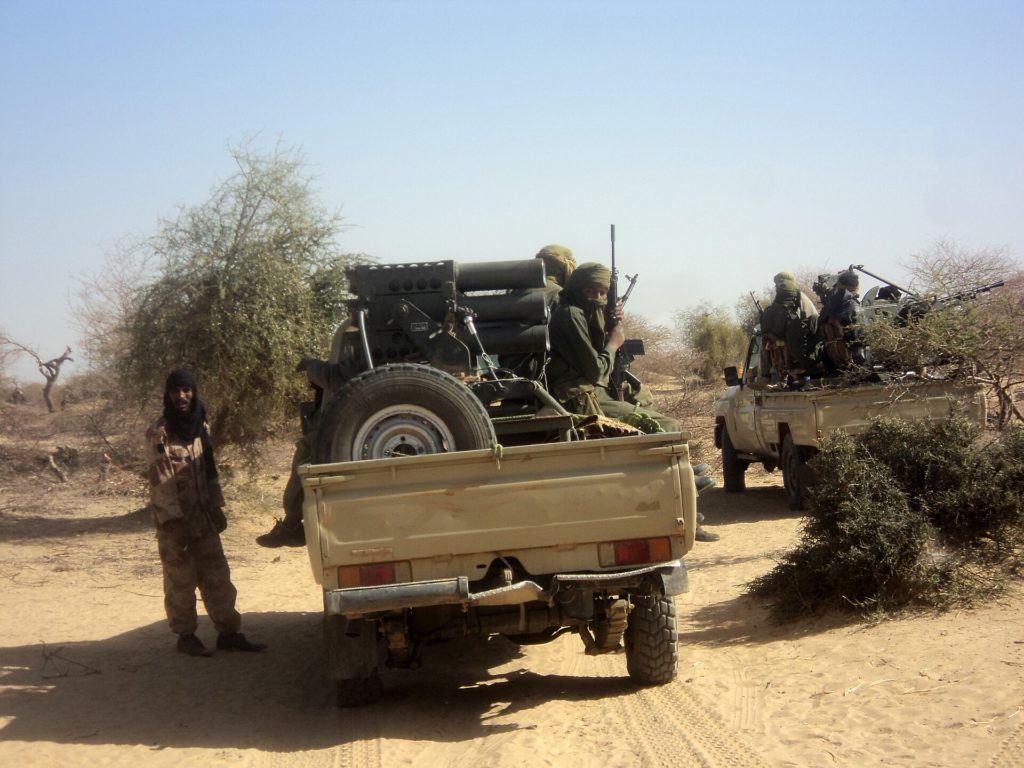
Tuareg fighters in a vehicle near Timbuktu on 7 May, the control of northern Mali with Islamist groups and al-Qaeda fighters., CC BY 2.0, via Wikimedia Commons.
Mali’s history was marked by cultural and scientific brilliance during the period of the Mali Empire in the 13th century, which was built through the unification of tribes and encompassed several cities, including Timbuktu, Gao and Djenné, which were cultural and commercial crossroads. Islam exerted a profound influence on the Mali Empire. Understanding it offers a better grasp of today’s challenges and what is at stake.
At the end of the 19th century, the French colonial administration engaged in repression and the economic plundering of Mali’s wealth, ignoring the realities of the socio-cultural make-up of the local population. Mali would not gain independence until 22 September 1960. It should be borne in mind that the legacy of colonial border demarcation gave rise to frustrations and claims that have fuelled recurring conflicts in the Sahel region, Mali included. Rivalries over control of the movement of licit and illicit goods intensified between tribes of Mali’s various ethnic groups, owing to the presence of foreign companies exploiting mineral resources, the establishment of foreign military bases, global warming with prolonged periods of drought, and the rise of the Salafi jihadist movement and other organised crime groups. These factors have created an environment of permanent insecurity that has undermined Mali’s stability.
A crossroads of trafficking and smuggling
Clearly, the decision by the United States to create AFRICOM reflects the importance this continent is set to assume in the near future, and is a sign of the expansion of the American security perimeter. The United States is indeed a hyperpower, and Africa has become a stake for it that will matter more and more. Bilateral issues will become ever more numerous, and none will escape its attention. It is already accepted that 30 to 40 % of the drugs entering US territory come from Africa, whether they were produced there or merely passed through in transit. The trafficking cartels are already under surveillance, and future Plan Colombias for Africa can already be envisaged. The military and security solution therefore seems to be gaining the upper hand as the response to the immense problems Africa faces ( Rogalski, 2008).
Since the 1980s, this region of the Sahel has depended on smuggling, and at the end of the 1990s tensions intensified with the growth of various forms of trafficking, such as smuggling, migrants, arms and drugs, for which Gao became “the hub towards Algeria and Libya”. These two countries developed rivalries – reflected in their use of local actors such as the Tuareg – over control of the trafficking in this region, which is regarded as a commercial node and a drug crossroads. The 2000s were marked by a regional geopolitical upheaval: the explosion in drug trafficking was coupled with the emergence of Salafist terrorism, whose armed groups would mobilise their resources in northern Mali and for whom control of the territory became a decisive issue. From 2008 to 2012, northern Mali became the regional epicentre of trafficking and of the manipulations of Islamist terrorism. This upheaval led to the presence of foreign Western powers, which followed a security-driven rhetoric and deployed in the region (Gantier, 2015).
The consequences of Gaddafi’s fall
Bamako had told its partners that the fall of the Libyan President, Gaddafi, needed to be better thought through, as its consequences could be a major destabilising factor for national security, both militarily and in terms of the population, the Tuaregs in particular. These warnings went unheeded […] One of the first consequences of the influx of Gaddafi’s former legionnaires was to radicalise the positions of certain Tuareg factions. Thus the National Movement of Azawad (MNA) became a movement for “liberation” (MNLA). It changed its military and political leadership, its new leader being a former colonel who had come from Libya, accompanied by fighters who had served in Tripoli’s army. It also changed its demands – now proclaiming that it was fighting for the independence of the northern regions – and its methods, by resorting to arms (Maiga, 2012).
Report No. 513 of 16 April 2013 by the “Sahel “working group of the French Senate’s Committee on Foreign Affairs, Defence and Armed Forces raises the prospect that Operation Serval would probably fail, and points to the lack of support from certain member states, apart from the United Kingdom, Belgium and Denmark. One passage it quoted foresaw the situation perfectly: ” The main risk today is that the Malian political process will become bogged down and that there will be no reconciliation. For France and the international community, that would be the worst-case scenario. The political process must be vigorously supported by France, the European Union and the UN.” (Sénat- France, 2013).
From traditional self-defence militias, we move on to “community” paramilitary groups, and finally to sweep operations by government armed forces. To these must be added elite units, the formation of new joint armies between states and the ever-present United Nations peacekeepers. Africa is estimated to be the continent through which most of the world’s weapons transit. This type of mobility seems to be encouraged: weapons and goods may circulate, but people who move are detained! (Mauro, 2019).
Foreign interventions and military coups
Interventions by foreign armed actors – the United Nations Multidimensional Integrated Stabilization Mission in Mali (MINUSMA), the French army’s Operations Sabre and Barkhane, the Chadian army’s intervention as part of Operation Serval and then the G5 Sahel, the Takuba Task Force (European special forces) and the G5 Sahel Joint Force: this diverse environment fosters indecision among Malian forces in the face of the many contradictory decisions taken by those intervening (Antil, 2020).
After two successive military coups, in August 2020 (the arrest of President Ibrahim Boubacar Keita) and May 2021 (the arrest of President Bah N’Daw), political, diplomatic and above all military relations between France and Mali deteriorated sharply. The military thus set up a transitional government on 16 May 2022 and expelled the French Ambassador in Bamako, Joel Meyer.
The conflict in Mali is closely bound up with the exploitation of strategic minerals (cobalt, platinum, gold, uranium and rare earths). Intervention by Western and Eastern powers plays a part in this invisible hand that sustains the security chaos. Among the factors that triggered the political reorganisation of Mali and the Sahel countries is the Western countries’ pursuit, at any cost, of a just democratic constitutional order in a country whose population suffers from poor governance, corruption and a sense of powerlessness in the face of the squandering of state resources. This is what drove the military of the three Sahel countries’ armed forces to seize the reins of power, expelling the French military presence, to unite under the Alliance of Sahel States (AES), to move closer militarily to Russia, and also to plan their withdrawal from the Economic Community of West African States (ECOWAS) in 2025.
Is there a link between the announcement of the creation of the Alliance of Sahel Democrats (ADS) on 7 April 2026 in Brussels and the series of terrorist attacks carried out by armed groups on 25 April 2026, in which President Assimi Goita was targeted ? In fact, it was the Minister of Defence, Lieutenant General Sadio Camara, who was killed at his home along with several members of his family in a suicide attack using a tanker lorry.
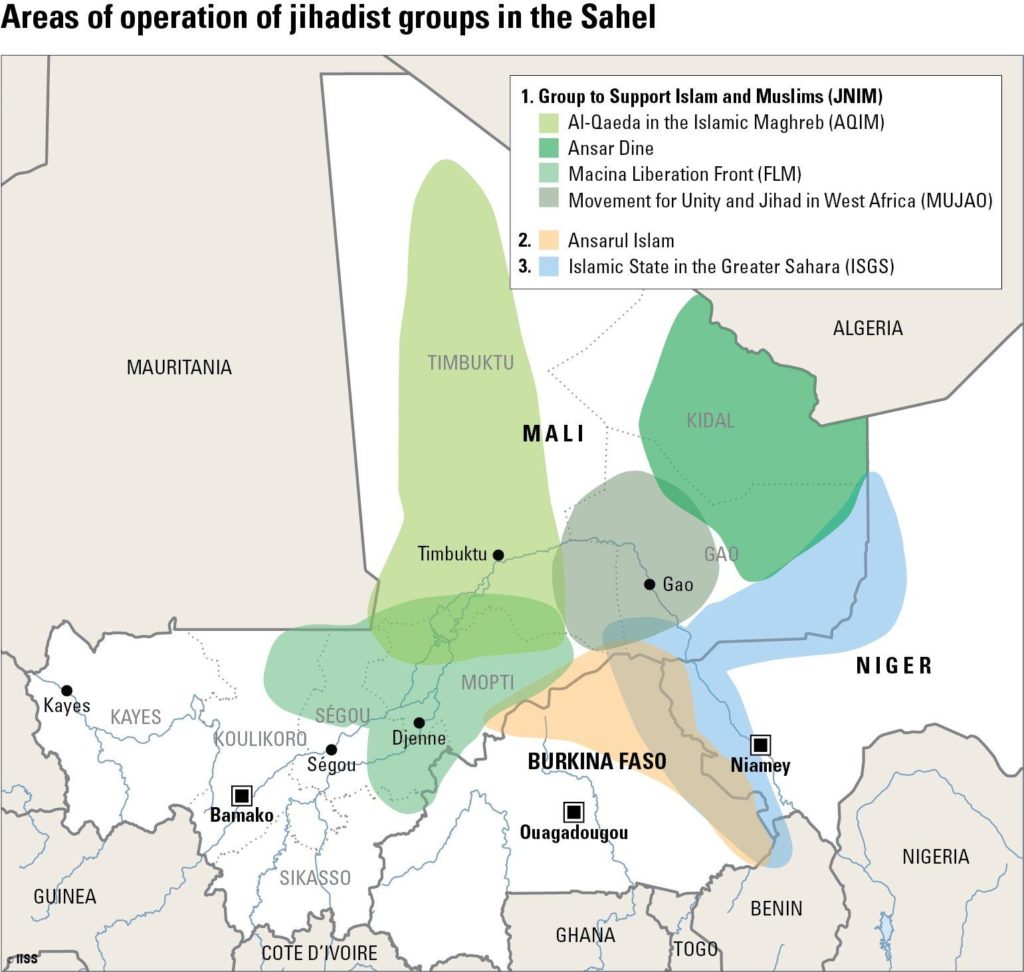
The series of offensives was carried out jointly on 25 April by Jama’a Nusrat ul-Islam wa al-Muslimin (JNIM, “Group for the Support of Islam and Muslims”) together with the Azawad Liberation Front (FLA). Several of the country’s major cities, including Bamako, Kati, Konna, Mopti, Gao and Kidal, were hit by simultaneous, coordinated attacks. The assaults killed a number of soldiers and civilians […] The attorney general’s statement also refers to the involvement of several political figures, such as Dr Oumar Mariko, a well-known left-wing opposition figure and co-founder of the communist party African Solidarity for Democracy and Independence (SADI), of which he is secretary general. Should the charges brought by the military court in Bamako prove well founded, they would point to the formation of a broad alliance, political even before it is military, aimed at offering an alternative to the junta, an alliance in which JNIM would play a central role, if only because of its military strength. This hypothesis gains weight in light of the abduction in Bamako of one of the military junta’s leading critics, the lawyer Mountaga Tall, who had defended several military officers arrested in recent months on charges of “attempting to destabilise state institutions” (Fides, 2026). In view of this hypothesis, we may suppose that a scenario along “Syrian” lines is taking shape in Mali.
Towards US intervention?
In the light of this new political divide, the Sahel finds itself split into two political blocs that are difficult to reconcile. The risk posed by this fragmentation is a lack of vigilance brought about by instability, which would directly benefit armed groups. In the absence of security coordination between the AES and the ADS, these jihadist organisations could exploit such gaps to carry out more terrorist operations. Moreover, the AES’s perception of the ADS as a threat could lead it to step up the repression it exercises, rendering its action counterproductive (Lammat, 2026).
On 14 May 2026, General Dagvin Anderson, in his report to the 119th session of Congress, referred to the direct threat posed to the security of the governments of Mali, Burkina Faso and Niger by two armed groups: Islamic State and Jamaat Nusrat al-Islam wal-Muslimin (JNIM). This leads us to believe that President Trump’s administration could be considering military operations in Mali in the near future, and that the presence of US military forces in the Sahel is likely to be longer-lasting.
“Terrorism remains the most acute threat in Africa. USAFRICOM’s area of responsibility has become the epicentre of global jihadism, with West Africa alone accounting for more than 51% of terrorism-related deaths worldwide in 2024. The Islamic State, through affiliates such as ISIS-West Africa and ISIS-Sahel, seeks to establish a caliphate by exploiting weak governance and lawless areas in the Sahel and the Lake Chad Basin. Jamaat Nusrat al-Islam wal-Muslimin (JNIM), an al-Qaeda affiliate, operates in the Sahel, exploiting violence and local grievances to extend its influence and destabilise the governments of Mali, Burkina Faso and Niger. Both groups maintain transnational networks that facilitate the movement of fighters, weapons and funding, thereby posing a direct threat to regional stability and global security. JNIM has refined tactics aimed at cutting off fuel supplies and key transport routes, first targeting the towns of Kayes and Nioro du Sahel before almost taking control of Bamako, the Malian capital. Unlike the capture of Mosul by ISIS in 2014, this would be a terrorist organisation seizing the resources and infrastructure of a nation state, underscoring the need to monitor and neutralise these growing threats. JNIM also aspires to threaten the US homeland and to carry out attacks against US personnel and facilities.”(United States Senate, 2026).
Such a US military intervention, if it went ahead, would make Mali the eighth country targeted by US strikes since the start of Donald Trump’s second term, after Yemen, Somalia, Syria, Iran, Iraq, Nigeria and Venezuela […] One of the leading advocates of this armed response to terrorism is reportedly Sebastian Gorka, Deputy Director for Counterterrorism at the National Security Council. The White House, for its part, has not confirmed the existence of plans for strikes […] A US intervention in Mali would carry additional risks, according to analysts interviewed by the Washington Post. In particular, it could lead to tensions with the Russian forces present in the country, and require coordination mechanisms similar to those set up between Washington and Moscow in Syria (Richet, 2026).
Asserting African sovereignty
The improvement in relations between Bamako and Algiers since 10 July 2026 offers an opportunity to revitalise the Nouakchott Process, a counter-terrorism cooperation mechanism created by the African Union (AU) in 2013. It currently brings together Algeria, Burkina Faso, Côte d’Ivoire, Guinea, Libya, Mali, Mauritania, Niger, Nigeria, Chad and Senegal. It could be expanded to include Togo, Ghana and Benin. The AU could also seek United Nations support for its regional peace initiatives under Resolution 2719, which authorises the funding of African peace support operations (Rodrigue Koné, 2026).
Regaining military sovereignty and reasserting a continent-wide political identity are the sine qua non for Africa to stop being a theatre of external rivalries and a coveted territory. On the contrary, they will enable it to place itself at the heart of the global power stakes. By asserting its sovereignty over its strategic resources and diversifying its partnerships, the continent will establish itself as a major geostrategic actor (Kananura, 2026). It is by identifying the various factors, both regional and international, raised by the conflict, and then by analysing the political, legal, economic, socio-cultural and diplomatic determinants, that one can hope to put into perspective solutions for the peaceful settlement of conflicts, rather than by focusing solely on the security dimension and foreign military intervention. Democracy cannot be decreed from outside; it is built from within.
Sources
- Antil, Alain, 2020, “ Violence sans fin au Sahel ”, revue Etudes, Editions S.E.R, September 2020, no. 4274, pp. 19-30 DOI 10.3917/etu.4274.0019
- Fides, 2026, Afrique/Mali-Un éventuel “ scénario syrien ” pour le Mali
- Gantier, Camille, 2015, “Galy, Michel, La guerre au Mali, comprendre la crise au Sahel et au Sahara. Enjeux et zones d’ombre”, Cahiers d’études africaines [online], 219 | 2015, published online on 1 January 2015, accessed on 22 September 2020.
- Kananura, Paul, 2026, L’Afrique face aux recompositions géopolitiques mondiales : entre vulnérabilités et affirmation stratégique. La Tribune des Nations, 9 March 2026.
- Lammat, Fatima Ezzahra, 2026, Vers une guerre diplomatique au Sahel, La Tribune des Nations, 22 April 2026
- Maiga, Soumeylou Boubeye, 2012, “L’impact de la crise libyenne sur la situation sécuritaire Nord-Mali” [The impact of the Libyan crisis on the security situation in northern Mali], Centre Français de Recherche sur le Renseignement (Cf2R), La FACE cachée des révolutions arabes, edited by Eric Denécé, éllipses,
- Mauro, Niger, 2019, Pratiques pour une guerre sans fin au Sahel [Practices for an endless war in the Sahel], le Club de Médiapart
- Richet, Enola, 2026, Bientôt des frappes américaines au Mali ? Cette intervention que l’administration Trump étudierait [US strikes in Mali soon? The intervention the Trump administration is reportedly considering], l’Express, 23.07.2026
- Rodrigue Koné, Fahiraman, 2026, Crise sécuritaire au Sahel : agir au-delà des promesses de solidarité [Security crisis in the Sahel: acting beyond pledges of solidarity], ISS, 30 July 2026.
- Rogalski, Michel, 2008, Afrique/Etats-Unis : une relation singulière [Africa/United States: a singular relationship], Fondation Gabriel Péri
- French Senate, 2013, Mali : comment gagner la paix ? [Mali: how to win the peace?], Information Report No. 513 (2012-2013), tabled on 16 April 2013.
- United States Senate, 2026, Committee on Armed Services, Report by General Dagvin R.M. Anderson – USAFRICOM, 14 May 2026,
Translated from French. The French original prevails.