By Pierre Raiman in partnership with Desk Russie
Warning of an existential threat
On 23 September 2026, Desk Russie, with the support of the Thucydides Centre at Paris-Panthéon-Assas University, held a round table on totalitarianism in the 21st century. Presentations by four specialists in the field, Bernard Bruneteau, Jean-Jacques Rosat, Philippe de Lara and Pierre Raiman, were followed by a lively debate. Desk Russie is publishing Pierre Raiman’s essay, based on his presentation, which analyses the Russian, Chinese, Iranian and North Korean regimes that form what he calls “an axis”: these are specific expressions of the totalitarian model. We will publish the other presentations in forthcoming issues.
The relegated word
When a word drops out of the vocabulary, the thing it named has not always dropped out of the world. After the dissolution of the Soviet Union, totalitarianism seemed destined for the museums: a 20th-century phenomenon, buried in Berlin, filed away in the Moscow archives. Yet the Party still ruled in Beijing, the Kims in Pyongyang, the mullahs in Tehran. These survivors were given a more convenient, almost reassuring name: authoritarianism. The end of history had been proclaimed in 19891. The market would do the rest.
Thirty-five years on, the landscape belies that relegation: the regimes thought to be living on borrowed time have transformed themselves; above all, they have found one another. Russia is waging the largest war in Europe since 1945. Xi Jinping has restored to the Party what the reforms had allowed to slip from its grasp. The Islamic Republic relies on its Guardians. North Korea, a communist dynasty turned nuclear power, is sending its soldiers to die in Kursk. How can a phenomenon deemed outdated endure, renew itself and spread? Totalitarianism is not a stowaway that slipped aboard the new millennium, but a paradoxical novelty: the continuation, in other forms, of a possibility that the previous century had not exhausted.
This paradox is not a quarrel among historians. The Cold War had a principal adversary, disarmament treaties, red lines and hotlines. Above all, it had a body of thought. In 1947, George Kennan published “The Sources of Soviet Conduct2“, which would shape Western policy for forty years. Four years before Hannah Arendt in The Origins of Totalitarianism3, Kennan wrote: “Only the Party was to have structure. All else was to be an amorphous mass.” Truth is “created by the leaders themselves” and may “vary from week to week”. These characteristics will endure, he warned, “until the internal nature of Soviet power is changed“. Today, four powers are joining forces against our freedoms and – a totalitarian innovation – nuclear weapons are being used to shield conquests from challenge. On the other side, it is not only arsenals that are lacking; it is, first and foremost, thought.
To think about twenty-first-century totalitarianism is, first of all, to stop expecting it to appear in its old garb. Karl Jaspers wrote as early as 1954: “Totalitarianism is neither communism, nor fascism, nor National Socialism; these regimes are merely forms it has already taken. More universal than any of them, it is the formidable threat that mass ‘civilisation’ poses to the humanity of the future4“. It had to be recognised, he said, from its very first signs. But how are we to read signs that our categories hide from view? The most visible of them bears an old name: the axis.
The axis, or that around which the world is invited to turn
The word has a date and a place. On 1 November 1936, in Milan’s Piazza del Duomo, Mussolini described the understanding sealed with Berlin the previous week as an axis around which “all European states animated by a will for collaboration and peace5” could collaborate. Ethiopia had already been conquered and gas had already been used. The axis was preparing for war in the language of peace. This first inversion contains all the others.
On 4 February 2022, the scene played out once more. In Beijing, Vladimir Putin and Xi Jinping proclaimed a “no limits” friendship which, they insisted, was aimed at no third country6. That same evening, the Winter Games opened. Less than three weeks later, Russian tanks were rolling towards Kyiv. Once again, a proclamation of peace served as the antechamber to war.
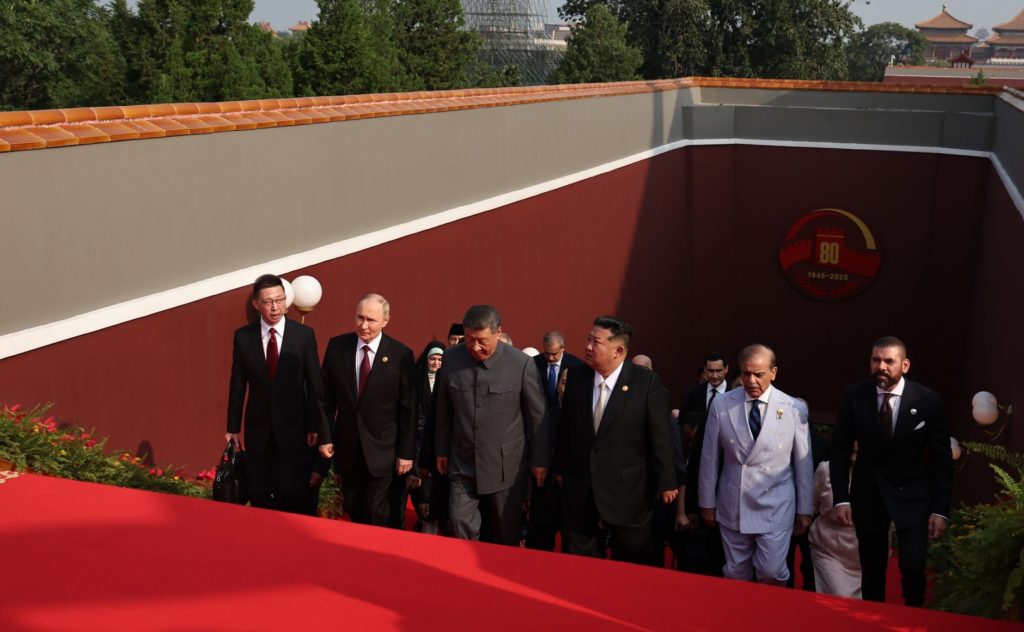
Since then, the axis has been set in motion. Iranian drones are rolling off the production lines of factories in Tatarstan by the thousand. North Korean shells, and then soldiers, are filling the gaps in the Russian army. China buys the oil and supplies the machine tools for Moscow’s war industry. On 3 September 2025, on the rostrum at Tiananmen, Xi Jinping, Putin and Kim Jong-un watched the Chinese army parade past. The Iranian president was also present7.
An alliance? Not in the NATO sense: there is neither an integrated command nor a mutual defence clause. But Berlin and Rome had no joint general staff in 1936 either. What makes an axis is its direction, its movement. Each pursues its own regional empire: Ukraine, Taiwan, the Shia arc, the Korean peninsula. All seek to ward off the contagion of the freedoms that threaten their power.
Why do they find freedom so intolerable? Because it gives them the lie. Ukraine, in choosing Europe, proves that a people declared a “brother” can decide something other than what Moscow wants. Taiwan proves that a Chinese democracy exists. South Korea prospers in the very language of the North; Pyongyang bans K-pop just as the USSR once banned rock8. In Iran, the mirror is in the street: since the death of Mahsa Amini, every woman who goes out bareheaded holds up to the regime the face it wanted to veil. So much proof that another future is possible.
In 1984, Orwell imagined three empires that switch alliances as readily as they switch lies. He did not foresee regimes that have nothing in common and which, without resembling one another, recognise one another. So what do they recognise in each other? None of them, on its own, reproduces any historical form of totalitarianism; together, they define the framework of an alternative modernity, united by a single name that we have removed from our vocabulary.
The word that was removed
What no longer has a name ceases to be seen, for our understanding of the world stops at the borders of our language. Foreign ministries think in terms of individual files; when vagueness obscures what the facts connect, the field of vision narrows. Diplomats, academics and those in government saw somewhat rough autocracies, difficult partners, markets to be conquered.
After the fall of the Wall, the word was dismissed, often disputed even as applied to the past: some historians saw it as nothing more than a weapon of the Cold War9. It had already been shelved in the 1970s by a school of Sovietology that treated the USSR as an industrial society like any other. In 1979, a classic textbook changed its title: the regime no longer ruled, it governed10. The dissidents – Sakharov, Solzhenitsyn, Havel – held on to the word because they were living the thing itself. In Alphaville, in 1965, Godard had imagined a city in which the dictionary loses, day by day, the words that might nourish dissent11. A quarter of a century later, no computer was needed to erase totalitarianism: we took care of it ourselves, believing we were turning towards the future.
What does a lost word cost? Let us reread February 2022. Germany believed in change through trade. On the 4th, the day of the “no limits” friendship, Gazprom nominated Gerhard Schröder to its board12. On the 7th, Macron spent five hours in the Kremlin, at the far end of a six-metre table13. On the 9th, Dominique de Villepin said he did not believe “in an imperialist, uncontrollable, expansionist Russia14“. On the 24th, the tanks rolled into Ukraine. Trade was supposed to change Russia. Russia turned it into a weapon.
The error lay in the diagnosis of the regime: authoritarianism had become a sufficient category. It masked the totalitarian dynamic, made up of imperial ambition, rejection of autonomous freedoms and fear of democratic contagion. An agreement can suspend this dynamic without abolishing it. In Budapest, in Minsk: signatures did not halt Russian expansion15.
How could we have blinded ourselves? The concept of authoritarianism dilutes this difference. A catch-all category, it lumps together the monarch who wants to endure and the Guide who wants to export his revolution, the general who guards his barracks and the Party that draws up a world order. Used in this way, the word spares us the need to think and to worry.
Legacies, masks and metamorphoses
Neo-totalitarian rather than new: the prefix denotes not what is being born, but what is being reborn in a new form. Totalitarianism, Jaspers said, outlives its forms. It sometimes resurfaces where it seemed dead, as in Russia. Putin is heir to the KGB, Xi to Mao’s Party, the Revolutionary Guards to Khomeini, and Kim to his grandfather. The 20th century was the century of foundations; the 21st is the century of inheritances. But what do these heirs lay claim to? Not the founder’s faith, only his apparatus. The century has known only one genuinely new totalitarianism: Islamic State, with its caliphate proclaimed in 2014, its filmed terror, and the Yazidis designated as enemies to the point of genocide16. Breaking it took Kurdish fighters on the ground and allied aircraft in the skies.
Jaspers described a Proteus who changes his mask at every moment and slips through your fingers17. The image contains both the mask and the metamorphosis. The mask deceives the onlooker: Russia invaded Ukraine while speaking of a “special military operation” and “denazification”. Yesterday it was peaceful coexistence, proclaimed in the very year Soviet tanks crushed Budapest. Today it is traditional values, the Global South, and the anti-colonialism of a power that is colonising Ukraine. The metamorphosis transforms the regime itself: doctrine, social base and apparatus change; the ultimate aim remains. The trap works both ways: we mistook the mask of trade for a transformation, and Russia’s imperial transformation for a mask, mere rhetoric for domestic consumption.
In Russia, from the Cheka to the FSB, the apparatus has outlived the ideology. In December 1999, Putin, feeling a need to venerate the ancestors, had the plaque honouring Yuri Andropov, Brezhnev’s KGB chief, restored at the Lubyanka18. Marxism has given way to the “Russian world”, the nomenklatura to clans. Ukrainians have named this compound “rashism” [or ruscism, a portmanteau of “Russia” and “fascism”, Ed.]19: fascist, Stalinist and mafia traits in the service of an empire, and the ear also catches in it the racism of an empire that denies its neighbours the right to be a people.
Deng Xiaoping opens up the economy without opening up politics; the tanks of Tiananmen mark the limit. In welcoming Beijing into the WTO in 2001, the West still believes that prosperity will bring freedom. Prosperity came, and it is prosperity that paid for the cage. Under Xi Jinping, the Party asserts that it “leads everything20”; algorithmic surveillance gives this ambition the means of a new modernity.
North Korea took the transformation as far as a communist dynasty. The regime that promised to abolish the privileges of birth has now been handed down through three generations. The fantasy of the One, which Claude Lefort saw at the heart of totalitarianism21, has taken flesh there: a people without divisions, merged into the body of its leader, the egocrat (the master who recognises nothing outside himself), a word Lefort drew from his reading of Solzhenitsyn, who applied it to Stalin22. Zamyatin had taken this dream of a people without divisions to its logical conclusion in We as early as 1920: under the Benefactor, re-elected unanimously every year, the One State reduces people to alphanumeric codes, regulates even their love lives and has their brains operated on to excise the imagination23.
In Iran, theocracy is sliding towards the military-mafia power of the Revolutionary Guards: the “Republic of the kepis” is overtaking that of the turbans. Mehran Tamadon, who filmed the militiamen for more than twelve years, describes a regime with two bodies24. The first is the sprawling state that watches and controls. The second is the armed mass of militiamen, grafted onto the state yet free to act, who still believe, enjoy their privileges and kill to keep them.
Arendt described this duality: a façade state, and behind it the movement in which real power resides25. This distinction helps us to read, in different forms, both the demobilisation of a majority that obeys without believing and the mobilisation of a minority that believes and strikes.
Power rather than faith
These minorities serve masters whose faith is indistinguishable from power. In The Iron Heel, published in 1908 and the first work of political fiction, Jack London has an oligarch declare: “Not God, not Mammon, but Power26!” This passion sheds light on the totalitarianisms of the 21st century. Remaking man is no longer their sole ambition: power enables the mafia-style appropriation of the economy, which in turn demands that power be monopolised. The Russian siloviki are the archetype; the Iranian Guards, masters of an economic empire and of smuggling networks, are not far behind. For these privileged castes, losing power would mean losing everything.
Impunity is a message
How should such power be measured? First, by what it does at home. This follows Jaspers, who urged us to look less at what a regime claims to be than at the fate reserved for human beings within its borders27. Impunity at home paves the way for violence that spills over abroad.
The 20th century had shown as much. From 1933, German Jews were dispossessed and humiliated. In 1936, the world came to the Berlin Games. In 1938, at Évian, it declared itself sorry, but had no room to take them in. The organised famine in Ukraine and the Great Terror came before Katyn and the Baltic deportations.
The 21st century has repeated the lesson without learning it. During the Second Chechen War, Grozny was razed, filtration camps were opened and tens of thousands of civilians were killed28. In 2006, Putin chaired the G8 in St Petersburg. The method moved on to Georgia, to Syria and then to Ukraine, where the camps reappeared and Mariupol suffered the fate of Grozny.
Iran had followed the same path. The Islamic Republic chose its own enemies within, from Baha’is to atheists and homosexuals. In the summer of 1988, commissions sent thousands of political prisoners to the gallows. One of those judges, Ebrahim Raisi, became president in 202129.
In Xinjiang, more than a million Uyghurs have been interned; the UN Human Rights Council refused to debate the matter30. In Tibet, the regime removes children from their families31 and places them in boarding schools. In Hong Kong, the 2020 National Security Law has stifled the press and the opposition. Jimmy Lai, founder of Apple Daily, was sentenced in February 2026 to twenty years in prison32. He is seventy-eight. Western capitals protested, then went back to business as usual.
Impunity is not an absence; it is a message. To the regime, it teaches what it will be able to get away with abroad; to its neighbours, it teaches them to look the other way. These regimes should therefore be measured first and foremost by the list of their domestic victims.
Totalitarianisms and empires
Arendt distinguished between British and French colonial imperialism, eager to seize the riches of overseas territories, and the continental imperialism of the pan-movements33. Pan-Germanism and Pan-Slavism sought to absorb neighbouring peoples in the name of a kinship of blood or soul, in contempt of borders and the law. She saw in these movements one of the antecedents of totalitarianism, and it is this one that Moscow has revived. The “Russian world” reactivates its logic: a pan-movement turned state doctrine34. Russia’s border, its president said in 2016, does not end anywhere35.
Why does a regime that demobilises its people need empire so badly? Having banned politics at home, it needs a front. Expansion becomes a source of mobilisation: it militarises its own people and those it annexes. Imperial ideology supplies its justifications. On the map, conquest is dressed up as historical right.
Each has its imperial mask. Beijing speaks of reunification and of redressing a century of humiliation: annexation is presented as the healing of a wound. Tehran has built an empire without annexation, made up of militias, arms corridors, sectarian loyalties and states parasitising states. Pyongyang, by supplying shells and soldiers to Moscow, takes part in Russia’s imperial war and practises a subcontracted imperialism.
The axis has Eurasian strategic depth, as well as the resources and industrial capacity that sustain its war effort. Its ambitions also extend to strategic chokepoints: Taiwan, Hormuz, Bab el-Mandeb, the Baltic36. Land is compounded by routes: controlling the narrows confers influence far beyond the territories conquered.
There remains Arendt’s distinction: imperialism conquers territory; totalitarian domination tends to abolish any outside. Russia does both: annexing Ukraine would give it land and people, while erasing a neighbouring freedom. One more empire, one less mirror.
The superfluousness of human beings and of truth
What is a human being worth behind this fence? Arendt used the term superfluousness for the condition of people rendered useless to a common world37. The 21st century is giving it new forms. The camps of the 20th century killed those deemed surplus; today’s regimes profit from their deaths. Paradoxically, the superfluous has become a resource.
Russia, which proclaims Ukrainians a brotherly people, is taking their children – more than 20,000, according to Kyiv38. In its poorer regions, enlistment bonuses and death benefits can make a man more profitable dead than alive: this is deathonomics39.
Hamas massacred Israelis on 7 October, then exposed Gaza’s civilians by fighting among them and leaving them without shelter under the bombs. In this strategy, Palestinian death becomes a propaganda resource. A double superfluousness: the former are eliminated as enemies; the latter are sacrificed as martyrs, useful for defeating Israel through narrative, though this trap does not erase the share of responsibility that falls to the Jewish state.
In January 2026, the Iranian regime cut off the internet and opened fire on its young people. More than seven thousand dead have been identified one by one, and tens of thousands according to the highest estimates40. Tiananmen, with its hundreds or thousands of dead41, had stood as the high-water mark of brutal and bloody repression. Tehran has taken the step that leads from repression to superfluousness: it is no longer merely a matter of crushing a revolt, but of sacrificing an irreducible generation. Such excess now prevents Iranians from imagining how far those in power are prepared to go42. “Normal men do not know that everything is possible”, wrote David Rousset on his return from the camps43.
It is not only human beings who become superfluous. Twentieth-century propaganda had a ministry, a newspaper called “Truth”, loudspeakers in the factories44. Twenty-first-century propaganda no longer needs a ministry. It is superfluid, in the physicists’ sense: it flows without friction, creeps up the walls and escapes through the tiniest pores. Social networks, designed to sell attention, offer it free of charge what Goebbels had to build: dissemination, targeting, repetition. Troll factories and Chinese accounts by the tens of thousands45 no longer seek to persuade, but to saturate. In October 2023, Stars of David painted on Paris walls were propelled online by a network that the French state linked to Russia46: the act mattered less than its circulation. Christopher Paul and Miriam Matthews described this “firehose of falsehood47“: volume, speed, indifference to consistency. In China, the flooding of content complements fear and friction48.
What, then, becomes of truth? Totalitarian power used to rewrite the facts and erase faces from photographs. It can now drown fact amid a sea of content: nothing is true and everything is possible49. Arendt was already describing an ideal subject for whom fact and fiction, true and false, are no longer distinguishable50. Social networks lend this enterprise new speed and new participation. Truth itself is superfluous: anyone can pass on what destroys their own capacity for judgement. In Russia, ideology is thus co-produced through clicks, videos and Telegram messages51.
In The Testament of Dr. Mabuse, banned by Goebbels in 193352, the dead criminal goes on dictating, a disembodied voice behind a curtain. AI lends this fiction a new resonance: Russian networks are publishing millions of articles designed to feed the models53; voice cloning is putting Hitler’s speeches back into circulation54. Speech breaks away from the one who uttered it and goes on acting. The Supreme Leader in Tehran, of whom no one knows whether he is still alive, sketches out the state version of this. Jaspers saw totalitarianism as a spectre that drinks the blood of the living and becomes real, while its victims outlive themselves as walking corpses55. Is the spectre finding in AI a new voice, so that humans, like Fritz Lang’s Dr Baum, possessed, carry out its orders?
Evil off-screen
Mabuse is merely a fictional character, but “the imagination is always an impatience of knowledge”, wrote Hermann Broch56. As early as 1879, at the dawn of imperialism, Verne’s The Begum’s Fortune57 contained it all: the factory city where men become serial numbers, the giant cannon and its gas shell, scientific racism, the plan to wipe out a city as an example. In 2020, in Mohammad Rasoulof’s There Is No Evil58, set in Tehran, a family man does his shopping, then at dawn presses the button that carries out the hangings. The banality of evil appears in the shadow of a system of radical Evil that organises killing. A soldier kills to earn leave, then discovers whom he has killed. He obeyed without thinking. An order received, Jaspers pointed out in 1946, does not erase moral guilt59. Finally, a conscript refuses to kill and flees. Hope lies in that refusal.
In February 2022, a Russian lieutenant, Lev Stupnikov, wakes up to videos of helicopters over Ukrainian cities. “They were dropping bombs on innocent civilians. It was Evil60.“ He needs no concept: Evil is recognised by what one sees. Around him, people recite the mask of Good: villages “liberated”, “nationalists” killed. He will turn refusal into a weapon, and he who swore allegiance to the motherland then informs the Ukrainian command of Russian positions.
And what does diplomacy do with this Evil? Pseudo-Realpolitik places it out of frame61. It does not deny it but makes it secondary, deferring it until after the negotiations. On 24 February 2025, three years to the day after the invasion, the Security Council deplored the deaths in the “Russia-Ukraine conflict” without naming the aggressor62. The victims disappear a first time in the crime, and a second time in the communiqué. This out-of-frame is the counterpart of the confusion between authoritarianism and totalitarianism: removing the word totalitarianism did not ward off evil; it granted it the advantage of being out of frame. This is what I call misalignment63.
Conclusion: the fear of freedom
One question remains, and it is the most unsettling. Why do these regimes endure, and why do they find admirers, even in our own countries? In 1941, Erich Fromm gave it a name: the escape from freedom64. Fear of women’s freedom, repressed in Tehran in the name of God and in Moscow in the name of the family; fear of economic chaos, kept alive by memories of the 1990s; nostalgia for the USSR, whose fall Putin has called “the greatest geopolitical catastrophe of the century65“. These fears run through our societies too. The masks of the axis find their footholds there.
In March 1970, an academician still laden with honours wrote to Brezhnev, Kosygin and Podgorny. Andrei Sakharov was trying to warn the regime: “We are infinitely behind in computing. […] The power of our stock of computers is hundreds of times lower than that of the United States, and as for the use of computers in the economy, the gap is so great that it is impossible even to measure it. We are simply living in a different era66.“ The letter went unanswered. Twenty-one years later, the Soviet Union collapsed. There were many causes, but one lies in that sentence: Soviet totalitarianism lost the computing race.
There is no guarantee that this opportunity will come round again. The confrontation with the axis is being fought out over networks, artificial intelligence and robots, and on that terrain China is running neck and neck with the United States; Russia borrows, “trolls” and hacks. Europe may not be living in another era, but a former President of the European Central Bank, in his 2024 report, warned it of a “slow agony67“ Sakharov’s letter has changed addressee. Victory is not assured, and that is the point of this warning.
There is more. As early as 1931, Jaspers was describing mass civilisation and its apparatus; in 1954, he saw totalitarianism not as a revolt against it, but as the threat it carries within itself68. Networks and artificial intelligence are this century’s mass civilisation, atomised screen by screen, and the axis has already set about organising it, Beijing through social credit, Moscow through its troll factories. The shock it inflicts on humanity is therefore not merely a contest of power; it bears on what Jaspers calls selfhood, which the apparatus threatens to reduce to a function. That is where the fear of freedom finds its widest foothold today.
To think about 21st-century totalitarianism is to put back at the centre the nature of regimes, the fate of their victims and what makes a neighbouring freedom unbearable to them. An axis is that around which the world is invited to turn. It is up to us to name those who issue the invitation, and to decline it.
Pierre Raiman
PhD in History, specialist in totalitarianism.
Notes
- Francis Fukuyama, “The End of History?”, The National Interest, no. 16, summer 1989, pp. 3–18; French trans. “La fin de l’histoire ?”, Commentaire, no. 47, autumn 1989.
- “X” [George F. Kennan], “The Sources of Soviet Conduct”, Foreign Affairs, vol. 25, no. 4, July 1947, pp. 566–582. Quotations in the text are translated by the author: “Only the Party was to have structure. All else was to be an amorphous mass”; “truth is not a constant but is actually created, for all intents and purposes, by the Soviet leaders themselves. It may vary from week to week, from month to month”; “until the internal nature of Soviet power is changed”.
- Hannah Arendt, The Origins of Totalitarianism, New York, Harcourt, Brace & Co., 1951 (British edition: The Burden of Our Time, London, Secker & Warburg, 1951); French trans. Les Origines du totalitarisme. Eichmann à Jérusalem, ed. Pierre Bouretz, Paris, Gallimard, “Quarto”, 2002.
- Karl Jaspers, “La lutte contre le totalitarisme” (1954), in Essais philosophiques. Philosophie et problèmes de notre temps, trans. Laurent Jospin, Paris, Payot, “Petite Bibliothèque Payot”, 1970, p. 24. German text: “Im Kampf mit dem Totalitarismus”, reprinted in Philosophie und Welt. Reden und Aufsätze, Munich, Piper, 1958.
- Benito Mussolini, speech in Piazza del Duomo, Milan, 1 November 1936: “questa verticale Berlino-Roma non è un diaframma, è piuttosto un asse attorno al quale possono collaborare tutti gli Stati europei animati da volontà di collaborazione e di pace” (“this Berlin-Rome vertical line is not a partition but rather an axis around which all European states animated by the will to collaboration and peace can collaborate”), Opera Omnia, ed. Edoardo and Duilio Susmel, vol. XXVIII, Florence, La Fenice, 1959. The German-Italian protocol had been signed in Berlin on 23 October 1936 by Ciano and von Neurath.
- “Joint Statement of the Russian Federation and the People’s Republic of China on the International Relations Entering a New Era and the Global Sustainable Development”, Beijing, 4 February 2022: “Friendship between the two States has no limits, there are no ‘forbidden’ areas of cooperation, strengthening of bilateral strategic cooperation is neither aimed against third countries…” (en.kremlin.ru/supplement/5770).
- Parade of 3 September 2025 marking the 80th anniversary of victory over Japan; Xi Jinping stood between Vladimir Putin and Kim Jong-un; twenty-six heads of state and government attended, including Masoud Pezeshkian, Alexander Lukashenko and Robert Fico. See Associated Press, “A look at the world leaders joining China’s military parade”, 3 September 2025.
- North Korea: the Law on Rejecting Reactionary Ideology and Culture, adopted on 4 December 2020, punishes possession of South Korean content with five to fifteen years of reform through labour, and its distribution with life imprisonment or death (Daily NK, “North Korea’s law on rejecting reactionary ideology and culture: a comprehensive backgrounder”, 2021). USSR: the list of thirty-eight “ideologically harmful” groups circulated by the Nikolaev Komsomol on 10 January 1985 is reproduced in Alexei Yurchak, Everything Was Forever, Until It Was No More. The Last Soviet Generation, Princeton University Press, 2006, chap. 6; on “rock on bones”, see Artemy Troitsky, Back in the USSR. The True Story of Rock in Russia, London, Omnibus Press, 1987.
- On the reading of the concept as an instrument of the Cold War, see as early as 1986 the “revisionist” critique by Sheila Fitzpatrick, “New Perspectives on Stalinism”, The Russian Review, vol. 45, no. 4, then the history of the concept by Abbott Gleason, Totalitarianism. The Inner History of the Cold War, Oxford University Press, 1995; for an overview of the debate, Enzo Traverso, Le Totalitarisme. Le XXᵉ siècle en débat, Seuil, 2001.
- Merle Fainsod, How Russia Is Ruled (1953), revised by Jerry Hough under the title How the Soviet Union Is Governed, Harvard University Press, 1979.
- Jean-Luc Godard, Alphaville, une étrange aventure de Lemmy Caution, 1965. In every room, the “Bible” is a dictionary from which forbidden words disappear; Natacha does not know the meaning of “conscience” or “tenderness”.
- Reuters, “Gazprom nominates former German Chancellor Schroeder to its board”, 4 February 2022. Schröder would give up the seat on 24 May 2022, after the Bundestag had stripped him of his privileges as a former chancellor.
- More than five hours of talks; the length of the table, “about six metres”, is the figure given by the Kremlin spokesman, Dmitry Peskov, on 11 February 2022 (Reuters; CNN, “Why the big table in Moscow? Macron refused a Russian Covid test”, 11 February 2022).
- Dominique de Villepin, radio interview of 9 February 2022 (France info, “Ukraine: ‘Nous sommes dans une bataille psychologique, politique et diplomatique'” [“We are in a psychological, political and diplomatic battle”]); quoted by Le Canard enchaîné, 16 March 2022, and by Vincent Laloy, “Dominique de Villepin, vestige du gaullo-communisme”, Desk Russie, 5 December 2024.
- Budapest Memorandum, 5 December 1994, under which Russia, the United States and the United Kingdom undertook to respect Ukraine’s independence and borders in exchange for its giving up its nuclear arsenal; Minsk Protocol, 5 September 2014, and the so-called “Minsk II” agreements, 12 February 2015.
- Caliphate proclaimed in Mosul on 29 June 2014. The UN Independent International Commission of Inquiry on the Syrian Arab Republic characterised the crimes committed against the Yazidis from August 2014 onwards as genocide: “They came to destroy”: ISIS Crimes Against the Yazidis, A/HRC/32/CRP.2, 15 June 2016.
- Jaspers, “La lutte contre le totalitarisme”, art. cit., p. 24: “This Proteus who changes his mask at every moment, who slips through your fingers like an eel, who does the opposite of what he says, who turns the meaning of words on its head, who speaks not to make himself known, not to tell the truth, but to lull, deceive, insinuate, intimidate and dupe.”
- Ambassador in Budapest during the 1956 uprising, Yuri Andropov headed the KGB from 1967 to 1982. His plaque, removed from the Lubyanka in August 1991, was unveiled there again on 20 December 1999, the Day of the Chekists, by Putin, then Prime Minister (Irina Borogan, “The true Andropov”, openDemocracy, 8 April 2011; Alexey Uvarov, “The Iron Man Returns”, Riddle, 13 May 2026).
- Timothy Snyder, “The War in Ukraine Has Unleashed a New Word”, The New York Times Magazine, 22 April 2022.
- “Party, government, military, civilian and academic, east, west, south, north and centre: the Party leads everything”, Xi Jinping’s report to the 19th Congress of the Communist Party of China, 18 October 2017; the formula was written into the Party constitution in October 2017, and the principle of Party leadership into the Constitution of the People’s Republic in March 2018.
- Claude Lefort, “L’image du corps et le totalitarisme” (1979), in L’Invention démocratique. Les limites de la domination totalitaire, Paris, Fayard, 1981.
- Claude Lefort, Un homme en trop. Réflexions sur “L’Archipel du Goulag”, Paris, Seuil, 1976, ch. III, “L’Égocrate”; Lefort takes up the term coined by Solzhenitsyn in The Gulag Archipelago.
- Yevgeny Zamyatin, We (My), written in 1920–1921; first published in English as We, trans. Gregory Zilboorg, New York, Dutton, 1924; French trans. Benjamin Cauvet-Duhamel, Nous autres, Paris, Gallimard, 1929, and Nous, trans. Hélène Henry, Arles, Actes Sud, 2017. The annual election of the Benefactor takes place on the “Day of Unanimity” (notes 24 to 26).
- Mehran Tamadon, “La République islamique d’Iran se serait sans doute déjà effondrée si elle n’était pas dotée de son corps fasciste” [The Islamic Republic of Iran would doubtless already have collapsed were it not endowed with its fascist body], Le Monde, 23 August 2026.
- Arendt, op. cit., Part 3, ch. XII, “Totalitarianism in Power”, 1 (“The So-called Totalitarian State”).
- Jack London, The Iron Heel, New York, Macmillan, February 1908, ch. V, “The Philomaths”: “There is the word. It is the king of words—Power. Not God, not Mammon, but Power”; French translation by Louis Postif, Le Talon de fer, Paris, Crès, 1923, with a preface by Anatole France.
- Karl Jaspers, Die Atombombe und die Zukunft des Menschen (1958), chapter “Freedom and Totalitarianism”: against the statistical criteria of the competition between systems, Jaspers sets “the relative satisfaction of human life in the two social systems, and their potential value for human substance, human dignity and freedom” (The Future of Mankind, trans. E. B. Ashton, University of Chicago Press, 1961, p. 113; author’s translation); French translation: La Bombe atomique et l’avenir de l’homme, Paris, Buchet-Chastel, 1963.
- Between 15,000 and 25,000 civilians killed, according to Memorial and Amnesty International. On the filtration camps, see Human Rights Watch, “Welcome to Hell”: Arbitrary Detention, Torture, and Extortion in Chechnya, October 2000; Anne Le Huérou, Aude Merlin, Amandine Regamey and Elisabeth Sieca-Kozlowski (eds), Chechnya at War and Beyond, London, Routledge, 2014. The G8 summit was held in Strelna, near St Petersburg, from 15 to 17 July 2006.
- Amnesty International, Blood-Soaked Secrets. Why Iran’s 1988 Prison Massacres Are Ongoing Crimes Against Humanity, 4 December 2018: at least 5,000 executions (up to 30,000 according to the opposition); Ebrahim Raisi, then deputy prosecutor of Tehran, is named in the report as a member of the capital’s “death commission”. Elected on 18 June 2021, he took office on 3 August.
- On 31 August 2022, the Office of the United Nations High Commissioner for Human Rights raised the possibility of crimes against humanity; on 6 October, the Human Rights Council voted by 19 to 17 against holding a debate.
- Tibet Action Institute, Separated From Their Families, Hidden From the World. China’s Vast System of Colonial Boarding Schools Inside Tibet, 7 December 2021; Office of the United Nations High Commissioner for Human Rights, “China: UN experts alarmed by separation of 1 million Tibetan children from families and forced assimilation at residential schools”, 6 February 2023.
- National Security Law imposed by Beijing on 30 June 2020. Detained since 31 December 2020, Jimmy Lai was convicted on 15 December 2025 on two counts of collusion with foreign forces and one count of sedition, and was sentenced on 9 February 2026 to twenty years in prison, the heaviest sentence handed down under the law (AFP and Associated Press, 9 February 2026).
- Arendt, op. cit., Part 2, Chapter VIII, “Continental Imperialism: The Pan-Movements”.
- On the “Russian world” (russkiy mir), see Marlène Laruelle, The “Russian World”. Russia’s Soft Power and Geopolitical Imagination, Washington, Center on Global Interests, 2015.
- Russian Geographical Society awards ceremony, Moscow, 24 November 2016. When a nine-year-old boy placed the border at the Bering Strait, Putin replied: “Russia’s border doesn’t end anywhere”, before adding that it was a joke (kremlin.ru/events/president/news/53289).
- Jean-Sylvestre Mongrenier, associate researcher at the Institut Thomas More; see in particular Le Monde vu de Moscou. Dictionnaire géopolitique de la Russie et de l’Eurasie postsoviétique, PUF, 2020.
- Arendt, op. cit., Part 3, Chapters XII and XIII; and letter to Karl Jaspers of 4 March 1951: radical evil “has to do with the following phenomenon: making human beings as human beings superfluous” (Hannah Arendt, Karl Jaspers, Correspondance 1926-1969, Paris, Payot, 1995).
- More than 20,600 children deported or forcibly displaced, according to the official Ukrainian platform Children of War (October 2026). On 17 March 2023, the International Criminal Court issued arrest warrants for Vladimir Putin and Maria Lvova-Belova for the unlawful deportation and transfer of children.
- The term was coined by the economist Vladislav Inozemtsev, “Putin’s ‘Deathonomics'”, Riddle, 11 July 2023; see also, by the same author, La « Deathonomics » russe. Coûts sociaux, politiques et économiques de la guerre en Ukraine, Ifri, “Russie.Eurasie.Visions”, No. 141, February 2026.
- The NGO HRANA had confirmed 7,015 deaths by name as of 15 February 2026, with 11,744 cases still being verified (report to the Human Rights Council, 16 March 2026); the UN Special Rapporteur Mai Sato spoke on 22 January of more than 20,000 deaths; networks of doctors cited by The Guardian and Time put the figure at 30,000; the authorities acknowledge 3,117. The figure of 40,000, repeated by some Western officials, is not backed by any human rights organisation.
- From several hundred to several thousand: the official Chinese death toll was 241; a telegram from the British ambassador Alan Donald, declassified in 2017, put the figure at 10,000. See Timothy Brook, Quelling the People. The Military Suppression of the Beijing Democracy Movement, Oxford University Press, 1992.
- M. Tamadon, op. cit.
- David Rousset, L’Univers concentrationnaire, Paris, Éditions du Pavois, 1946; reissued by Éditions de Minuit, 1965, p. 181: “Normal men do not know that everything is possible. Even if the testimonies force their intelligence to admit it, their muscles do not believe. The camp inmates know.”
- Pravda (“Truth”), founded in 1912, the organ of the Central Committee. On the wired loudspeaker network (radiototchka) installed in factories, collective farms and flats, see Stephen Lovell, Russia in the Microphone Age. A History of Soviet Radio, 1919-1970, Oxford University Press, 2015.
- Meta, Adversarial Threat Report, Second Quarter 2023, August 2023: 7,704 Facebook accounts and thousands of pages, groups and Instagram accounts linked to the Chinese “Spamouflage” operation, “the largest known covert influence operation”.
- Ministry for Europe and Foreign Affairs, “Russia – New Russian digital interference against France”, 9 November 2023: Viginum identified 1,095 accounts in the RRN/Doppelgänger network that had published 2,589 messages, the first of them forty-eight hours before the first authentic photograph of the graffiti.
- Christopher Paul and Miriam Matthews, The Russian “Firehose of Falsehood” Propaganda Model, RAND Corporation, 2016.
- Margaret E. Roberts, Censored. Distraction and Diversion Inside China’s Great Firewall, Princeton University Press, 2018.
- The phrase is the title of Peter Pomerantsev’s book, Nothing Is True and Everything Is Possible. The Surreal Heart of the New Russia, PublicAffairs, 2014.
- Arendt, op. cit., ch. XIII, “Ideology and Terror” (1953): “The ideal subject of totalitarian rule is not the convinced Nazi or the convinced Communist, but people for whom the distinction between fact and fiction (i.e., the reality of experience) and the distinction between the true and the false (i.e., the standards of thought) no longer exist.”
- Ian Garner, “Where Does Russia’s Violent Imperialism Come From?”, Foreign Policy, 2 October 2026, review of Ilya Budraitskis and Ilya Matveev, Russia’s New Imperialism, Stanford University Press, 2026.
- Fritz Lang, Das Testament des Dr. Mabuse, banned by the Berlin Filmprüfstelle on 29 March 1933; premieres in Budapest (April) and Vienna (12 May 1933); German premiere in 1951. The account of Lang being summoned by Goebbels is the film-maker’s own.
- Viginum, Portal Kombat. Un réseau structuré et coordonné de propagande prorusse, 12 February 2024; American Sunlight Project, Russian Propaganda May Be Flooding AI Models, 26 February 2025 (3.6 million articles published in 2024 by the “Pravda” network); NewsGuard, 6 March 2025: the ten leading chatbots repeated this network’s narratives in a third of the cases tested.
- Media Matters for America, “Hitler speeches that appear to be AI-generated are getting millions of views on TikTok”, 17 September 2024.
- Jaspers, “La lutte contre le totalitarisme”, op. cit., p. 25.
- The phrase Ungeduld der Erkenntnis, “impatience of knowledge”, is Broch’s, who applies it to Dichtung, literary creation; see Création littéraire et connaissance, trans. Albert Kohn, Paris, Gallimard, 1966 (repr. “Tel”, 1985).
- Jules Verne, Les Cinq Cents Millions de la Bégum, Paris, Hetzel, 1879 (serialised in the Magasin d’éducation et de récréation, January–September 1879), based on a manuscript by Paschal Grousset.
- Mohammad Rasoulof, There Is No Evil (Sheytan vojud nadarad), 2020, winner of the Golden Bear at the Berlinale; shot clandestinely, the film is banned in Iran.
- Karl Jaspers, Die Schuldfrage, Heidelberg, Lambert Schneider, 1946; French trans. La Culpabilité allemande, trans. Jeanne Hersch, Paris, Éditions de Minuit, 1948 (repr. 1990): of the four kinds of guilt Jaspers distinguishes, moral guilt is the one from which “an order is an order” never absolves.
- Matthew Luxmoore, “The Defector: A Russian Officer Turned Against His Country and Helped Ukraine Kill Hundreds”, The Wall Street Journal, 15 October 2026: “They were dropping bombs on innocent civilians. It was evil.“
- Nicolas Tenzer, Notre guerre. Le crime et l’oubli : pour une pensée stratégique, Paris, Éditions de l’Observatoire, 2024, chapter “Le mal, catégorie centrale de la pensée stratégique”.
- Security Council Resolution 2774 (2025), adopted on 24 February 2025 on a US draft by 10 votes to none, with 5 abstentions (Denmark, France, Greece, United Kingdom, Slovenia); the British amendments referring to Russian aggression were rejected.
- See Pierre Raiman, “L’Axe totalitaire et les désaxés”, Desk Russie, 26 July 2026.
- Erich Fromm, Escape from Freedom, New York, Farrar & Rinehart, 1941 (British edition: The Fear of Freedom, London, Kegan Paul, 1942); French translation: La Peur de la liberté, Paris, Buchet-Chastel, 1963.
- Vladimir Putin, Address to the Federal Assembly, 25 April 2005 (kremlin.ru/events/president/transcripts/22931).
- A. D. Sakharov, V. F. Turchin and R. A. Medvedev, letter to L. Brezhnev, A. Kosygin and N. Podgorny, 19 March 1970; Russian text at sakharov.space (“Меморандум А. Сахарова, В. Турчина и Р. Медведева”); author’s translation. Removed from the Arzamas-16 centre in 1968, Sakharov was at that time still an academician and three times a Hero of Socialist Labour. Sakharov parle (Seuil, 1974).
- Mario Draghi, presentation of the report The Future of European Competitiveness, Brussels, 9 September 2024: “Do this, or it’s a slow agony”; he spoke of an “existential challenge”.
- Karl Jaspers, Die geistige Situation der Zeit, Berlin, de Gruyter, 1931; French trans. La Situation spirituelle de notre époque, trans. Jean Ladrière and Walter Biemel, Louvain-Paris, Nauwelaerts-Desclée de Brouwer, 1951. The word “totalitarianism” does not appear in it; it was in 1954 that Jaspers defined totalitarianism as “the formidable threat that mass ‘civilisation’ poses to the humanity of the future” (“La lutte contre le totalitarisme”, op. cit., p. 24).
Translated from French. The French original prevails.