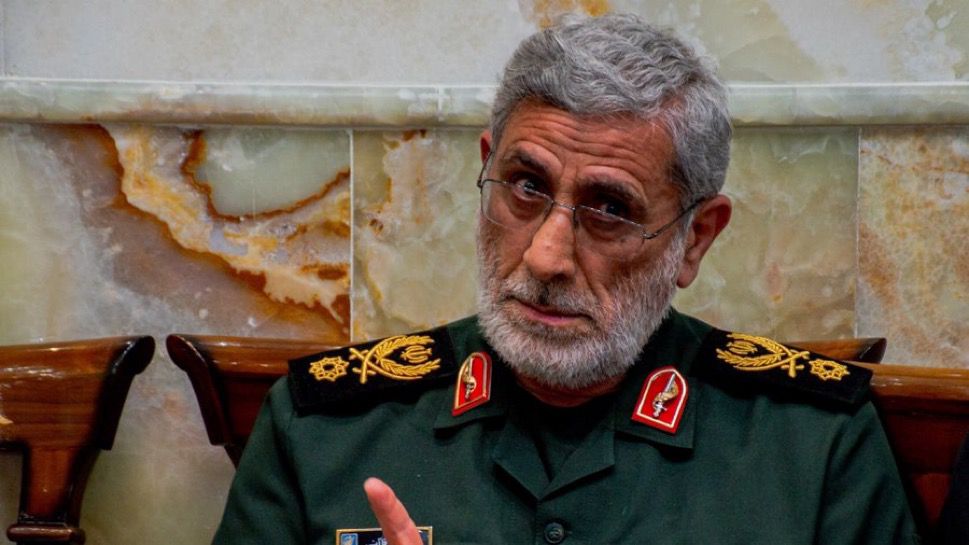
The commander of the Quds Force of Iran’s Islamic Revolutionary Guard Corps, Esmail Qaani.
The commander of the Quds Force of Iran’s Islamic Revolutionary Guard Corps, Esmail Qaani, has issued a fresh warning to Israel, calling on it to withdraw its forces from southern Lebanon or face, in his words, a defeat comparable to that of 2000.
In a message broadcast by Iranian media and picked up by several international news agencies, the head of the Quds Force declared: “If you do not withdraw from southern Lebanon of your own accord, the epic of 2000 will be repeated.” He went on: “Today too, if you persist in aggression and occupation, you will be driven out in humiliation and defeat. The choice is yours.”
These remarks are among the most forceful statements by Esmail Qaani since the 2023-2024 conflict, which profoundly altered the strategic balance between Israel and Hezbollah. They come as southern Lebanon remains at the heart of regional tensions and as diplomatic talks between Washington and Tehran remain particularly fragile.
The precedent of 2000 as a strategic reference point
By invoking “the epic of 2000”, Esmail Qaani was referring to the unilateral withdrawal of Israeli forces from southern Lebanon in May 2000, after eighteen years of occupation. For Iran and Hezbollah, that episode remains the symbol of the “resistance”‘s first strategic victory over Israel.
Beyond the historical reference, Tehran is seeking to point out that a lasting Israeli military presence in Lebanon would, in its view, eventually become politically, militarily and humanly unsustainable. The message to Jerusalem is clear: withdrawal is presented not as a possibility but as an inevitable outcome, with the only question still open being whether it will come about through political choice or under military pressure.
Hezbollah caught between reconstruction and adaptation
This rhetoric, however, comes in a context profoundly different from that of the 2000s or even the 2006 war. Since the 2023-2024 conflict, Hezbollah has suffered the heaviest losses in its history. Part of its senior command has been eliminated, many regional commanders have been killed and several command centres, weapons depots and logistics facilities have been destroyed. The death of its long-standing secretary-general, Hassan Nasrallah, marked a major turning point for the organisation, which is now carrying out a far-reaching reorganisation of its military apparatus.
Although the movement remains the region’s main non-state armed force, analysts believe its military capabilities have been significantly reduced. It nevertheless retains several thousand experienced fighters, a substantial arsenal of rockets and missiles, reconnaissance and attack drones, and modern anti-tank missiles.
Hezbollah is also striving to absorb the lessons of recent conflicts. Israeli intelligence services are closely monitoring the possible acquisition of fibre-optic-guided FPV (First Person View) drones. Unlike drones controlled by radio link, these devices unspool a fibre-optic cable during flight, making them virtually immune to electronic jamming. Already widely used on the Ukrainian front, they offer a high degree of precision against armoured vehicles, fortified positions and military equipment in an environment heavily shaped by electronic warfare. Although no large-scale deployment has been publicly confirmed, several specialists believe this technology could gradually strengthen the movement’s tactical capabilities.
At the same time, Hezbollah is continuing to transform its operational organisation. The traditional hierarchical structure is gradually giving way to more autonomous cells, intended to limit the movement’s vulnerability to Israeli targeted strikes and intelligence infiltration. This shift reduces its ability to conduct large-scale conventional operations, but strengthens its resilience in a war of attrition.
Iranian support remains decisive
The losses suffered since 2023 have deepened Hezbollah’s dependence on Iran, which continues to provide financial, logistical, technological and military support aimed at preserving and then gradually rebuilding the movement’s capabilities. Esmaïl Qaani has unambiguously reaffirmed Tehran’s commitment. “Supporting the resistance in Lebanon is the duty of each and every one of us,” he said, adding that “driving Israel out of the region is an achievable goal”.
According to him, “the minimum demand of the resistance” remains the return of Israeli forces to the positions they held before the outbreak of the war. Beyond its military support, Iran intends to preserve Hezbollah as the main pillar of its strategy of deterrence against Israel. For Tehran, the Shia movement is not merely a regional ally: it remains an essential instrument for projecting influence and a central component of the “axis of resistance”, whose credibility rests on its ability to continue to weigh on the security balance of the Levant.
Outside reinforcements still unconfirmed
Amid this reorganisation, reports circulating on social media and in some regional media outlets point to a possible deployment to Lebanon of fighters belonging to pro-Iranian Shia factions of Iraq’s Hashd al-Shaabi to support Hezbollah.
According to these reports, which have not been independently confirmed, several dozen Iraqi fighters have already been committed to the Lebanese theatre and have suffered casualties. However, no official Lebanese, Iraqi, Israeli or Western source has confirmed these claims at this stage.
Should such involvement be established, it would reflect a significant shift in Iranian strategy. Rather than relying exclusively on Hezbollah, Tehran could seek to mobilise several components of the “axis of resistance” in order to offset the losses suffered by its main Lebanese ally. Such a shift would also heighten Israeli concerns about a growing regionalisation of the conflict and could further complicate diplomatic talks between Washington and Tehran.
Israel rules out any withdrawal for now
Faced with Iran’s demands, the Israeli authorities are taking a diametrically opposed position. For now, there is no sign that Israel is prepared to withdraw its forces from the areas it controls in southern Lebanon. The Israeli government considers that this military presence meets security imperatives and that no redeployment can take place until the threat posed by Hezbollah has been lastingly reduced.
The Israeli Defence Minister, Israel Katz, reaffirmed this line, stressing Iran’s central role in arming its regional allies. “$Every dollar that enters Iran turns into a ballistic missile in Iran, a drone in Lebanon, a rocket in Gaza and an aircraft in Yemen,” he said. He added that “the economic campaign against Iran is the most important front for Israel’s security”.
These statements illustrate Israel’s strategy of regarding Hezbollah as one of Iran’s main military proxies in the Middle East. According to this reasoning, a withdrawal without security guarantees would, in Jerusalem’s view, risk allowing the Shia movement gradually to rebuild its military infrastructure and its deterrent capability along the border.
Lebanon enters Iran-US negotiations
This military deadlock now threatens to weigh directly on the ongoing negotiations between the United States and Iran. While the talks officially focus on Iran’s nuclear programme, economic sanctions and certain regional issues, the Lebanese question is now becoming an unavoidable factor in the balance of power.
For Tehran, Israel’s continued military presence in Lebanon reinforces the need to maintain an “axis of resistance” capable of putting pressure on Israel. For Washington, Iran’s military influence through Hezbollah complicates any prospect of substantial sanctions relief. Israel is also seeking to weigh indirectly on these negotiations. By asserting that every inflow of foreign currency into Iran contributes to the development of ballistic missiles, drones and rockets, as well as to strengthening the military capabilities of its regional allies, Israel Katz aims to convince Washington that easing sanctions would risk directly benefiting Hezbollah, Hamas, the Houthis and Tehran’s other partners.
This approach seeks to prevent the talks from being confined to the nuclear issue alone, by bringing in the question of Iran’s military support for its regional allies.
Hezbollah, Tehran’s diplomatic lever
The threats issued by Esmail Qaani are therefore not aimed solely at Israel. They are also a message to Washington. By pointing out that Hezbollah remains capable of waging a war of attrition against Israel, and by reaffirming that the withdrawal of Israeli forces is a minimum demand, Tehran is making clear that the Lebanese front remains a lever of pressure in any regional negotiation.
This stance allows the Islamic Republic to pursue diplomatic dialogue with the United States while retaining an indirect means of pressure on Israel. It also confirms that Hezbollah remains a central element of Iran’s deterrence strategy, militarily as well as diplomatically.
A war of attrition as strategy
Specialists believe that Hezbollah no longer has the means to conduct a large-scale conventional offensive comparable to the scenarios drawn up before 2023. The movement does, however, retain sufficient capabilities to impose a heavy military cost on Israel through a strategy of attrition based on rocket fire, anti-tank missiles, attack drones, mobile units and, in time, the use of new technologies such as fibre-optic-guided FPV drones.
This shift reflects the movement’s gradual adaptation to new forms of conflict, favouring resilience, the dispersal of its assets and the wearing down of the adversary over seeking a conventional confrontation.
Towards a new regional equation
Despite this rise in tensions, Washington and Tehran still share an interest in avoiding a regional escalation. The United States is seeking to contain Iran’s nuclear programme, preserve regional stability and avoid a direct confrontation involving Israel, Hezbollah and Iran. For its part, the Islamic Republic hopes to secure sanctions relief, a resumption of its oil exports and recognition of its regional role.
The Lebanese question, however, complicates these objectives. If Washington agrees to ease sanctions, Israel fears that the financial resources thus freed up would enable Iran to speed up the rebuilding of Hezbollah’s military capabilities. Conversely, maintaining maximum economic pressure could prompt Tehran to step up the activities of its regional allies still further in order to raise the strategic cost of the deadlock.
Beyond the customary statements, the positions of Tehran and Jerusalem now appear difficult to reconcile. Iran has made an Israeli withdrawal from southern Lebanon a major political condition, while Israel now regards its military presence as essential to prevent Hezbollah from rebuilding its fighting capability.
In this new strategic equation, the Lebanese front is no longer a peripheral theatre. It has now become one of the main barometers of the regional balance, where Israel’s security interests, Iran’s strategic ambitions and the diplomatic objectives of the United States intersect. The future of negotiations between Washington and Tehran will depend as much on developments in the nuclear file as on the shifting balance of power in Lebanon, making the country one of the main sources of uncertainty for stability in the Middle East.
Translated from French. The French original prevails.