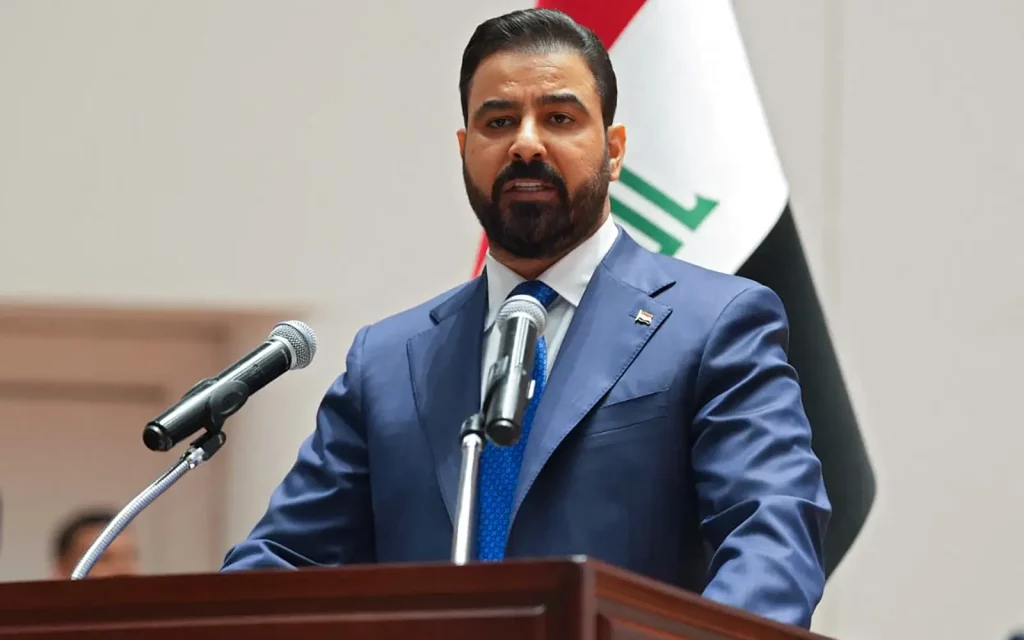
Prime Minister Ali al-Zaidi.
Does Prime Minister Ali al-Zaidi’s speech mark the start of a genuine turning point in Iraq? With the disarmament of the powerful pro-Iranian militias looking extremely difficult at this stage, the government appears to be favouring another lever: the fight against corruption and the financial networks that fuel their influence. It is a strategy that could redefine the balance of power between the Iraqi state, the armed groups, Washington and Tehran.
A few hours after Prime Minister Ali al-Zaidi’s speech, the government spokesman, Haider al-Aboudi, offered a clarification that sheds light on Baghdad’s intentions. The armed groups have been informed that they have until 30 September to place their weapons under state control. Those who refuse would face prosecution “in accordance with the law”. At the same time, the government rejected any suggestion of a link between this policy and the head of government’s forthcoming visit to Washington.
These statements mark a new stage in the Iraqi authorities’ strategy. For the first time in many years, the government is publicly setting a timetable to reassert the state’s monopoly on the use of force, while also announcing an offensive against corruption. Even so, reducing this political sequence to a mere attempt to disarm the militias would doubtless be an analytical error. The real novelty may lie elsewhere: in the state’s determination to gradually tackle the political, administrative and financial mechanisms that allow these groups to retain their influence.This nuance is essential to understanding the significance of Baghdad’s announcements.
Iraq, the main arena of the rivalry between Washington and Tehran
Since the fall of Saddam Hussein in 2003, Iraq has remained one of the main arenas of indirect confrontation between the United States and Iran. The demise of the Ba’athist regime profoundly upset the country’s sectarian balance. Long excluded from power, the Shia majority established itself at the heart of the new institutions. Tehran swiftly consolidated its influence by forging close ties with a number of political parties, religious movements and armed organisations that have become major players in national life.
At the same time, part of the Sunni community felt marginalised in the new political order. This sectarian rift fuelled the rise of insurgent movements, then the emergence of the Islamic State group, and has left behind wounds that remain largely open. Even after the jihadist organisation’s military defeat, population displacement, accusations of reprisals, land disputes and mistrust between communities continue to undermine national cohesion.
In this environment, several armed groups brought together under the Hashd al-Shaabi have gradually acquired considerable political, security and economic weight. Their influence now extends far beyond the military sphere alone, reaching into many areas of the administration and public life. It is against this particularly complex backdrop that the Baghdad government’s strategy is now unfolding.
Disarmament faces considerable obstacles
By setting a deadline of 30 September for placing weapons under state control, the government is signalling strong political will. But between announcing a goal and implementing it, the road ahead looks particularly difficult.
For more than twenty years, the various components of the Hashd al-Shaabi have been more than mere armed organisations. They form a set of political, military and economic forces deeply embedded in the Iraqi landscape. Several have representatives in Parliament, allies within the administration, influence in the security services and economic clout that is at times considerable.
In these circumstances, disarmament is not simply a matter of seizing arsenals. It would mean challenging a balance built up over successive wars, the fight against the Islamic State group and the regional power struggle between Washington and Tehran.
The first reactions illustrate this difficulty. Several influential organisations, including Iraq’s Kataib Hezbollah and Harakat Hezbollah al-Nujaba, have already made it known that they have no intention of giving up their weapons. For these movements, their military capability remains inseparable from their political role and their proclaimed mission of “resistance”.
This position comes as no surprise. The Lebanese experience shows how hard it is for a state to disarm an organisation that regards its arsenal as the guarantee of its political existence. In Iraq, as in Lebanon, weapons serve at once as a deterrent, an instrument of influence and a source of legitimacy among part of their supporters.
The Iraqi government is well aware of this. A direct confrontation with the main components of the Hashd al-Shaabi could trigger a serious political, or even security, crisis at the very moment Baghdad is seeking to stabilise the country. That is why Zaidi’s real strategy may be subtler than it appears.
Corruption, the new battleground
While disarmament remains the officially stated goal, the fight against corruption appears to be the lever over which the government has the most room for manoeuvre. By pledging to relentlessly pursue those involved in the embezzlement of public funds, Ali al-Zaidi is not merely tackling an administrative failing. He is also targeting economic and financial networks that have for years fed the country’s political power struggles.
In Iraq, corruption goes far beyond the management of public finances alone. Public procurement, oil contracts, customs, border crossings, banks, state-owned enterprises and money transfer channels are all sectors where political interests, patronage and regional influence intersect.
By weakening these networks, the government could gradually reduce the resources of certain armed groups without engaging in direct military confrontation. In other words, unable to act swiftly on the weapons themselves, Baghdad may be seeking to act on the means that allow them to be financed and that preserve their influence.
This approach is by no means guaranteed to succeed. But at this stage it appears to be one of the few options capable of gradually strengthening the authority of the state without provoking an open clash with the main armed factions.
Washington expects results
The Iraqi government is striving to dispel any political reading of this offensive against corruption. Its spokesman, Haider al-Aboudi, insisted that the campaign could not be linked to the Prime Minister’s forthcoming visit to Washington.
This denial is nonetheless significant. It shows that Baghdad is aware of the questions raised by this political sequence of events. For several years, the United States has been calling for the authority of the Iraqi state to be strengthened, for the influence of armed groups to be reduced and for greater transparency in the management of public finances.
Even so, Washington also knows that the complete disarmament of the main components of the Hashd al-Shaabi cannot be achieved in a matter of weeks. The real question, then, is less the announcement of a timetable than the government’s ability gradually to regain control of the levers of the state.
It is precisely on this front that the fight against corruption takes on its full strategic significance. By tackling the embezzlement of public funds, opaque financial channels and networks of influence, Baghdad can demonstrate its determination to restore the authority of the state without entering into a direct confrontation with the main armed organisations.
This strategy is nevertheless fraught with pitfalls. Corruption networks are deeply embedded in the country’s political, administrative and economic structures. Weakening them inevitably means challenging interests that have been entrenched for more than two decades.
More than disarmament: reclaiming the state
Beyond the rivalry between Washington and Tehran, the current sequence of events raises a more fundamental question: is the Iraqi state still capable of fully exercising its sovereignty?
Since 2003, Baghdad has never regained an effective monopoly on violence, nor full control over all its political, economic and security resources. Successive wars, sectarian divisions, the fight against the Islamic State group and regional rivalries have fostered the emergence of parallel centres of power.
In this context, disarming the militias is not simply a matter of recovering weapons. It means challenging a political, economic and security system that has gradually established itself at the very heart of the state. Zaidi’s real ambition may therefore be less to disarm the armed groups immediately than to restore, step by step, the ability of institutions to exercise their prerogatives.
If that is indeed his aim, the fight against corruption is probably the area in which the government currently enjoys the greatest freedom of action. The 30 September deadline will show whether this strategy is beginning to bear fruit. But whatever the outcome, it will above all be a test of the Iraqi state’s ability to gradually regain the initiative from actors who, for more than twenty years, have learnt to share – and at times to rival – its authority.
A decisive deadline
30 September is unlikely to be merely a deadline for the armed groups. Above all, it will make it possible to assess the government’s real ability to turn political rhetoric into action.
Several scenarios remain possible. Some organisations might accept limited or symbolic measures to avoid a confrontation with the state. Others might maintain their refusal, believing that their weapons remain the guarantee of their political influence and of their role in what they present as the “resistance”. Between these two positions, Baghdad will have to show that it is able to enforce its decisions without provoking a fresh domestic crisis.
Whatever happens in the coming weeks, one reality is already apparent. The Iraqi government seems to have understood that restoring the authority of the state cannot rest on disarming the militias alone. It will also require regaining control of the institutions, public finances, administrations and economic networks that have gradually slipped out of the central government’s grip., The fight against corruption is thus becoming far more than an administrative reform. It may well be the first act of a broader attempt to rebuild the Iraqi state.
For Ali al-Zaïdi, the fight against corruption is not merely a government programme. It may be the main lever at his disposal as he tries gradually to restore the authority of a state that has, for more than twenty years, faced the rise of rival centres of power.
30 September may reveal whether the militias are prepared to hand over all or some of their weapons. Above all, it will reveal whether, for the first time since the fall of Saddam Hussein, the Iraqi state is able to impose its will on actors who had until then learned to live alongside it… and sometimes above it.
⸻
READ ALSO: Iraq: two more Shia armed groups rally behind Al-Zaidi’s government
After the war, Iran could step up funding for its “axis of resistance”
Northern Iraq: Turkish military presence redraws the regional balance of power
US-Iran agreement: who really wins the peace?
Translated from French. The French original prevails.