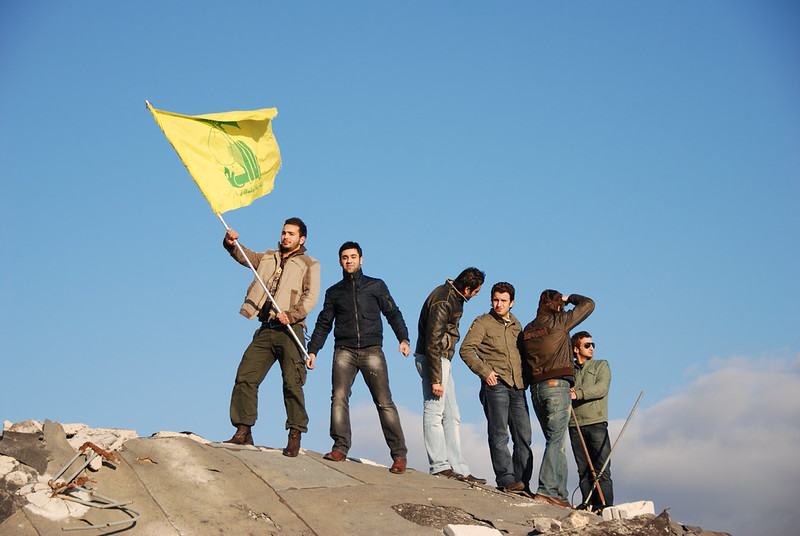
Young Lebanese people waving the Hezbollah flag in Beirut. Photo Paul Keller (Creative Commons licence, non-commercial use)
The Israeli strike on Beirut on 8 April was prompted by intelligence from US intelligence services and Mossad about the threat that Hezbollah would occupy Beirut in the event of a ceasefire agreement between Israel and Lebanon. This intelligence from the CIA and Mossad thus led, on 8 April 2026, to a massive raid by the Israeli Air Force to thwart the Shia plan just before it was carried out.
A highly elaborate plan
According to our information, the Shia militia’s plan was to move the party’s fighters withdrawn from the South and deploy them across the northern, eastern and central districts of Beirut in order to block roads and terrorise the population. One group was to lay siege to the Grand Serail, the seat of government, with the help of officers and members of a security force collaborating with the party. Rocket launchers were to be aimed at the Serail should the attempt to arrest the head of government, Nawaf Salam, and execute him in Beirut fail.
The abduction of minister Youssef Raji had also been planned, along with his execution out of public view. Small groups had rented flats near the headquarters of Lebanese political parties opposed to Hezbollah, with the task of carrying out assassinations. One of the flats, on the same floor as the home of President Joseph Aoun’s sister and next door to it, was rented by a woman whose husband had been assassinated (he was a commander in Iran’s Quds Force). Another flat targeted was close to that of a senior Lebanese Forces official; it too had been rented by a woman, for a member of the Revolutionary Guards (she was having an intimate relationship with him in the flat).
Security forces officers were involved in planning this attempted coup. Their task was to close roads to prevent reinforcements from arriving to lift the siege of the Serail, and to arrest the heads of government institutions, a list of whom had already been drawn up. The final stage of the plan was to bomb the presidential palace in Baabda and surround it in order to force Joseph Aoun to resign; otherwise he would be assassinated.
US intelligence accuses Suleiman Franjieh of being a partner in the plot. He is suspected of having received promises from Iran’s Revolutionary Guards that he would be appointed President of Lebanon. For the time being, these accusations are unsubstantiated.
Mossad agents and a CIA team spied on gatherings of Hezbollah members and commanders as they assembled in residential areas. They deceived them into believing that a ceasefire was in place, leading them to gather without taking any particular security precautions.
Just one hour before the coup plan was due to be carried out at 2.30pm, Israel launched a bombing raid on the assembly points in Beirut. Some fifty aircraft dropped 160 bombs. Notably, no prior warning was given to the civilian population in the targeted urban areas, so as to guarantee the element of surprise. It was a massacre. 3,000 members of the party were killed or wounded. The rocket launchers installed by Hezbollah in central Beirut in preparation for the coup were destroyed.
The Lebanese government would play down the party’s losses and acknowledge only the number of civilian casualties, around 250. The reactions of the Lebanese government and of President Aoun were extremely awkward.
Revolutionary Guards rearm Hezbollah
These betrayals, and the collusion of security force commanders and Lebanese army officers with the party, complicate matters. The names of around 250 of them are now known.
Had President Aoun asked the Ministry of Defence to use force against Hezbollah, army units under the control of Colonel Souheil Behiig Harb – whose dismissal the Americans are demanding, along with that of the army commander – would have turned against the regime.
The brutal intervention of the Israeli air force saved the Lebanese government, or at least gave it a respite. Whether or not a peace agreement is reached between Iran and the US, Lebanon will remain a battleground between Iran and Israel.
According to al-Hadath, Iran’s Islamic Revolutionary Guard Corps is currently overseeing the rebuilding and rearming of Hezbollah. US estimates suggest that 100 officers of Iran’s Islamic Revolutionary Guard Corps, carrying Lebanese passports, have arrived in Lebanon in recent months.
Likewise, elements of the Assad regime have taken refuge in Lebanon and are using their networks in Syria to smuggle weapons and money. It is clear that Iran, with the backing of its Lebanese allies, fully intends to thwart the Israeli offensive in Lebanon and to keep tensions in the region high.
US steps up sanctions
In response to the actions of Iran and its Lebanese allies, the United States is stepping up sanctions. These US sanctions, as the Lebanese judge Peter Gemanos asserts, are no longer mere symbolic instruments of pressure used against Hezbollah and its traditional leaders, but have turned into a process of gradually dismantling the security, political and financial structure that shields Iranian influence in Lebanon. The US Treasury Department is no longer content with targeting Hezbollah MPs or its direct financial networks, since the party has for many years been virtually cut off from much of the global and Arab financial system, in particular the Gulf and international banking systems, which treat it as a hostile entity subject to sanctions.
That is why placing Hezbollah MPs on sanctions lists no longer carries the same strategic impact it did a little under a decade ago. The party has adapted to isolation and built a parallel economy as well as unconventional financing networks ranging from trafficking to the cash economy and direct Iranian support. But what is new and dangerous today is the shift of US sanctions towards the wider Shia milieu, and more specifically towards the Amal Movement and its security and political figures.
The dangers of isolating Amal
The sanctions against Ahmad Assaad al-Baalbaki, the Amal Movement’s security chief, carry implications that go beyond the man himself. Since 1983, to be precise, the Amal Movement had been regarded by the West and the United States as “the acceptable arm” of Shia representation, while Nabih Berry was treated both as a difficult element in Lebanon’s balance of power and as the obligatory channel for any internal or external agreement. Even during the most intense phases of confrontation with Hezbollah, Washington maintained some scope for indirect communication with Berry, regarding him as part of Lebanon’s traditional political make-up.
But the picture has changed radically. After the sanctions against Ali Hassan Khalil, the former Minister of Finance and one of Berry’s strongmen, now come those against al-Baalbaki, along with other names from the security forces and officers, signalling that Washington no longer distinguishes between the political wing and the security wing within the Amal Movement, nor between Amal and Hezbollah when it comes to protecting Iranian weapons inside the Lebanese state.
The most dangerous aspect of these sanctions is that they strike at the historical relationship between the Amal movement and the Shia capital spread across Africa, the United States and the Gulf. This capital, which still drew a distinction between Amal and Hezbollah, will become more cautious in any financial, commercial or banking relationship with figures affiliated with the movement. And therein lies the danger of the American decision: the gradual isolation of the Amal movement from the traditional Shia funding, investment and diaspora networks.
These sanctions could be a final American warning to Nabih Berry to reposition his political and security stance, or perhaps the start of a tougher phase whose defining feature would be a shift from punishing individuals to encircling the entire structure that provides political and security cover for Hezbollah within the Lebanese state.
Translated from French. The French original prevails.