By Marc Finaud, Vice-President of Initiatives pour le Désarmement nucléaire (IDN)
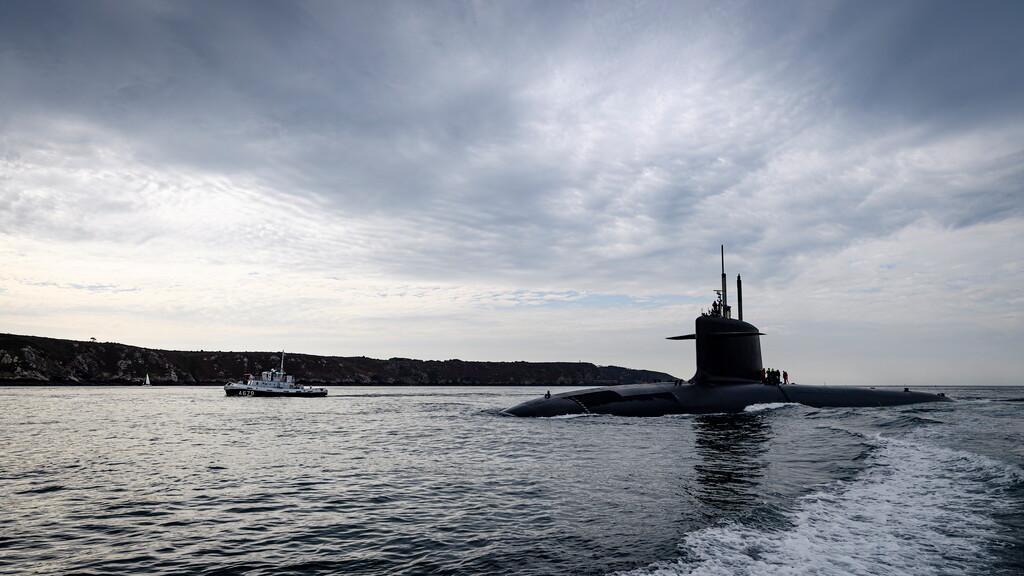
Le Triomphant, a pillar of French nuclear deterrence
Advocates of nuclear disarmament are regularly dismissed by the cheerleaders of nuclear deterrence as unrealistic naïfs, utopians or even irresponsible. Yet this “doctrine” of deterrence, regarded by France as the “cornerstone” of its national security, rests on quasi-religious beliefs, a theory that is impossible to prove, risky gambles and fragile assumptions. So much so that one may legitimately ask which side the “Care Bears” are really on.
Idealists and realists
It was Hubert Védrine, François Mitterrand’s former Minister of Foreign Affairs, who repeatedly coined the phrase “Europeans are a sort of Care Bears who do not realise that they are living in Jurassic Park “. He applies this allusion to the cartoon for well-behaved children not only to what he regards as weakness or idealism in the face of predatory states driven by the will to power, but also to those who advocate multilateral cooperation that respects international law, with a view to reducing tensions, and disarmament as a factor for peace. He therefore fully subscribes to the idea that only nuclear weapons are capable of protecting France against any aggression.
He is, of course, neither the only one nor the first to play down the importance of international norms such as those of the UN Charter or international humanitarian law in the face of great-power competition, in a “realist” or “realpolitik” approach. Thus, after the First World War, the French nationalist right branded as “bleating pacifism” the policy embodied by Aristide Briand, the architect of the Locarno Treaties (1925), which sought to bring Germany back into the European diplomatic fold, of the Kellogg-Briand Pact (1928), which proclaimed the “outlawry of war”, and of the plan for a European Union (1929). And this even though Briand had been a wartime leader during the First World War and had voted for the funds essential to national defence.
Later, during the Cold War, President Mitterrand, faced with crowds protesting against the deployment of new American missiles in Europe, would deliver his famous line: “The missiles are in the East, the pacifists are in the West!“. Yet a decade later, after the collapse of the Soviet Union and the Warsaw Pact, the Socialist president, now aware of the changed context, would launch an ambitious disarmament plan, including in particular accession to the Treaty on the Non-Proliferation of Nuclear Weapons and an end to nuclear testing, without, however, renouncing nuclear deterrence.
Nuclear deterrence on shaky foundations
As the philosopher Jean-Pierre Dupuy points out, “[i]f there has never been a nuclear war so far, nuclear deterrence has had little to do with it. (…) It is luck that meant that during the Cold War and since, although we have come within a hair’s breadth of the worst some thirty times, it did not happen. (…) [T]his constant flirtation with the abyss has more or less helped to give the actors in the drama the wisdom needed to avoid catastrophe. (…) Another reason not to credit nuclear deterrence with having prevented nuclear war is that deterrence played a very minimal role in the nuclear policies pursued by America as well as by the Soviet Union and Russia.“
Indeed, as shown by Daniel Ellsberg, a former US Cold War planner and the whistleblower behind the Pentagon Papers, cited by Jean-Pierre Dupuy, the great powers based their strategy not on the restraint inherent in deterrence, but on a first-strike capability to neutralise the enemy’s retaliation. Yet in one of his last interviews, Ellsberg spoke of the uncertainty felt by many US military personnel about the order to retaliate in the event of an attack, which might never reach them. This paralysis, known to the enemy, he concluded, ends up rendering deterrence ineffective.
All in all, nuclear deterrence, whose aim is to persuade a potential aggressor to refrain from any attack for fear of devastating nuclear retaliation, ends up handing one’s adversary the strategic decision over one’s own security. And this, paradoxically, in the name of pursuing national independence, the main motivation cited by France since General de Gaulle.
Such dependence on a weapon meant to terrorise the enemy, but which could also threaten one’s own population with extermination, presupposes blind faith in the rationality of the adversary, who, it is hoped – without any guarantee – will refrain from attacking. Yet many historical examples show that this rationality can be lacking, or that nuclear weapons do not always deter.
Between nuclear powers, deterrence has not prevented direct conflicts (such as the Sino-Soviet border conflict of 1969 or the clashes between India and Pakistan in 1999, 2019 and 2025), nor indirect conflicts involving third countries or fought by proxy (such as the Korean War from 1950 to 1953, the Vietnam War from 1955 to 1975, the Arab-Israeli wars of 1967 and 1973, the Syrian civil war from 2011 to 2025, and so on). Moreover, non-nuclear states impervious to the notion of deterrence have not hesitated to launch attacks on nuclear powers : North Vietnam against the United States, Egypt and Syria against Israel in 1973, Argentina against the United Kingdom in 1982, and more recently Iran in retaliation against the United States and Israel, or Ukraine in response to the Russian invasion, despite Russian threats to use nuclear weapons.
Some experts, including former US deterrence policy officials such as Rose Gottemoeller, former NATO Deputy Secretary General and negotiator of the US-Russian New START agreements, now acknowledge it bluntly: “nuclear deterrence does not work” and “nuclear weapons can appear powerless in the face of sustained conventional or hybrid attacks.”
Security doctrine or religious belief?
Absolute faith in nuclear deterrence, which France describes as the “keystone of its security”, can easily be likened to a religious belief that turns any opponent or sceptic into a “renegade”, or even a traitor. As Colonel Jean-Luc Lefebvre pointed out for IDN, “nuclear deterrence has its own clergy! There are the initiates: the military, the armaments engineers, the civilian engineers and technicians working on the weapons and their delivery systems and, above all, the members of the Military Applications Division of the Atomic Energy Commission (CEA/DAM), for whom ‘the bomb’ is their very raison d’être. This entire clergy has its own rites, taking particular care over the gradual initiation of new adepts. (…) Presiding over this clergy is the President of the Republic, who alone holds the power of life and death over millions of human beings! The current High Priest delivered his latest sermon, in his own words, in ‘this cathedral of our sovereignty’ that houses the nuclear-powered ballistic missile submarines (SSBNs).“
Ultimately, as history has shown, nuclear deterrence is not only a risky gamble on the enemy’s behaviour, but also an absolute faith in the luck that has so far made it possible to avoid catastrophe and the end of humanity. Yet no credible defence can be built on the hope that luck will continue to smile on us, as Professor Benoît Pelopidas reminds us.
The inherent contradiction of deterrence
The French “doctrine” in this case is marked by a fundamental contradiction:
- On the one hand, nuclear weapons are officially regarded as the ultimate guarantee of national security. The term “guarantee” recurs in many French presidential speeches: according to Jacques Chirac in 2001, “[o]nly the deterrent force protects France against the possible use of weapons of mass destruction, whatever their nature.” According to Emmanuel Macron in 2020, “our nuclear deterrent remains, as a last resort, the cornerstone of our security and the guarantee of our vital interests. Today as in the past, it guarantees our independence and our freedom of judgement, decision and action.“
- At the same time, as made clear in every presidential speech since 1994, the possibility that deterrence might fail is not only contemplated, but France then promises an adversary that has not been deterred a “final warning” consisting, according to President Macron in 2026, of a “single, non-repeatable nuclear warning (…) always decided at France’s sole discretion, to signal in very concrete terms that the nature of the conflict has just changed and that France intends, by this means, to preserve a last chance of restoring deterrence.” According to the expert Yannick Princé, “[i]t would be a single strike, delivered either by a Rafale or by an SSBN (ballistic missile submarine), bearing in mind that the number of nuclear warheads in the SSBNs’ M51 missiles can be adjusted. There are generally six to ten nuclear warheads in each of the sixteen missiles, but there is probably one with a single nuclear warhead, dedicated to this final warning strike.“
The yield of an Airborne Nuclear Warhead (TNA) carried by a Rafale is estimated at 300 kt (20 times that of the Hiroshima bomb), and that of an Oceanic Nuclear Warhead (TNO) fired from a ballistic missile submarine (SSBN) is estimated at between 100 kt and 150 kt (7 to 10 times the yield of the Hiroshima bomb). It is hard to see, then, how such a nuclear strike could be confined to “military interests” (the official target) when a 300 kt nuclear weapon on Beijing would instantly kill more than 700,000 people and injure more than two million. Indeed, this is the only certainty about nuclear weapons that history bears out: their use would have catastrophic humanitarian and environmental consequences.
In these circumstances, it is even harder to imagine that such a nuclear strike would succeed in “restoring deterrence” rather than prompting a nuclear retaliation that would set off an escalation towards all-out nuclear war and the annihilation of France – an outcome which former President Valéry Giscard d’Estaing cited in his memoirs as the fundamental reason why he had ruled out “pressing the button”.
So who are the naïve, the irresponsible, the “Care Bears”? Those who gamble France’s security and future in a game of liar’s poker or Russian roulette, or those who advocate interim measures to reduce the risk of nuclear weapons being used, whether intentionally or not, and their gradual, negotiated and verifiable elimination?
Translated from French. The French original prevails.