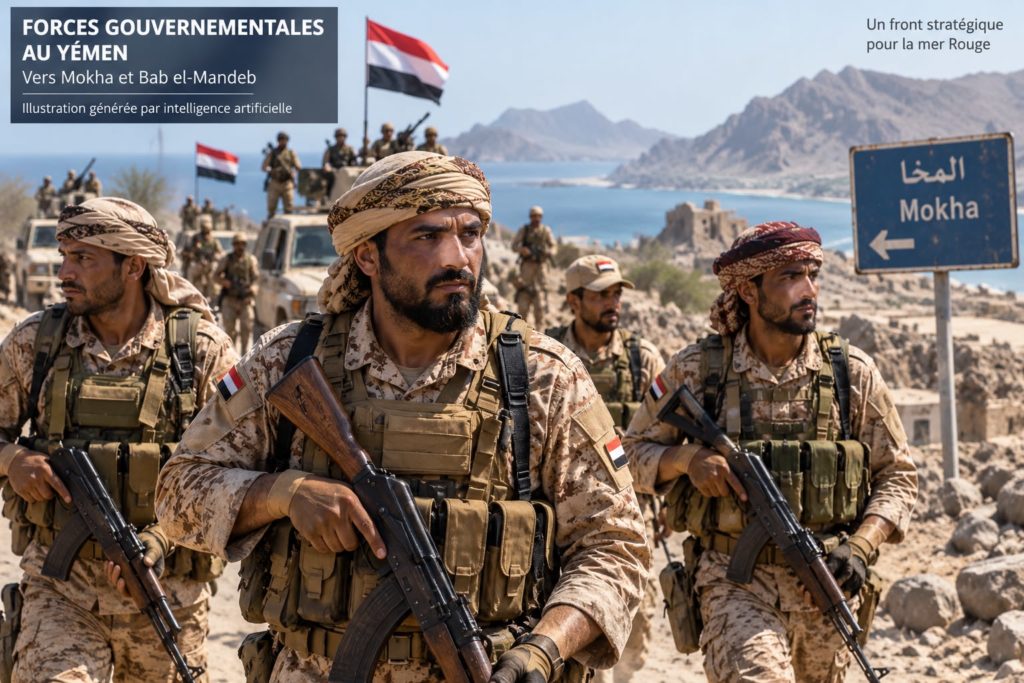
Illustration produced with AI.
Taiz, Al-Jawf, Marib and Mocha: the successes of the Riyadh-backed counter-offensive should not obscure the threat to overland supply routes.
The war in Yemen has changed pace. After the Houthi breakthrough in September towards Mocha and the Bab el-Mandeb, the internationally recognised government launched a counter-offensive on several fronts in early October, with increased Saudi air support. Yet the military picture cannot be reduced to a steady reconquest: coastal positions have been retaken, the high ground remains contested and the Houthis still threaten the approaches to Taiz. [1][2] These four sectors must be examined together. They serve different purposes: pinning down enemy reserves, protecting lines of communication or controlling the approaches to the Bab el-Mandeb, a passage vital to global trade.
Taiz: encirclement by road
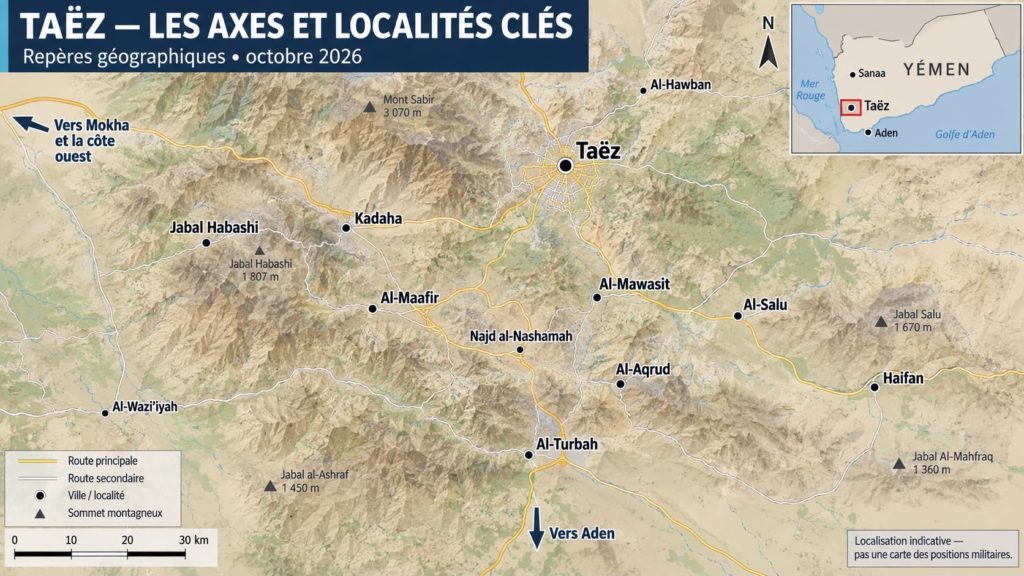
For the Yemeni government, Taiz is the most worrying front. The Houthis have advanced towards Al-Turbah and the roads linking the city to Aden. According to the CTP-ISW analysis dated 8 October, the city has effectively been encircled since 6 October, after the last government-held overland routes were cut. This does not mean that Taiz has fallen, but that supplying it with fuel, food and ammunition is becoming particularly difficult. [3]
Government forces reportedly held off fresh advances on 7 and 8 October at Jabal Habashi and Al-Salu. They also claim to have retaken several high points in Haifan, including Al-Manzara, Al-Ashari and Dhiban. These tactical gains do not, however, show that the Taiz–Aden road is safe once more. [3][4] By threatening Taiz, the Houthis are forcing its defenders to hold back units that could otherwise be deployed on the coast. A local success near Mocha can thus coexist with a strategic deterioration further inland.
Al-Jawf: pressure to disperse Houthi reserves
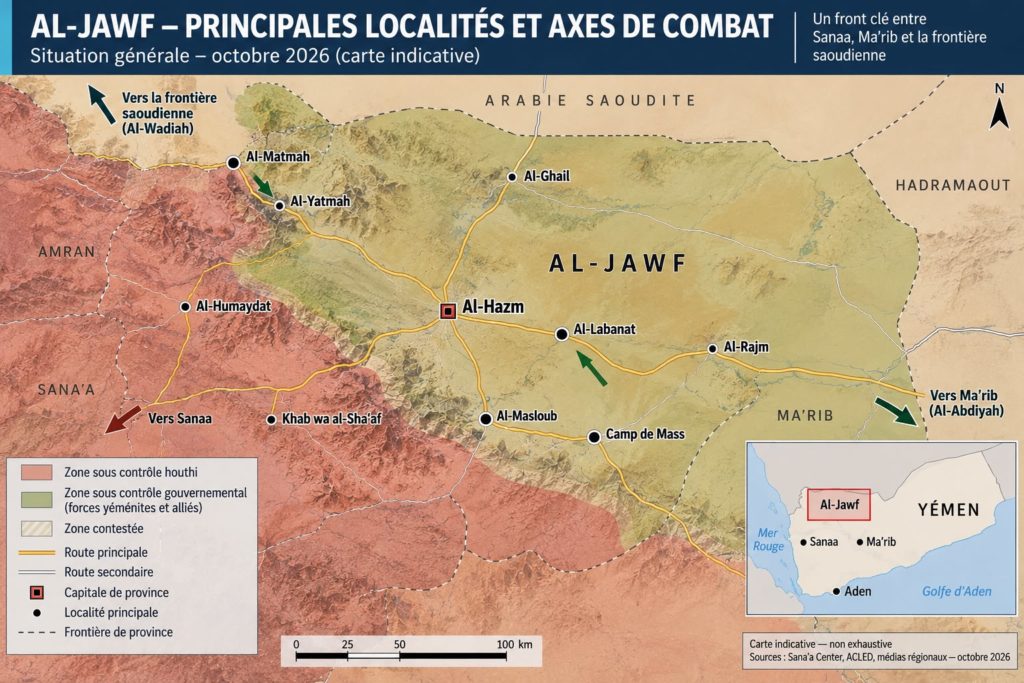
In Al-Jawf, government forces are seeking to keep up pressure towards Al-Hazm, the Houthi-held provincial capital, notably along the Al-Yatmah and Al-Labanat axes. Fighting and strikes have been reported, but the available evidence does not establish a decisive breakthrough or the recapture of Al-Hazm. Claims of gains must therefore remain attributed to the parties concerned. The objective is as much operational as territorial. By activating this north-eastern front, Riyadh and its allies hope to pin down Houthi units and prevent their transfer to Taiz or Bab el-Mandeb. It remains to be seen whether this pressure will genuinely alter the distribution of the enemy’s reserves. [2][5]
Marib: limited progress, no breakthrough
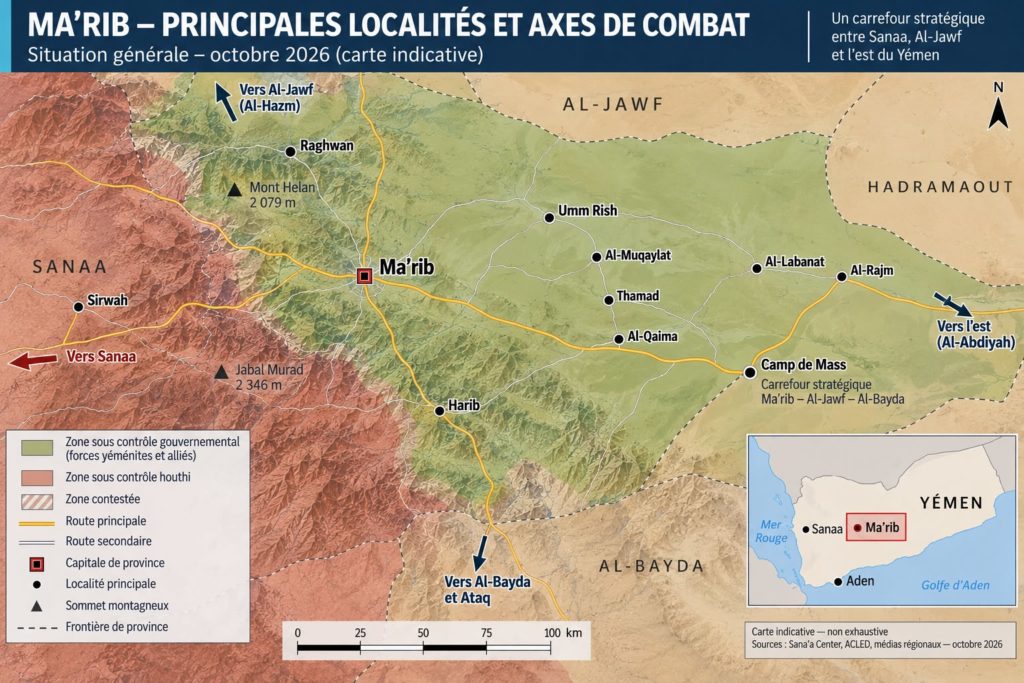
In Marib, government forces have resumed attacks along several axes, including Raghwan to the north and the mountain positions to the west and south. CTP-ISW reports, citing government sources, the capture of the Umm Rish camp on 7 October. This is a tactical gain, not a collapse of the Houthi front. [5] The province remains vital: it concentrates energy resources, infrastructure and a political and military apparatus indispensable to the internationally recognised government. The fighting aims to push back the threat and pin down the enemy. There is, however, nothing to suggest an imminent breakthrough towards Sanaa. One limitation is already emerging: according to CTP-ISW, the offensives in Marib and on the coast have not forced the Houthis to redeploy enough reserves to loosen their grip on Taiz. [3][5]
Mokha: coastal reconquest put to the test on the heights
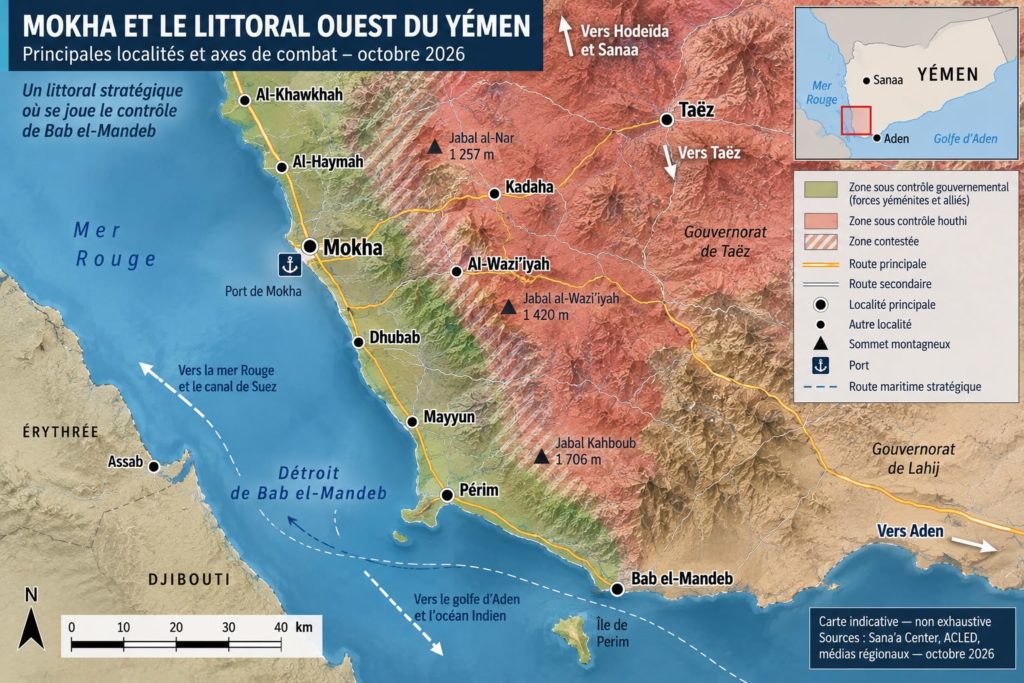
The counter-offensive has produced its most visible results on the western coast. On 5 October, government forces, backed by Saudi strikes, retook much of Dhubab district and advanced towards Mokha. The Yemeni Ministry of Defence announced that the town had been recaptured; Reuters, for its part, reported that the troops had reached its outskirts and that the Houthis were withdrawing to the heights. A distinction must therefore be drawn between claims of full control and corroborated facts. [1][6]
The Giants Brigades, the National Shield Forces and other formations took part in this manoeuvre. On 8 October, the National Shield Forces announced that they had taken Jabal Kahboub, a range of heights overlooking the coastal plain. CTP-ISW believes this advance could facilitate a push northwards, while stressing that the Houthis retain the capacity to threaten the new government positions. [3]
Air support can make it possible to retake a coastal road quickly; holding it for the long term means controlling the high ground, the crossroads and the supply routes. Mokha, Dhubab and Bab el-Mandeb therefore form a single strategic whole. Further north, towards Al-Khawkhah, the situation remains too uncertain to establish a definitive front line.
Allies who must learn to fight together
The offensive brings together formations whose histories and objectives sometimes diverge: the government army, the Riyadh-backed Nation’s Shield, Tarek Saleh’s National Resistance, the Giants Brigades and local units. Their rivalries contributed to the rout in September. Their ability to coordinate their operations is now a decisive factor. [7]
In Aden, the attacks reported near the airport affect an important point of entry for connections and for the delivery of equipment destined for the government camp, particularly from Saudi Arabia. This threat could complicate the logistics of the counter-offensive, but does not in itself allow the conclusion that deliveries have been lastingly interrupted. [8][12]
Saudi Arabia has stepped up its air, logistical and operational support, though its air superiority does not guarantee control on the ground. At the same time, the Houthis are seeking to extend hostilities to Saudi territory: they claim to have fired on airports, energy facilities and other infrastructure. The attacks targeting the airports in Riyadh and Abha caused casualties; the flight disruptions in Riyadh illustrate the possible repercussions for civilian activity. Several missiles were also intercepted. The extent of the damage and responsibility must be assessed in the light of the confirmations available. [8][10][11]
The spread of the conflict to the kingdom has prompted US security alerts. Pakistan and Turkey have raised the possibility of defensive assistance to Riyadh. Ankara is considering, in particular, cooperation on air defence and electronic warfare, while ruling out any involvement in offensive operations in Yemen. These plans should be distinguished from deployments that have actually been confirmed. [10][13]
Why these four fronts also matter for Hormuz
The war in Yemen is now part of a regional crisis over energy routes. In Hormuz, Iran-linked attacks and restrictions are disrupting Gulf flows; at Bab el-Mandeb, the Houthi advance is weakening another strategic sea passage. Strikes on Saudi infrastructure and bypass routes are compounding this vulnerability. [1][9] It would, however, be going too far to conclude that Tehran directs every Houthi operation. The effects are nonetheless cumulative: Riyadh must protect its facilities, support a complex ground campaign and keep access to the Red Sea open.
The real test: holding the gains and reopening Taiz
Three indicators will show how things unfold: the restoration of a reliable land link to Taiz, the securing of the heights overlooking Mokha and Dhubab, and the ability of the offensives in Al-Jawf and Ma’rib to tie down Houthi reserves. Without progress on these fronts, tactical successes on the coast could come with growing strategic vulnerability around Taiz.
The battle for Bab el-Mandeb is therefore also being fought far from the strait: on the roads to Taiz, in the mountains of Ma’rib, along the Al-Jawf routes and in the government camp’s ability to act in a coordinated way. Retaking the coast is only one step; holding it will be the decisive test.
Translated from French. The French original prevails.