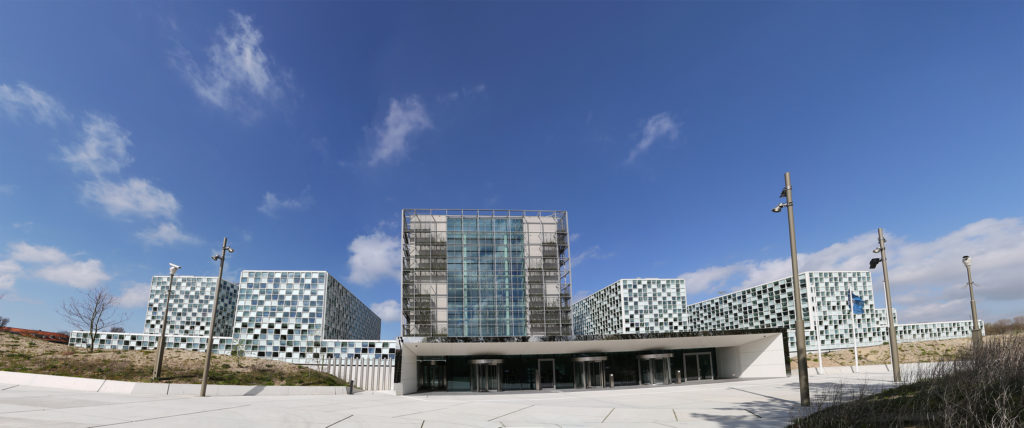
The International Criminal Court in The Hague.
Chad’s announced withdrawal from the International Criminal Court (ICC), following those of Mali, Burkina Faso and Niger, marks a new stage in the challenge to international criminal justice mounted by several African regimes. For the Rencontre africaine pour la défense des droits de l’homme (RADDHO), this trend goes beyond a mere debate over state sovereignty: it threatens to deprive victims of serious crimes of one of the last international avenues of judicial redress. In a statement issued after N’Djamena’s official announcement, the Senegalese organisation expressed its “deep concern” at what it regards as a major setback in the fight against impunity on the continent.
An institution shaped with Africa’s support
The criticism now voiced by several African governments stands in contrast to the history of the International Criminal Court. Established in 2002 following the adoption of the Rome Statute, the ICC owes a great deal to African states. According to RADDHO, they played a decisive role in the diplomatic negotiations that led to the birth of the first permanent court tasked with prosecuting those responsible for genocide, crimes against humanity, war crimes and, more recently, the crime of aggression.
Even today, African countries account for nearly a third of the 125 states parties to the Rome Statute, making the continent the Court’s main geographical pillar. It is precisely this historical involvement that makes the successive withdrawals so particularly symbolic.
Sovereignty versus international justice
Chad now joins the three members of the Alliance of Sahel States (AES) – Mali, Burkina Faso and Niger – which have also decided to leave the jurisdiction of The Hague. These governments justify their decision with a recurring criticism of the ICC, which they accuse of being a “politicised” institution and of dispensing selective justice, focusing on African countries while sparing the major powers.
The argument is not new. For more than a decade, several African leaders have denounced what they see as an imbalance in the Court’s work, while influential states such as the United States, Russia and China are not parties to the Rome Statute.
Victims the biggest losers
RADDHO, however, takes a radically different view. For the organisation, the ICC remains above all an essential instrument for victims when national judicial systems are unable – or unwilling – to prosecute those responsible for the most serious crimes. “The ICC represents a means of redress and a hope of justice for the victims of disproportionate repression by regimes that oppress their fellow citizens,” the statement stresses.
The organisation believes that, in several African states, judicial institutions have neither the independence nor the resources needed to try political or military leaders suspected of mass human rights violations. In its view, withdrawal from the Court therefore risks entrenching a climate of impunity.
The sensitive question of “double standards”
Criticism that international justice is applied unevenly nevertheless remains one of the main challenges facing the ICC. For many years, most of its investigations concerned African situations, fuelling the perception that it treated them differently from other major conflicts. RADDHO acknowledges that this perception feeds the arguments of the Court’s opponents. But it believes that the comparison with Western democracies is misleading.
According to the organisation, several Western states have judicial systems capable of prosecuting the perpetrators of crimes themselves, in line with the principle of complementarity enshrined in the Rome Statute. By contrast, it considers that some African states lack sufficiently independent mechanisms to guarantee genuine accountability.
A sovereignty of “variable geometry”
The statement goes further, attributing the withdrawals to a political desire to escape international prosecution. RADDHO asserts that some leaders invoke national sovereignty while repressing their populations and curbing domestic checks and balances. For the organisation, sovereignty cannot serve as a justification for weakening international human rights protection mechanisms.
This analysis reflects a broader concern about the political trajectory of several Sahel countries, marked by military transitions, restrictions on civil liberties and a deteriorating security situation.
Civil society calls for mobilisation
In response to these developments, RADDHO has set out several demands.
- It calls on the African Commission on Human and Peoples’ Rights (ACHPR) to strengthen its cooperation with the ICC in order to preserve regional and international mechanisms for combating impunity.
- The organisation also calls on the United Nations, the African Union, the European Union and international partners to step up their support for civil society organisations, which are continuing their work in what it describes as a “complex and fragile” environment.
A lasting rift?
Beyond the case of Chad, this new wave of withdrawals exposes a fundamental tension between two visions of international justice. On one side, several governments are asserting greater sovereignty and challenging an institution they consider unbalanced. On the other, many human rights organisations believe that the International Criminal Court, for all its limitations, remains one of the few safeguards against impunity when national justice systems fail.
For RADDHO, what is at stake goes beyond the fate of the ICC itself. It concerns the ability of victims of international crimes to obtain justice in settings where national remedies often remain non-existent. From this perspective, the withdrawal of several African states could mark not only a diplomatic turning point, but also a setback for the protections afforded to populations facing the most serious human rights violations.
Translated from French. The French original prevails.