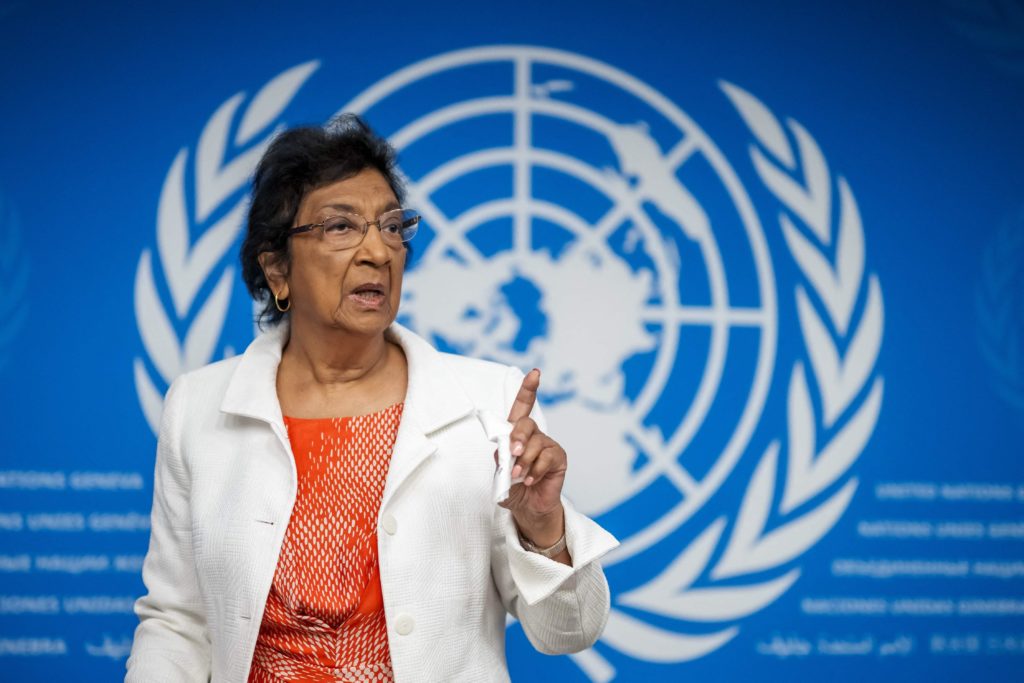
Navi Pillay, former United Nations High Commissioner for Human Rights. Photo: Eric Bridiers / U.S. Mission Geneva.
Born under apartheid into a South African family of Indian Tamil descent, former United Nations High Commissioner for Human Rights Navi Pillay has been awarded the 2026 Nobel Peace Prize for her commitment to peace and international law. Now 85, the lawyer has devoted more than six decades to defending victims of discrimination, securing recognition of sexual violence as an international crime and promoting the idea that no one should escape justice because of their power or position.
The Nobel Committee places the award in a context marked by a proliferation of conflicts and political attacks on international judicial institutions. Through Navi Pillay’s career, it seeks to underline that the peaceful settlement of disputes also depends on a legal order capable of holding perpetrators of crimes to account and guaranteeing the rights of victims.
A lawyer against apartheid
Navanethem “Navi” Pillay was born on 23 September 1941 in Clairwood, a district of Durban, into a family of modest means of Tamil descent. Her father was a bus driver. In segregationist South Africa, racial barriers severely restricted non-white people’s access to the legal professions and to public office. After graduating in law from the University of Natal in 1965, she struggled to find a firm willing to hire her because of the colour of her skin and her sex. So in 1967 she opened her own practice, becoming the first woman to do so in the province of Natal. This career choice marked the beginning of a commitment that would never be confined to defending individual clients.
Her firm took on anti-apartheid activists and opponents prosecuted by the South African authorities. Among others, she defended members of black political movements, intervened in detention cases and helped to assert the rights of political prisoners. She also came up directly against repression: her husband, the lawyer Gaby Pillay, was himself detained by the security police, and she conducted his defence.
At the same time, Navi Pillay campaigned for the rights of women and victims of domestic violence. She helped to set up a support service for women who were victims of violence and became involved in legal and activist organisations. Her fight against apartheid thus broadened into a question central to her career: how can justice be made accessible to those whom power structures marginalise or silence?
Rwanda: securing recognition of rape as a weapon of genocide
After the end of apartheid, her career took on an international dimension. In 1995, Navi Pillay was appointed a judge of the High Court of South Africa, becoming the first black woman to hold that office in her country. The same year, the United Nations General Assembly elected her to the International Criminal Tribunal for Rwanda (ICTR), set up to try those most responsible for the 1994 genocide. She would serve there for eight years, including several years as its President.
Her role in the case of The Prosecutor v. Jean-Paul Akayesu stands as one of the major milestones of that career. In 1998, the tribunal handed down a landmark judgment: it recognised that rape and sexual violence can constitute acts of genocide when committed with intent to destroy, in whole or in part, a protected group. The judgment also recognised that sexual violence can amount to crimes against humanity.
This jurisprudence is helping to shape the development of international criminal law. It establishes that sexual violence is not a secondary or inevitable consequence of conflict, but can be a deliberate instrument of persecution and collective destruction. For Navi Pillay, the legal recognition of these crimes is an essential step towards ensuring that victims are heard and that those responsible can be prosecuted.
From the International Criminal Court to the United Nations
In 2003, Navi Pillay was elected a judge of the International Criminal Court (ICC) in The Hague, where she served until 2008. This permanent court is responsible for prosecuting individuals for the most serious crimes within its jurisdiction, including genocide, crimes against humanity and war crimes. Her time at the ICC extended a commitment to an international justice that does not stop at national borders.
In July 2008, she was appointed United Nations High Commissioner for Human Rights in Geneva, a post she held until 2014. In that role, she championed fundamental freedoms, equality and the protection of populations exposed to human rights violations. She stressed in particular that fundamental rights cannot depend on the identity, origin or political stance of the people concerned.
Her institutional career was not, however, confined to the courts. In South Africa, she also took part in campaigns for equality and women’s rights. She contributed to the work of the Women’s National Coalition and was involved in organisations devoted to combating discrimination. These commitments link her experience under apartheid to her later work within international institutions.
Gaza: report puts Israel at centre of international controversy
Between 2021 and 2025, Navi Pillay chaired the United Nations Independent International Commission of Inquiry on the Occupied Palestinian Territory, including East Jerusalem, and Israel. It was in this role that she found herself at the centre of a major diplomatic and legal controversy.
On 16 September 2025, the commission concluded that Israel had committed genocide against Palestinians in the Gaza Strip. Its report identifies several acts that it considers to constitute genocide under the 1948 Convention and concludes that the evidence examined establishes the intent required under international law. It is a controversial interpretation. The commission also called on states to act to prevent further crimes and demanded that those responsible be held to account.
Israel firmly rejects these findings, which it describes as false and biased. In particular, it disputes the interpretation of its military operations and the accusation of genocidal intent. It should be noted that the report sets out the findings of a UN commission of inquiry, not a judgment handed down by an international criminal court.
This stance is consistent with the course of Navi Pillay’s career: examining the actions of authorities in the light of international law, even when the conclusions are politically sensitive. It has brought her greater visibility, but also criticism, in a case where legal characterisations, responsibilities and interpretations of the conflict are the subject of intense diplomatic clashes.
The Rohingya case before the International Court of Justice
Navi Pillay is also continuing her judicial work at the International Court of Justice (ICJ) in The Hague, serving as judge ad hoc in the case between The Gambia and Myanmar concerning the application of the Genocide Convention. The proceedings concern allegations of genocide against the Rohingya, a Muslim minority in Myanmar that has suffered persecution and mass forced displacement.
The role of judge ad hoc allows a State party to a case before the ICJ to appoint a judge when no judge of its nationality sits on the Court. It is a judicial function in inter-state proceedings, distinct from that of a prosecutor or judge at the ICC, which deals with individual criminal responsibility.
This latest step highlights the place Navi Pillay holds in shaping contemporary international law: from racial repression in South Africa to mass atrocities in Rwanda, and then to the cases concerning Gaza and the Rohingya, her career has intersected with several of the most sensitive issues of recent decades.
A Nobel that champions the idea of international justice
In honouring Navi Pillay, the Nobel Committee is recognising a career in which personal experience of discrimination, legal practice and the exercise of international responsibilities come together. Her path is a reminder that justice is not built solely on texts and institutions: it also depends on the ability of judges and lawyers to enforce legal principles in the face of political power struggles.
The symbolic significance of this award therefore goes beyond the recognition of an individual career. At a time when international courts and their rulings are being challenged by several states, the 2026 Nobel Peace Prize highlights the defence of an international order founded on law, accountability and the protection of victims.
Navi Pillay’s legacy rests in part on this principle: whether a political prisoner under apartheid or a population subjected to mass violence, no one should be denied justice because of their origin, their status or the identity of those who persecute them.
Main sources
- Norwegian Nobel Committee — Official profile of Navi Pillay, 2026 Nobel Peace Prize laureate.
- International Criminal Court — Official biography of Judge Navi Pillay.
- United Nations — Biography and contributions of Navi Pillay.
- United Nations — Report of the commission of inquiry on Gaza, August 2025.
- The Guardian — Announcement of the 2026 Nobel Peace Prize.
Translated from French. The French original prevails.