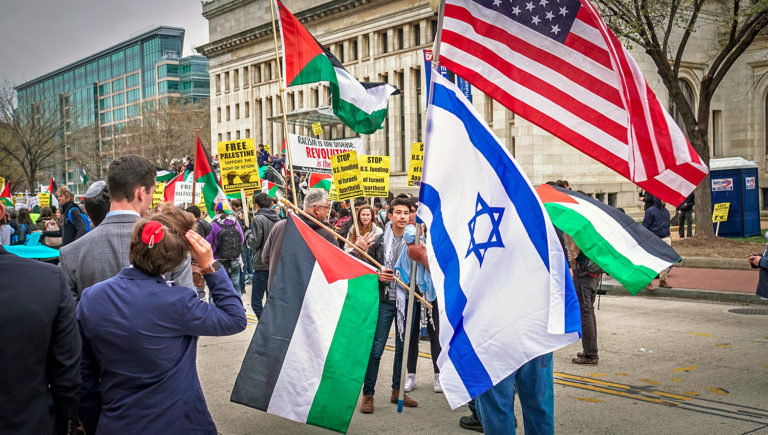
This article examines social polarisation as a new front line in international security, analysing its implications and the security responses it calls for. You can read and print the full study in PDF here.
In social psychology, polarisation refers to the tendency of groups to harden their positions after discussion. It is a phenomenon that can be observed in many contemporary political contexts (1) Transposed to the political and security sphere, this mechanism is no longer solely a matter of societies’ internal dynamics.
Long seen as a symptom of democratic crises, social and identity-based polarisation is now being actively exploited by state and non-state actors. It is a means of weakening states’ internal cohesion and challenging their sovereignty. Social polarisation can no longer be understood as a mere pathology of contemporary societies. Internal and external actors exploit these fault lines, manipulating rumours, narratives and the media to weaken the state from within. It has now become a lever of cognitive conflict.
From this perspective, the analysis of social phenomena becomes central to the study of international relations and conflict. How, then, has internal polarisation become a new front line in international security, and why are traditional security mechanisms struggling to respond?
When societies become battlefields
In recent years, internal polarisation within societies has often been presented as a mere symptom of today’s democratic crises. The rise of extremes, distrust of institutions, the fragmentation of public debate: the diagnosis is by now familiar. Yet this reading remains largely inadequate. Amid heightened international rivalries, polarisation is no longer simply endured. It is exploited, encouraged and at times even manufactured. This makes it a strategy for weakening states from within without resorting to direct military confrontation.
This shift fits squarely within the logic of hybrid warfare. Contemporary conflicts are no longer fought solely along visible front lines, but in information and cognitive spaces that have become strategic. The preferred targets are public opinion, collective identities and trust in institutions. Polarisation acts here as a multiplier of vulnerability, undermining social cohesion and reducing the state’s ability to build even a minimal consensus on national security issues.
From social fracture to challenges to sovereignty
The mechanism at work is fairly consistent. The societies subjected to this process are already riven by multiple fractures. These may be religious, ethnic, territorial, economic or identity-based. Such fault lines provide ground for strategic exploitation, identified and analysed by internal or external actors. Next, these fractures are amplified through powerful information vectors. The media, social networks and algorithms fuel the spread of emotive or divisive narratives.
Information bubbles reinforce pre-existing convictions and shrink the space for dialogue. Political disagreements then gradually turn into entrenched clashes of identity. As these dynamics take hold, the legitimacy of the state and its institutions is undermined. Part of the population comes to see the authorities as biased, incompetent or even illegitimate.
The security forces are accused of taking sides, of repressing certain groups or, conversely, of being unable to maintain order. The social contract slips away. Sovereignty is contested from within. It is precisely here that the heart of cognitive warfare lies.
Polarisation as a vehicle for indirect interference
Polarisation goes beyond conventional internal conflicts. By exploiting existing tensions, external actors can influence a state’s political or economic decisions without ever showing their hand. A deeply polarised society becomes structurally vulnerable to disinformation, radicalisation and the constant contestation of its institutions.
In this context, polarisation can no longer be regarded as a mere democratic malfunction. It constitutes a new front line in international security, where social cohesion becomes a strategic issue in its own right. As quoted in a recent article by the GCSP, “cognitive warfare aims to influence reasoning and decision-making, making the cognitive domain a new dimension of warfare. […] The misuse of information should be considered a new form of weapon of mass destruction: not a weapon of physical destruction, but a weapon of mass disinformation.” (2) It is now a central strategic issue at the heart of international security.
Contrasting cases of polarisation: Lebanon, Taiwan, Morocco
These dynamics are not abstract. They play out differently depending on the structure of states, their political history and their exposure to informational pressure. The cases of Lebanon, Taiwan and Morocco thus illustrate three contrasting trajectories of polarisation as a strategic lever.
- Lebanon: sectarian polarisation and functional collapse
Lebanon offers a particularly revealing example of polarisation that has become structural. Embedded at the heart of a sectarian political system, it directly affects the functioning of institutions and the security apparatus.
The Internal Security Forces (ISF), although conceived as a pillar of law enforcement and national cohesion, are hampered by competing communal loyalties, deep political divisions and a loss of legitimacy in the eyes of a population in crisis. The state is struggling to exercise its authority over the whole of its territory.
In the areas left vacant, politico-military actors such as Hezbollah are taking over, thereby redrawing sovereignty. Polarisation does not merely produce instability: it fragments the function of the state itself. Residents bear the brunt of these fractures directly: mistrust of institutions, unequal access to services and fear that communal tensions will escalate locally.
Moreover, this internal dynamic is compounded by an external dimension. The fragmentation of Lebanon’s political and security landscape creates an environment particularly conducive to foreign interference. Western states, while officially professing support for stability, reform and Lebanese sovereignty, sometimes opportunistically exploit existing fault lines, which are exploited more directly by neighbouring states.
The conditionality of international aid and uneven diplomatic pressure often reinforce perceptions of interference, fuelling polarisation rather than reducing it. As a report by the French National Assembly points out, “excessive conditionality becomes not only an obstacle to resolving the crisis, but also a factor of political polarisation […] weakening reforming governments, which are seen as passive conduits for external agendas”.(3) The Lebanese case thus illustrates a polarisation that fragments the state and erodes its sovereignty over the long term.
- Taiwan: political and identity polarisation and proactive cognitive resilience
Taiwan is an emblematic case of polarisation managed as a permanent strategic risk. Taiwanese society is riven by deep political and identity polarisation, pitting different conceptions of national identity, sovereignty and the relationship with China against one another. This polarisation is actively exploited by Beijing as part of its strategy of informational and cognitive pressure.
Disinformation campaigns, the manipulation of identity narratives and the exploitation of political divisions are aimed at weakening Taiwan’s internal cohesion. Unlike Lebanon, the Taiwanese state has incorporated this polarisation as a structural component of its national security. The government has developed a proactive approach to cognitive resilience, combining the fight against disinformation, institutional transparency, media literacy and close cooperation with civil society and digital platforms.
This strategy relies in particular on institutionalised fact-checking mechanisms and on close cooperation with organisations in the fight against disinformation. The aim is not to stifle democratic debate, but to prevent it from being captured by external manipulation. Polarisation persists, but it is contained within a robust institutional framework that prevents it from undermining the sovereignty of the state.
The Taiwanese case thus illustrates a contained and managed polarisation, turned into a matter of strategic vigilance rather than a factor of state fragmentation. While Taiwan has incorporated its polarisation as a lever of strategic resilience, other states facing contained polarisation adopt different, often less proactive, approaches.
- Morocco: contained polarisation and information vulnerabilities
This is the case of Morocco. The state retains a strong capacity for institutional control, more stable political legitimacy and largely cohesive security forces. Divisions exist, but they are to a great extent channelled through effective political and security regulation mechanisms. However, certain information vulnerabilities remain, particularly in the context of regional rivalries.
In this respect, the question of the Moroccan Sahara is a major flashpoint. It is the target of very frequent disinformation campaigns, often amplified by regional rivalries, particularly with Algeria. According to a report by the independent platform Misbar, “Morocco was among the countries most targeted by disinformation campaigns in June 2024, ranking among the three most targeted countries in the MENA region”. (4)
Social media and digital platforms play a central role here in spreading competing narratives, sometimes emotionally charged, that seek to sow doubt or stir up protest. The Moroccan state’s ability to control the security space, to produce a coherent institutional discourse and to sustain confidence in its institutions allows it to contain the effects of polarisation. The vulnerability is real, but it remains in check and has not, at this stage, reached a critical threshold for the Kingdom.
Strategic analysis: functional collapse, proactive resilience and contained vulnerability
Comparing Lebanon, Taiwan and Morocco highlights three distinct trajectories of polarisation as a lever of cognitive warfare. In Lebanon, polarisation is leading to a partial functional collapse of the state, durably weakening its sovereignty and opening up strategic space for non-state actors and foreign powers. It acts as a corrosive internal dynamic that is difficult to reverse in the short term.
Taiwan, by contrast, illustrates polarisation that has been anticipated and built in as a permanent strategic risk. Political and identity-based polarisation remains intense there, but it is contained by institutions capable of limiting its exploitation in the information sphere without stifling democratic debate. Polarisation does not fragment the state: it is managed as a national security parameter.
Morocco occupies an intermediate position. Polarisation there is broadly kept in check by robust institutions, but it remains open to exploitation as a means of informational and diplomatic pressure, particularly against a backdrop of regional rivalries.
What separates these trajectories is less the existence of divisions than the state’s capacity to absorb and regulate them while preserving social cohesion. These cases show that polarisation does not automatically lead to state collapse. Rather, it is a key strategic indicator of how vulnerable or resilient a state is in the face of cognitive warfare.
The security blind spot: why do states fail?
Internal polarisation poses an unprecedented challenge for states. Armed forces and police forces are traditionally trained and organised to respond to conventional threats. They are not prepared to handle diffuse conflicts that play out within the social fabric.
Polarisation takes effect upstream of visible crises, exploiting a blind spot in national security. A major risk is that polarisation directly affects the security forces themselves. A perceived loss of neutrality undermines public trust and deepens divisions.
This phenomenon is present in the West and, for several decades now, in France. According to the Institut Rousseau, “the decline in trust in the police is causing a deterioration both in the relationship between law enforcement and the population and in the context in which police officers and gendarmes operate, ultimately threatening their ability to carry out their duties and the stability of institutions.” (5)
It can prove particularly critical in states where historical or identity-based divisions are already very pronounced. Internal cohesion and institutional legitimacy thus become decisive strategic factors.
Initiatives such as Security Sector Reform (SSR) and the trust-building programmes promoted by DCAF emphasise the neutrality of the forces, the transparency of chains of command and the inclusion of civil society in oversight mechanisms.
Recommendations: towards resilient security
Rising social and political polarisation makes it necessary to rethink security policies beyond a strictly coercive approach. Resilient security rests on prevention, anticipating tensions and strengthening the bond between institutions and societies. Integrating social cohesion into Security Sector Reform (SSR)
Security Sector Reform must explicitly address the question of social cohesion. This makes it possible to anticipate the risks of internal fragmentation and to adapt security arrangements before crises arise. They encourage a more nuanced understanding of the social dynamics that affect the stability of states.
At the same time, security forces must be trained in institutional neutrality and in managing internal tensions. In polarised contexts, the perception of impartiality is decisive in maintaining the legitimacy of security action. Training focused on understanding social conflicts helps to prevent tensions from escalating and to strengthen trust between populations and institutions.
It is also necessary to develop tools that place sociological and psychological indicators at the heart of the security apparatus. These could combine, for example, the level of trust in institutions and the degree of media fragmentation.
These units would monitor not individuals but “fault lines”, taking sociology and social psychology out of the purely academic sphere and integrating them directly into operational intelligence. The aim is not target intelligence, but to detect and anticipate cognitive pressures before they turn into structural threats.
Developing early warning systems against polarising disinformation Disinformation is today a major factor in amplifying contemporary polarisation. Setting up early warning systems depends on structured information monitoring, combining digital tools with qualitative analysis – particularly tools relying on AI, as can be widely seen on X (Twitter).
This approach cannot, however, translate into a general restriction of freedom of expression. In highly polarised contexts, it is tempting to equate critical discourse, or discourse that departs from the dominant narrative, with security threats. Such reasoning would be counterproductive. It would risk fuelling mistrust and worsening the very polarisation dynamics it claims to combat.
The fight against polarising disinformation must not restrict the plurality of opinion or political criticism. It must target only campaigns of lies or manipulation, especially those orchestrated by foreign actors to destabilise the state. Finally, such a strategy requires close cooperation between the state, civil society and digital platforms.
Such cooperation must take place within a transparent and properly regulated legal framework, so as to reconcile security effectiveness with respect for civil liberties. The structuring role of international organisations and think tanks International organisations and think tanks play a structuring role in analysing and preventing polarisation. They help to bring objectivity to these dynamics by producing comparative mappings that make it possible to identify the fault lines most likely to be exploited.
Their contribution also lies in the strategic support they provide to states, notably through training institutional actors, evaluating public policies and disseminating good practice in cognitive and informational resilience. Finally, social and political polarisation is no longer merely a democratic dysfunction. It has now become a central strategic lever, capable of weakening states from within.
On the chessboard of international relations, it can be exploited as a means of pressure or, conversely, expose pre-existing structural vulnerabilities. Responding to this threat does not require restricting freedom of expression, but rather strengthening the internal sources of state resilience. This means consolidating social cohesion, guaranteeing the neutrality of the security forces and restoring trust in institutions.
From this perspective, cooperation with civil society and digital platforms appears decisive. Contemporary security is thus played out as much in the social fabric as on the military front. Understanding, anticipating and containing the dynamics of polarisation is now a strategic imperative for preserving the legitimacy, stability and resilience of states.
(1)Myers, D. G. (2020). Social Psychology. New York: McGraw-Hill.
(2) GCSP – Geneva Centre for Security Policy. 2023. Enhancing Cognitive Security and Societal Resilience: Countering Cognitive Warfare. https://www.gcsp.ch/publications/enhancing-cognitive-security-and-societal-resiliencecounter-cognitive-warfare
(3) French National Assembly. 2023. https://www.assembleenationale.fr/dyn/opendata/RINFANR5L17B1686.html
(4) Misbar. 2024. Report: Morocco Among Top Countries Targeted by Fake News in June 2024. 3 July 2024. https://www.moroccoworldnews.com/2024/07/17429/report-moroccoamong-top-countries-targeted-by-fake-news-in-june-2024/
(5) Institut Rousseau. 2024. Note sur la confiance dans la police [Note on trust in the police]. https://institut-rousseau.fr/wpcontent/uploads/2024/10/Note-police_VF.pdf
Translated from French. The French original prevails.