Among the 10 geopolitical risks for 2026, the annual report by the Eurasia Group, founded by the American political scientist Ian Bremmer, identifies a Europe on course to be paralysed at best and destabilised at worst. “France, Germany and Britain are starting the year with weakened and unpopular governments”, under pressure from populist parties of the right or the left.
The first test will come in Britain with the local elections and Reform UK, the party of Nigel Farage, the chief architect of the Brexit campaign, who subsequently lost interest in what followed by resigning as leader of his party, Ukip. Reform UK is forecast to win this election in almost every poll published in 2025.
These local elections could serve as a springboard for his far-right party ahead of the general election. In any case, Keith Starmer’s Labour government, unpopular and pulled by its left wing, has little chance of surviving the spring. According to the Eurasian Group report, “his successor will be weaker still and further to the left”, while the Conservatives have not recovered from the 2022 crisis, which burnt through three prime ministers who entered 10 Downing St. The two-party system that has defined British politics for a century is likely to struggle to withstand this sequence of events.
France, for its part, finds itself at a political impasse, with the National Assembly split along partisan lines and two populist forces, on the left and on the right, which have so far prevented any majority coalition. Yet a presidential election held under a two-round majority system sits uneasily with such fragmentation. Having worn out three prime ministers in a single year, the French political system is dysfunctional, unable for the second year running to reach agreement on the budget. Should there be another dissolution, it would, if the polls are to be believed, bring the far right to Matignon, in cohabitation with a very weak president at the end of his tenure.
In Germany, five state elections are due to be held in September. Having come second in the federal elections in February 2025, Alternativ für Deutschland (AfD) is now capable of winning a majority in some eastern states. That would be a first in a country accustomed to coalitions. The weakening of the Social Democratic Party (SPD) could lead the CDU to abandon its refusal to ally with the far right and form a coalition with it.
In these three major European countries, public opinion is being stirred by a simmering anger over immigration, stagnating living standards, deindustrialisation and the sense of a chasm between the rhetoric of the elite and people’s lives. And the youngest voters are proving receptive to populist and anti-establishment rhetoric from both right and left.
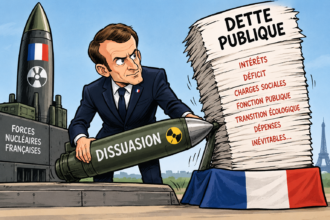
The political players in power can do little more than try to weather the ill wind, and lack the footing to undertake the reforms their country needs. Heavily indebted, France will struggle to find the means to adapt to the technological leap now under way with artificial intelligence, to say nothing of the investment that would be required for its health and education systems to recover their former efficiency and performance.
Already hobbled by a Brexit that has undermined its economy and created a new class of poor, Britain remains isolated. And Germany, the continent’s largest economy, is experiencing a slowdown, if not a recession, caused by a structural crisis and falling exports.
These three countries are therefore hard pressed to influence the destiny of the Union, which finds itself without an engine at a time when it ought to be acting to revive itself (the Draghi report) or to coordinate on defence.
Targeted by destabilisation campaigns on social media, by commando-style operations seeking to divide national communities, and by cyberattacks paralysing administrations such as the postal service or hospitals, Europe is directly threatened by the Kremlin. The three major European countries supporting Ukraine are also being targeted by the United States, which is using its influence to help anti-European sovereigntist parties come to power and is calling the Western alliance into question. American support for Ukraine, attacked by Russia in a war that has already lasted almost twelve years, is increasingly uncertain. This position of weakness clearly exposes them to the risk of an increase in Russian hybrid attacks, as well as to American pressure to dismantle the EU as a competitor and deal bilaterally with its member countries.
Grim scenarios indeed for Europe in 2026.
Translated from French. The French original prevails.