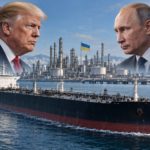
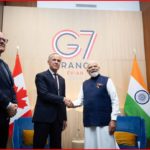
On 24 February 2022, Vladimir Putin launched the invasion of Ukraine. On 27 February 2026, Donald Trump authorised strikes on Iran. Two wars, two theatres, two camps that appear to be on opposite sides. What they have in common lies first in the way they were decided: by one man acting alone, on the strength of an alternative narrative that the facts contradicted. It lies, secondly, in their combined effect. Seven months after Operation “Epic Fury”, Europe is paying all three bills at once: energy, military and political.
By Nicolas de Ziegler, President of the Geneva Geostrategic Observatory
Two decisions taken alone, one and the same method
Moscow, February 2022: a war written in advance
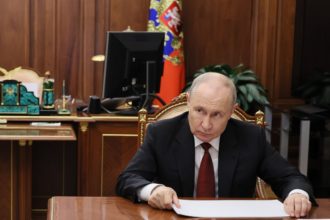
The war in Ukraine was conceived before it was launched. On 12 July 2021, Vladimir Putin published a lengthy essay, “On the Historical Unity of Russians and Ukrainians”, which denied Ukraine any national existence of its own. Seven months later, on 21 February 2022, Russia’s Security Council met in front of the cameras to endorse the recognition of the “republics” of Donetsk and Luhansk. The scene has stuck: Sergei Naryshkin, head of foreign intelligence, stammered, corrected himself and was curtly put right by the president. That day, the world watched a system of power at work in which no one contradicts – they guess…
The rest is well known. The short war the Kremlin had counted on, with a Ukrainian government expected to collapse within days, has now lasted four years and seven months. In early October 2026, Moscow struck the bridges of Kyiv while Friedrich Merz was visiting the Ukrainian capital, and the Ukrainian army was regaining ground around Kupiansk.
Washington, February 2026: a threat reinvented
On the American side, the narrative preceded the decision by a few weeks. In June 2025, after the strikes on Fordow, Natanz and Isfahan, Donald Trump claimed that Iran’s nuclear programme had been “obliterated”. In his State of the Union address in February 2026, he argued the opposite: Iran had supposedly relaunched its programme and was developing missiles capable of reaching American territory. US intelligence assessments said otherwise: no direct threat, and no intercontinental ballistic capability before 2035.
The inner circle as echo chamber
The two systems share one trait: the disappearance of dissenting voices. In Moscow, this is long-standing and methodical. In Washington, it comes through the choice of personnel, servile before they are competent. The Secretary of Defense, Pete Hegseth, made a name for himself in March 2025 by discussing strikes in Yemen on a consumer messaging app on which a journalist had been included by mistake. The negotiations on Ukraine have been entrusted to Steve Witkoff, a property developer and friend of the US president with no diplomatic experience whatsoever, and to Jared Kushner, Donald Trump’s son-in-law…
Two front lines, one landing point: Europe
The energy trap
Before 28 February, the Western strategy of putting pressure on Russia was beginning to bear fruit. In February 2026, according to the International Energy Agency, Russia’s revenue from exports of crude oil and oil products fell to $9.5 billion, its lowest level since 2022. The Iran war reversed the trend within a fortnight. For Europe, the effect is twofold. It is watching Russian coffers that it had been striving to drain fill up once again, and it is bearing the full brunt of the gas shock. The European Union thus finds itself caught in a pincer. On 26 January 2026, it adopted the phased ban on Russian gas: long-term LNG contracts are to end on 1 January 2027, and pipeline gas by 1 November 2027 at the latest. The timetable will therefore fall in the depths of winter, creating a shortage. The regulation provides that the Commission may suspend the ban for four weeks if security of supply is under threat. Moscow will not need to campaign for such a suspension. The market will see to it.
The military trap
The second knock-on effect concerns air defence. According to our information, the United States took delivery of only 172 Patriot interceptors in the 2026 fiscal year, and fired more than a thousand of them in the Iran war. Stocks would not be replenished before 2029, provided the war does not resume.
Kyiv is gauging the consequences. At the end of May, after a Russian attack involving 54 cruise missiles, 30 ballistic missiles and three hypersonic missiles over a single weekend, Volodymyr Zelensky wrote to Donald Trump: “To defend ourselves against ballistic missiles, we depend almost exclusively on the United States.” He added that there is “hardly a more painful sight than Patriot batteries without loaded missiles”.
The bill will fall to the Europeans, who will be left to plug the gap. Yet the commitments made this summer will not produce interceptors before 2029.
The political trap
The third bill is the least visible. In December 2025, the US National Security Strategy spoke of Europe facing “the prospect of civilisational erasure” and announced its intention to “cultivate resistance” among “patriotic parties”. Three months later, Washington went to war with Iran without consulting its allies, then asked them to reopen the Strait of Hormuz. Emmanuel Macron replied that France “will never take part” in such operations “in the current context”. Donald Trump called the allies “cowards” and warned that their refusal would be “very bad for the future of NATO”.
Meanwhile, Moscow is stepping up its hybrid war. On 4 August, a quadcopter laden with explosives struck the wing of an Antonov An-124 at Leipzig airport, close to the fuel tank. Berlin officially attributed the attack to Russia. In September, NATO aircraft shot down an explosive-laden drone over Lithuania, Danish intelligence reported plans to sabotage defence manufacturers, and Donald Tusk warned that Russia was preparing to test Article 5. Just as Washington casts doubt on its guarantee, Moscow is testing its strength.
Wider targets, new players
Neither war has stayed within its original bounds.
On 1 March, a Shahed-type drone, launched from Lebanon according to Nicosia, struck the runway at the British base of Akrotiri, in Cyprus. For the first time, the Iran war reached the soil of a European Union member state. France sent counter-drone systems, Greece reinforced its presence, and Brussels opened discussions on the mutual assistance clause.
Saudi Arabia, the UAE, Kuwait and Bahrain, for their part, became belligerents after Iranian strikes on their territory. Hezbollah resumed fighting two days after Khamenei’s death, and the Houthis opened a second maritime chokepoint in the Red Sea.
Above all, the two theatres became linked through unexpected actors. As early as 6 March, the Washington Post reported, citing US officials, that Russia was supplying Iran with intelligence, including satellite imagery, to target US forces in the region. Ukraine, meanwhile, has become an exporter of security. Approached by Washington, even though direct US military aid had been suspended, it is deploying more than 200 specialists to Qatar, Saudi Arabia and the UAE, and is offering interceptor drones that cost around a thousand times less than a Patriot missile
An oblique Russian strategy or a convergence of effects?
Does speaking of the “same war” imply coordination between Moscow and Washington? Nothing, as things stand, supports such a claim. It is better described as a convergence of effects, which each of the two men exploits in his own way.
Vladimir Putin is behaving as a methodical opportunist. Grégoire Roos, director of the Europe and Russia programmes at Chatham House, sums up his stance in three words: spectator, beneficiary, actor. Moscow supports Tehran without a mutual defence treaty, maintains its deconfliction channels with Israel, pockets the oil windfall and advances its pieces wherever the risk is low. The aim, he writes, is not to confront the United States everywhere, but to show that Russia cannot be excluded anywhere.
Donald Trump, for his part, did not launch the Iran war to serve the Kremlin. But his indifference to Europe’s fate makes these effects acceptable in his eyes. The waivers on Russian oil were intended to bring down American petrol prices, not to fund the Russian army. And the itinerary of Donald Trump’s two envoys speaks volumes: Moscow first, Kyiv second. Vladimir Putin told Witkoff and Kushner once again that Russia would achieve its objectives and that the “root causes” of the conflict had to be addressed. At the end of September, the Kremlin is still betting on the military route…
This is where the Russians’ oblique strategy comes into its own. If Washington shifts from a policy of weakening Russia to one of managing it, the burden of pressure will fall on Kyiv, which at some point will be told to accept a compromise amounting to capitulation. And every crisis that keeps energy prices high strengthens Moscow’s argument: that Russia is the more enduring player, and Ukraine a costly file with no quick way out.
For Europe, the outlook is, alas, less uncertain. It is the only player suffering at once from Putin’s war and the consequences of Trump’s, without having decided on either. Its gas reserves are at their lowest since 2013. Its American allies criticise it for not fighting in Hormuz, while Russian drones are turning up at its airports. The question is not only whether the two fronts belong to the same war, but also how long the European Union can go on paying the price without having any influence on the outcome of either war.
Translated from French. The French original prevails.