For decades, Western democracies believed that power was managed above all through institutions, multilateral summits, carefully calibrated communiqués and grand declarations of principle, as well as respect for international law. Diplomacy was meant to be polished, elegant, codified, almost anaesthetised. It was still enough to convene the Security Council, the United Nations, or at the very least to firmly condemn this or that action. Words sometimes counted for more than the balance of power itself. Then Donald Trump returned with his highly personal brand of diplomacy. And with him came a different geopolitical grammar, one to which we may have to yield in order to survive in the international jungle.
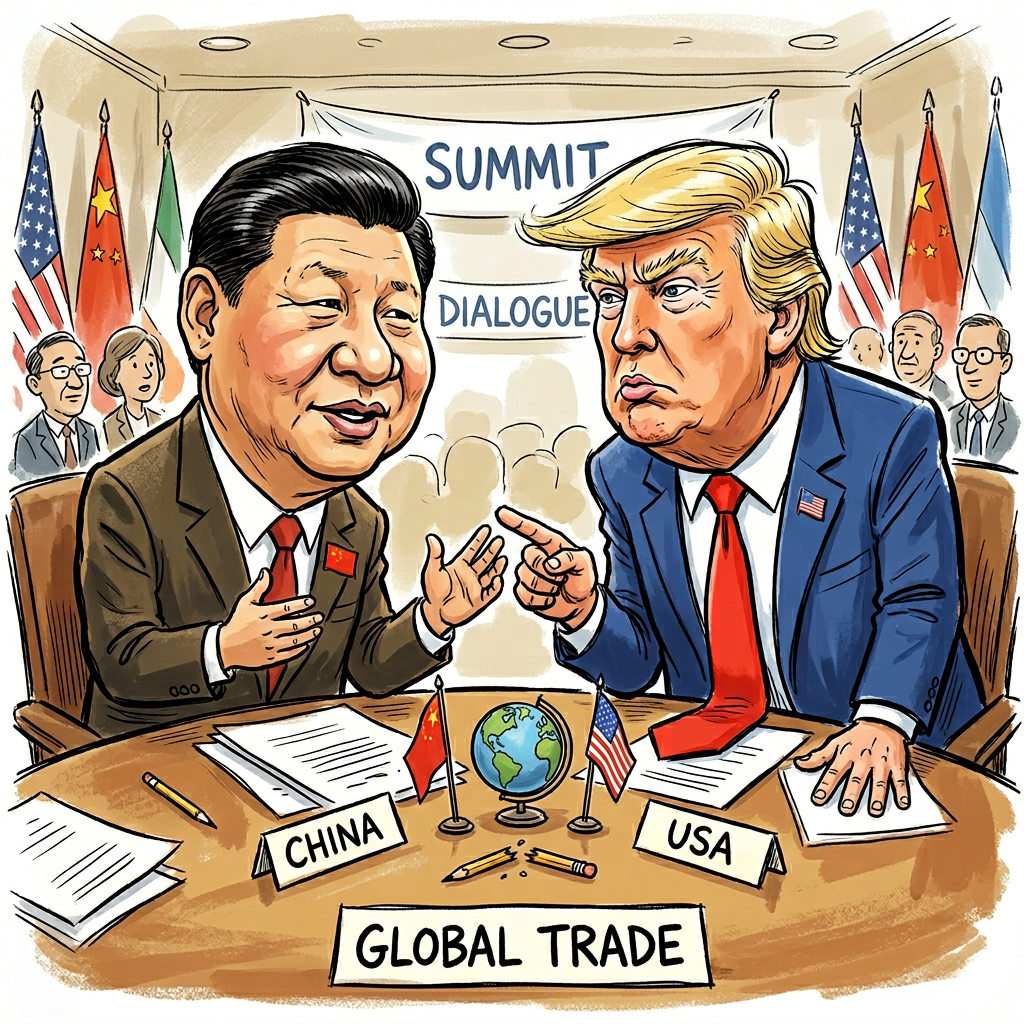
The visit to China by the US President, together with a large and historic political and economic delegation, already bears little resemblance to the great traditional diplomatic set pieces between Washington and Beijing, all the more so as no such visit had taken place since 2017. Of course, trade, technology, artificial intelligence, semiconductors, trade deficits and Taiwan will all be on the agenda. These issues are even more pressing today than they were eight years ago. But the heart of the matter perhaps lies elsewhere. Above all, this trip reflects a profound shift in the language of global power, and a charm offensive by a United States that now realises it can no longer regulate the world on its own as it once did.
Trump has grasped this and, while many in Europe content themselves with condemning Beijing round the clock, he now speaks to China in the same codes long used by authoritarian regimes or so-called “revisionist” powers. It is a blunt, direct, transactional language, in which the aim is no longer to charm but to try to impose a clear balance of power and to come out of the meeting with a “win-win” deal. It is a diplomacy stripped of the grand moral sermons and Western “talking points” that have long served to mask strategic impotence.
The end of the diplomacy of grand and petty phrases
Trump has understood something that many European leaders still refuse to see: the world is no longer governed solely by the rules of free trade or international law. It has once again become an arena of permanent confrontation between powers that use every tool available to defend their interests.
China absorbed this long ago, with the New Silk Roads, its massive investments, its economic diplomacy and its global influence strategies. Iran does it with its nuclear programme, regional militias and the constant threat hanging over the Strait of Hormuz. Russia has practised it for years through military force, energy, interference operations and cyber and hybrid threats.
Faced with this, Trump does not respond with the classic reflexes of Western diplomacy. He responds with the same software: business, pressure, intimidation, direct negotiation and the extreme personalisation of power relations. He is not trying to lecture Beijing. He is trying to get something out of Beijing.
This is precisely what so unsettles some Western elites. Trump no longer speaks the language of the liberal diplomacy inherited from the 1990s. He speaks the language of the deal and of open power politics. In this respect, he is paradoxically closer to Chinese codes than many European leaders, who are gradually cutting themselves off from the new global dialectic of international relations.
Trump, or brutal adaptation to the new world
Since his return, Trump has implicitly been repeating a simple idea: being the world’s leading power is no longer enough to impose one’s will on the rest of the world. The United States remains dominant technologically, financially and militarily, but its adversaries have learnt to circumvent that dominance. Washington has been paying the price of Iranian resistance for two and a half months. That may well prove to be the great lesson of this war for the United States.
China is building enormous economic dependencies across Africa, the Gulf and Central Asia. Iran uses strategic geography and energy as bargaining weapons. Other powers play on raw materials, migration flows, infrastructure, critical minerals or technology.
In other words, modern power no longer rests solely on aircraft carriers or patents. It also rests on the ability to create constraints, dependencies and permanent levers of pressure.
But Trump has also grasped something else: one no longer speaks to the BRICS+ countries today as one once spoke to states aligned with or dependent on the West. These emerging powers have learnt to resist in other ways. They know how to circumvent sanctions, build their own networks of influence, exploit regional crises and turn interdependencies against the Western powers themselves.
Russia demonstrated it against Ukraine by accepting a long and costly war that many thought impossible to sustain. Iran is showing it against the United States and Israel by using its regional reach, its militias, energy routes and the threat to Hormuz as levers of pressure. China, for its part, is moving more patiently, but with the same logic: creating a relationship of global dependence that makes any confrontation too costly.
Trump appears to have grasped this shift before many in the West. His method is brutal, often excessive, sometimes chaotic, but it rests on a clear-eyed observation: in today’s world, the states that survive are those that know how to impose a cost on their adversaries.
This is also why he fascinates part of Western public opinion. He projects the image of a leader willing to engage head-on, to “step into the arena”, whereas many European leaders appear trapped in technocratic mechanisms or defensive postures.
A lesson for Europe too
At this stage, no one really knows what will come out of this meeting between Donald Trump and Xi Jinping. Recent history, moreover, counsels caution. Trump’s major summits have not always produced the upheavals promised. His face-to-face meeting with Kim Jong-un in 2018 resulted above all in a spectacular piece of stagecraft. His talks with Vladimir Putin have often produced more images than concrete results, notably in Anchorage, Alaska, last year.
Yet this visit to China nonetheless carries strong symbolic weight. It shows an American president willing to go directly to the home of his main strategic rival to discuss the future of the global balance of power without going through the filter of the usual grand diplomatic set pieces.
And behind the figure of Trump, with all his outrageousness and excesses, a deeper reality is perhaps taking shape: Western diplomacy will probably have to shed at last some of its illusions and idealism if it wants to carry any weight in the world to come.
The era of “song-and-dance” diplomacy, of empty declarations and summits without consequence, may be drawing to a close. The world is entering a period in which the balance of power is once again central, in which strength is measured as much by the capacity to drive a hard bargain as by the capacity to set norms. It is time, once again, to get our hands dirty.
Europe, too, will have to choose: go on believing that rules are still enough to protect the continent’s strategic interests, or finally accept that the 21st century will also be one of power unashamedly exercised.
Translated from French. The French original prevails.