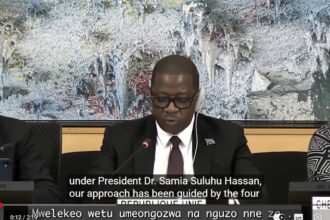
At a side event organised on 2 July 2025 by the European Public Law Organization on the sidelines of the session of the UN Human Rights Council, one address stood out for its depth of analysis and the force of its warning: that of Mongi Hamdi, former Minister of Foreign Affairs of Tunisia and senior UN official, known as an exceptional mediator in several African crises.
Entitled “Sudan between two tyrannies: internal and external”, his address painted a merciless picture of Sudan’s bloody trajectory, caught between home-grown conflicts and foreign predation, drawing on rare field experience and a political clarity forged over decades of active diplomacy.
Mongi Hamdi is no armchair expert. A former head of MINUSCA, he led the United Nations mission in the Central African Republic at the height of the crisis, and held other senior posts within the UN, notably in the Horn of Africa. He understands the logic of war, communal rifts and, above all, the diplomatic deadlocks shaped by the competing interests of the major powers. It was with that authority that he spoke in Geneva, without notes, without beating about the bush, and with a breadth of vision that was praised in the corridors of the Palais des Nations.

“Sudan is going through the worst humanitarian crisis in the world, but this tragedy is far from an exception in its history,” he declared at the outset. Recalling the two civil wars before and after the independence of South Sudan, he highlighted the structural causes of the conflict: chronic political instability, the ideological dominance of political Islam, and the collapse of institutions.
Hamdi stresses one central point: the predatory role of political Islam in shaping the Sudanese state, particularly under Omar al-Bashir, who held power for thirty years. “Under Bashir, Islam became a state ideology. The Muslim Brotherhood structured political life, with the backing of the major religious brotherhoods,” he explains, referring to Hassan al-Turabi, an emblematic figure of Sudanese fundamentalism. He points out that the religious brotherhoods even founded their own political parties, creating a lasting confusion between religion and politics and holding back any attempt at democratic transition.
But the diplomat’s gaze does not stop at internal dynamics. He denounces the growing stranglehold of foreign powers over Sudan’s resources and territory: gold, arable land, and strategic access to the Red Sea and the Sahel. “Sudan produces 70 tonnes of gold a year, 80% of which disappears from official channels. This is not mere smuggling: it is organised capture, in which certain powers turn a blind eye or take an active part”, he charges. Behind this coveted wealth, Russia (through the Wagner Group), China, Turkey, Iran, Saudi Arabia, and also Egypt – concerned about Sudan’s alliances with the Gulf powers – are moving their pieces into position.

“Sudan is merely the tip of the iceberg. The whole of Africa suffers from this logic of domination and fragmentation. Africa is treated as a reservoir to be exploited, a geostrategic cash cow,” Hamdi declares, in a forceful statement applauded by the participants.
Having worked for peace as a minister, diplomat and special envoy, he is calling for a rethink of relations between Africa and the West, moving away from a utilitarian approach to build a framework for cooperation that is fair, lasting and respectful of African sovereignty. Known for his strategic composure, his political intuition and his ability to engage with all parties, Mongi Hamdi is one of the few African diplomats to have been called upon by the United Nations to handle sensitive files, from the Sahel to the Great Lakes region. His visit to Geneva, at a time when Sudan is sinking ever deeper into horror, is a reminder of how valuable the voices of experienced mediators are — especially when they dare to unsettle and to break with conventional frameworks of analysis.
Translated from French. The French original prevails.