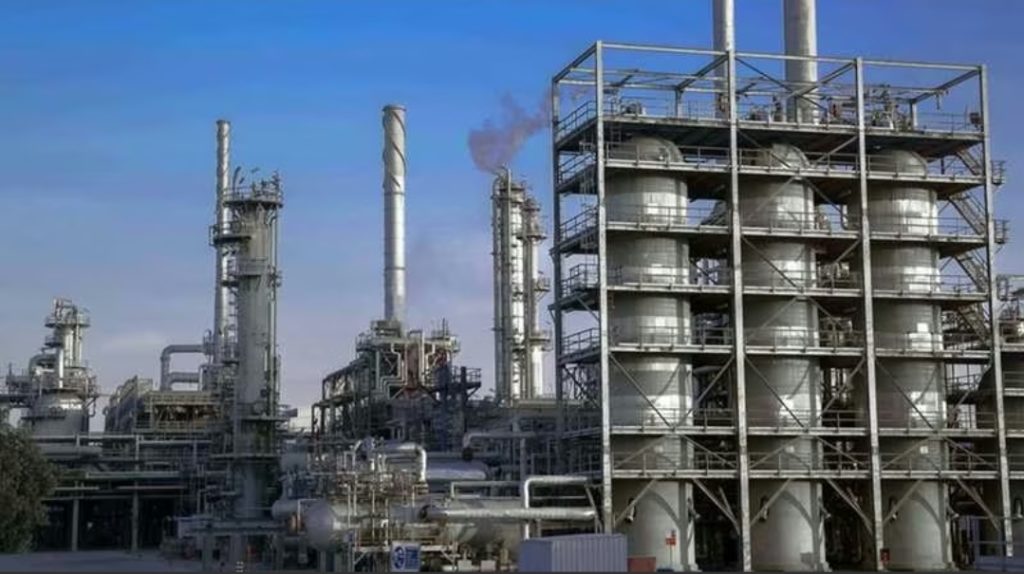
The seawater desalination plant in Kuwait targeted by Iran.
The targeting of a desalination plant in Kuwait during the recent wave of Iranian attacks was neither a chance occurrence nor an isolated incident. It forms part of a growing pattern of attacks on civilian infrastructure in the Gulf states, reflecting a qualitative shift in the nature of the threats facing the region. The attack on a vital facility directly linked to the water security of Kuwaiti society carries strategic implications that go beyond the stated military objectives, placing civilians and critical infrastructure at the heart of the calculus of deterrence and escalation.
Broken commitments
In this context, the developments that preceded the outbreak of military confrontation between the United States and Israel on the one hand and Iran on the other take on particular significance. Last February, a few days before the war began, the Secretary of Iran’s Supreme National Security Council, Ali Larijani, toured the Gulf, including Qatar, the Sultanate of Oman and the United Arab Emirates, carrying a message of thanks from the Supreme Leader, Ali Khamenei, for these states’ refusal to allow their military bases to be used in any offensive action against Iran, as well as for their request that US forces leave those bases. The message also contained a clear commitment from Iran not to target the Gulf countries, provided that this position was maintained.
However, events on the ground soon contradicted these commitments. Within the first hours of the US-Israeli attack, Iran struck all six Gulf states without exception, in an escalation unprecedented in its scale and audacity. The strikes hit vital civilian infrastructure, including a desalination plant in Kuwait, illustrating a clear shift towards widening the range of targets to include the essentials of daily life, and not just military sites.
Unconvincing explanations
The official Iranian account maintains that the attacks were aimed exclusively at US bases in the region, which it regards as launch pads for operations against Iran. This account, however, raises several fundamental contradictions. On the one hand, there is no concrete evidence that these bases were used in offensive operations. On the other, the facts point to the absence of US forces at several of these bases, after the Gulf countries asked for them to be evacuated before the war broke out, in an evident attempt to avoid any involvement in the conflict.
In an effort to contain the political and media fallout from the targeting of sensitive civilian infrastructure, the Iranian embassy in Kuwait issued a statement asserting that the attack on the desalination plant had not been carried out by Iran, and blaming Israel for it. This account was met with widespread scepticism, as it is incompatible with the operational data, notably the launch of hundreds of Iranian missiles and drones towards the Gulf states. This lends weight to the hypothesis that media messaging is being used instrumentally to deny responsibility rather than to provide a credible explanation.
Moreover, the operational data raise further questions about the credibility of Iran’s claims. By some estimates, nearly 4,000 missiles and drones were launched. Had that firepower been directed at a dozen or so military bases in the Gulf and Jordan, those bases should have been completely destroyed and put out of action, which was not the case. On the contrary, the attacks struck purely civilian infrastructure, such as desalination plants, airports and oil facilities, suggesting that the real objectives went beyond the declared military framework.
War crimes
The targeting of the desalination plant in Kuwait is all the more serious given the country’s dependence on water imports from the sea: some 95% of Kuwait’s population relies on desalinated water as its main source for daily life. Striking these facilities is therefore not merely an attack on technical infrastructure, but a direct assault on the right to water, which is closely bound up with the right to life and to health. Seen in this light, targeting desalination facilities amounts to attacking civilians and their means of subsistence.
Under international humanitarian law, attacks on vital civilian infrastructure, particularly that which is indispensable to the survival of the population, may constitute war crimes, especially when it serves no direct military purpose. In this context, the targeting of the desalination plant in Kuwait may be construed as a serious violation of the rules protecting civilians.
This assessment is reflected in the international position. In Resolution 2817, adopted on 11 March, the United Nations Security Council condemned the Iranian attacks, describing them as a violation of international law and of the principles of good-neighbourliness, and rejected their justification as self-defence under Article 51 of the Charter of the United Nations. This position takes on particular significance in light of the official apology offered by Iranian President Massoud Pezeshkian to certain Gulf countries, raising questions about the contradiction between an official discourse justifying the attacks and political conduct that implicitly acknowledges their illegality.
Gulf states as the main target
The figures reinforce this analysis. Around 85% of Iranian missiles and drones were reportedly directed at the Gulf states and Jordan, with only a limited share aimed at Israel. Moreover, nearly 70% of these missiles have a range of no more than 400 kilometres, revealing a clear geographical focus on the western shore of the Gulf rather than on Israel’s strategic depth. These technical details confirm that the Gulf states were a main target in Iranian operational planning, not a secondary theatre of the conflict.
In conclusion, the targeting of the desalination plant in Kuwait, together with the subsequent attempts to deny responsibility and deflect the accusations, reveals a strategic shift in Iranian behaviour, combining direct military escalation with information warfare. It also highlights the gravity of targeting vital resources on which the population depends almost entirely, with major humanitarian and legal consequences. This situation calls for a more integrated approach at Gulf level to protect critical infrastructure and to strengthen mechanisms of deterrence and international accountability.
Translated from French. The French original prevails.