In partnership with Desk Russie.
Geohistory and the demands of the hour
Do the Iranian blockade of the Strait of Hormuz and the American counter-blockade mark a strategic turning point? These moves are said to herald the start of a conflict for control of the seas – more precisely, of the shipping lanes and the geostrategic areas that govern the passage of flows (straits, canals, capes and gulfs), or indeed of the seabed (the “war of the abyss”). In the light of history, the claim is surprising. Does the concept of thalassocracy not date back to ancient Greece? Moreover, Russian naval activity in the North Sea is a reminder that these conflicts are also being played out in Europe and form part of a long history.
Opening onto the Atlantic Ocean, the North Sea covers some 575,000 km². It lies between the British Isles and northern Europe. To the south, the Strait of Dover controls passage to the English Channel; to the east, the Øresund controls passage to the Baltic Sea. From the early Middle Ages, the North Sea was a hive of commercial activity, plied by Frisian seafarers. It was also the route taken by Viking raids on the coasts of western Europe (and beyond). Later, trade between England and Flanders developed across it (English wool in exchange for Flemish cloth), and the Hanseatic League dominated the North Sea–Baltic trade axis. Its networks stretched from London to Novgorod, with the city of Lübeck as its leader and geographical hub.
At the heart of long-running power rivalries
The rise of territorial states around the Baltic and the North Sea, together with the shift in the centres of gravity of economic life towards the Atlantic Ocean following the discovery of the Americas, eventually got the better of the Hanseatic League and its bonds of solidarity. It was around the North Sea that the modern maritime powers of the United Provinces (today’s Netherlands) and Tudor England took shape. In the 17th century, the North Sea was thus the theatre of the Anglo-Dutch Wars, fought for naval supremacy. At the end of the Revolutionary and Napoleonic Wars (1792–1815), British hegemony asserted itself in the North Sea, as it did in Europe and the rest of the world.
At the end of the 19th century, Wilhelmine Germany was on the rise and strengthened its base on Heligoland (the island had been exchanged with the United Kingdom for Zanzibar in 1890). During the First World War, the British fleet reasserted its clear superiority over the German fleet, a superiority reinforced by the military clauses of the Treaty of Versailles (1919) and left unchallenged by the Anglo-German Naval Agreement of 1935. During the Second World War, the North Sea was above all an adjunct to the theatre of the Battle of the Atlantic.
During the Cold War, the North Sea was one of the geostrategic arenas in which East and West took each other’s measure, with the navies of NATO member countries tasked with tracking and monitoring Soviet submarines as they emerged from the Baltic Sea. In the present context, the coastal states all belong to the European Union and/or NATO (Norway is not a member of the EU but takes part in the European Economic Area).
The North Sea also covers a continental shelf rich in hydrocarbons, which has made an important contribution to European energy security in the period that began with the first oil shock (1973). The oil and gas fields of the North Sea – in British and Norwegian waters in particular – have been exploited since the 1970s1. Finally, the North Sea, beyond the Danish straits, is the Russian navy’s route to the English Channel and the Atlantic Ocean.
A new East / West conflict
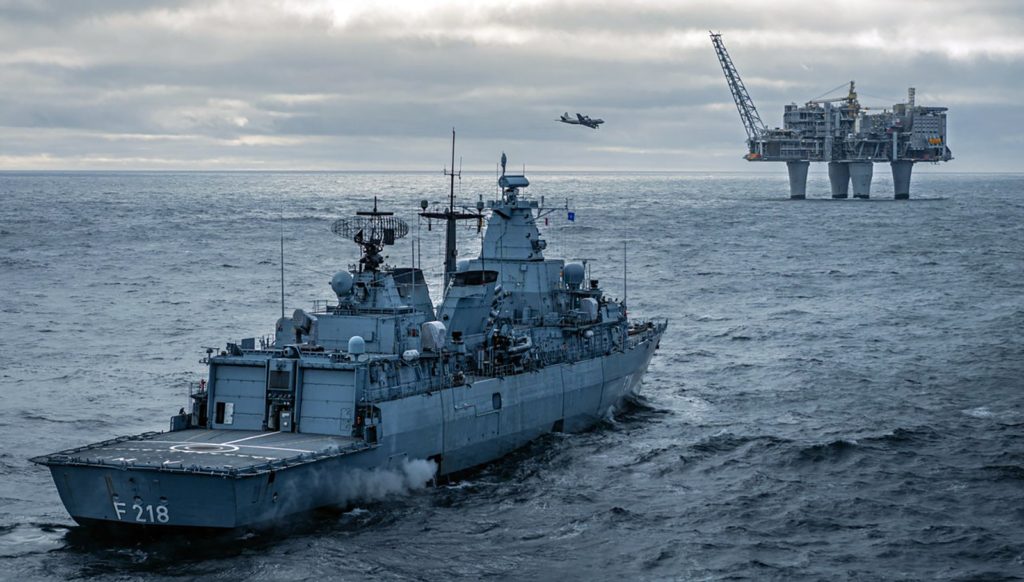
The rise in tensions since Russia’s annexation of Crimea manu militari in 2014 and the incidents caused by Russian vessels and aircraft intruding into the waters and airspace of the North Atlantic coastal powers have revived strategic interest in the North Sea, all the more so following the Russian “special military operation” launched against Ukraine on 24 February 2022. Having become a high-intensity war, the conflict is accompanied by a covert, so-called “hybrid” war against NATO, in the North Sea as in the Baltic. Energy platforms, wind farms, oil and gas pipelines and undersea cable networks are the targets of this low-key war. Several coastal states have therefore signed a regional security pact (see below).
In truth, Russia’s provocations are becoming increasingly brazen. While all eyes are on the Strait of Hormuz and the Persian Gulf, the Kremlin is testing the resolve of the United Kingdom and NATO in the North Sea and the English Channel. For more than a month, three Russian submarines conducted covert operations in British waters of the North Sea, above so-called “critical” infrastructure (cables and gas pipelines). According to the British Defence Secretary, John Healey, who revealed the affair on 10 February, Russia’s aim was to identify and map the gas pipelines that are vital to the United Kingdom’s energy supply, as well as the data cables running between the two sides of the North Atlantic.
At the same time, we learn that two “shadow fleet” tankers, escorted by a Russian frigate, passed from the North Sea into the English Channel, daring the Royal Navy (and the French Navy) to board them. They were the Universal and the Enigma, under the protection of the Admiral Grigorovich, a Black Sea Fleet vessel. Since the start of the year, more than 300 “shadow fleet” tankers are reported to have transited British waters in the North Sea. The Russian authorities are threatening to retaliate should London venture to board any of these vessels.
Current strategic developments in the North Sea, like the long sweep of history, therefore undermine the notion of a “liberal international order”. That order did indeed exist, but it was not established through the power that its champions attribute to law (witness the slogan “the force of law against the law of force”). Limited in its reach during the Cold War, this so-called “order” depended on the capacity and the will of the United States, bolstered by its alliances in Europe and Asia, to enforce it ; it rested on geopolitical conditions that have been called into question since the chaotic beginnings of the 21stcentury. The will to power of revisionist states, the missteps of American policy and the shifting balance of power have ushered in a new era.
By way of conclusion
In such a context, it is important that European states, at sea as on land, take on as large a share of their own defence as possible. This great geostrategic game is being played out from the Arctic and the North Atlantic to the “Greater Mediterranean” (Mediterranean / Middle East), along the Baltic–Black Sea axis and on Europe’s eastern borders. Such an effort calls for something other than virtual “coalitions of the willing” which, from Ukraine to the Arabian-Persian Gulf, leave the initiative to the West’s enemies and adversaries (no deployment without their consent).
Conversely, let us be aware that the lessons in law and morality handed out by certain European leaders, and the fantasy of a third way that would cast Europe as the driving force of a hypothetical “Global South2“, would look like a sublimation of our collective powerlessness. They would run counter to the need for “burden-sharing” (“burden-sharing“) between the old and the new West, a transfer of responsibilities already made uncertain by the attitude and inclinations of the Trump administration.
On the North Sea Security Pact
Negotiations on a North Sea “security pact” began in April 2023 in Ostend, on the sidelines of a European intergovernmental summit initially devoted to developing offshore wind energy and green hydrogen production. Nine countries, including France, were represented and signed a declaration aimed at strengthening their cooperation in these fields. At the same time, five of them signed a joint declaration on the security of critical infrastructure in the North Sea: Germany, Belgium, Denmark, the Netherlands and the United Kingdom, joined by Norway a year later (5 April 2024).
This “security pact” covers in particular the networks of gas and oil ” pipes ” and undersea cables (data exchange and internet links), as well as the wind farms of the North Sea. In the face of pressure from the Russian navy, the six countries decided to strengthen cooperation between their national and regional surveillance systems, notably through North Seal, a shared communication and information-exchange platform. The overall aim of this platform is to detect suspicious movements and incidents very quickly and pass them on to the relevant authorities as well as to the European Union and NATO. In addition, the security arrangements will rely on cameras, aerial and underwater drones and artificial intelligence techniques. The North Sea Security Pact draws attention to the place of “seabed warfare” (Seabed Warfare) in the new Cold War between Russia and the West.
Jean-Sylvestre Mongrenier holds the agrégation in history and geography and is a researcher at the Institut Français de Géopolitique (Université Paris VIII). The author of several books, he works at the Institut Thomas More on geopolitical and defence issues in Europe. His research covers the Baltic–Black Sea region, post-Soviet Eurasia and the Mediterranean.
Notes
- It is the largest offshore hydrocarbon area in the world (more than 450 oil platforms). However, these fields are ageing and production costs are rising.
- A kind of “Bandung syndrome” that is affecting people’s thinking.
Translated from French. The French original prevails.