By Professor El Hassane HZAINE
The outcome of the latest WTO Ministerial Conference comes as no surprise given the geopolitical context, set against the backdrop of the war in the Strait of Hormuz and the divisions within the international community over this crisis, which expose fault lines between the Global South and the West on the one hand and, on the other, the all but final rupture between Europe and the United States.
Among the issues on which the conference stumbled were the reform of the institution, the perennial questions of agricultural subsidies, and the extension of the moratorium on electronic transmissions and e-commerce (software, streaming, e-books, etc.).
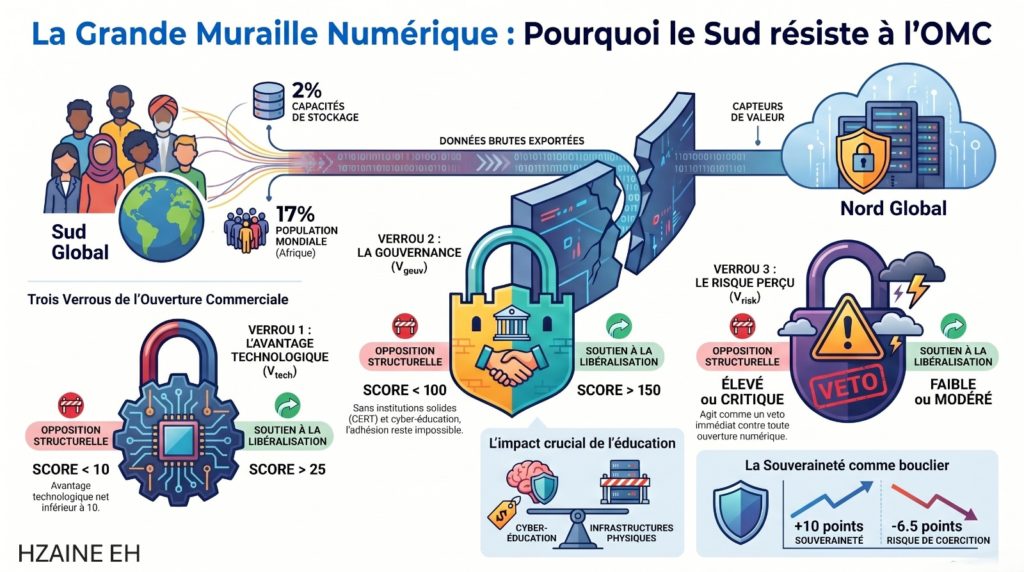
Indeed, the architecture of the global digital order also rests on unequal exchange. Yesterday, the Global South exported raw materials and imported manufactured goods; today, it exports raw data while digital value is captured by the dominant centres. The figures are stark: the cloud giants (Amazon, Microsoft, Google) account for more than 60% of the global market, while Africa, home to 17% of the world’s population, holds only 2% of the planet’s data storage capacity. African data circulate, are processed and are governed elsewhere, reproducing structural dependency in an intangible form.
This is the new face of unequal exchange and of dependency, a theory first developed by Latin American economists, among them an institutional proponent, Raúl Prebisch, the former Executive Secretary of ECLAC, and taken up by their African counterparts, including the Egyptian Samir Amin and the Moroccan Aziz Belal.
The medium has changed; the logic remains. In this context, digital nationalism is becoming a historic imperative for the Global South: breaking unequal digital exchange, regaining control of data, building local ecosystems and turning vulnerability into collective power. But an imperative calls for a diagnosis. And a diagnosis calls for a tool.
The invisible chains of digital dependency
To understand digital vulnerability, we have developed a proto-barometer: the Cloud Coercion Resilience Index (CCRI), which has been calibrated on 30 countries and which explains 87% of the variance in the risk of cloud coercion and 74% of vulnerability to cyberattacks.
The CCRI rests on four factors:
1. First, the CSI (Cloud Sovereignty Index) measures the degree of national control over cloud infrastructure: ownership of data centres, localisation laws, regulatory oversight and continuity plans. The higher the CSI, the harder it is for a foreign provider to cut off access.
2. Second, the CAI (Cloud Allegiance Index) assesses the diversification of providers: relying on a single American or Chinese giant is a structural weakness.
3. The third factor, the MI (Misalignment Index), measures the gap between what a country believes it controls and what it actually controls: the index of digital self-delusion.
4. Finally, Cyber_Edu captures the human factor: the training of citizens and public officials in digital security.
A score close to 100 signals critical vulnerability; below 30, genuine resilience. Most countries of the Global South sit somewhere in the middle range.
The empirical analysis yields clear lessons. Digital sovereignty is the best shield: every 10-point gain in the CSI reduces the risk of cloud coercion by 6.5 points. Misalignment is a risk multiplier: every 10-point gain in the MI increases vulnerability by 5.5 points. Beyond a certain threshold, the MI automatically adds 8 to 18 points of vulnerability. Cyber-education is a solution only if the infrastructure keeps pace: it works fully only when the CSI exceeds 55. The geopolitical context amplifies everything: in conflict zones, sovereignty provides twice as much protection. The most striking finding is that Cyber-Edu carries the same protective weight as the CSI (0.38 in absolute value). Improving training therefore has as much impact as building infrastructure — at lower cost and more quickly.
The three determinants of countries’ positions at the WTO
An analysis of 73 countries accounting for 98% of global GDP reveals that three locks determine a state’s position on the e-commerce moratorium and the expansion of the ITA at the WTO. If any one of them is closed, the country cannot support liberalisation. The correlation between the full model and observed positions reaches 0.93, with a predictive accuracy of 93.2%.
First lock: net technological advantage (V_tech = CSI – MI). This ratio measures a country’s ability to compete in the digital sector. The data show a clear threshold: above 25, the country is supportive; below 10, it is opposed; between 10 and 25, its position is conditional. Finland, with a V_tech of +65, firmly supports liberalisation. Ukraine, with a V_tech of -1, is structurally opposed. The correlation with observed positions at the WTO is 0.87, and this indicator alone explains 76% of the variance in national positions.
Second lock: institutional governance (V_gouv = Cyber_Edu × CERT). Technology is not enough; the institutions that manage it are just as decisive. The CERT (Computer Emergency Response Team) is scored from 1 to 3 according to its operational capacity. The observed thresholds mirror those of the first lock: above 150, the country is supportive; below 100, it is opposed. South Korea, with a V_gouv of 216, has world-class institutions. Iran, with a V_gouv of 25, has no functioning CERT.
Third lock: perceived risk (V_risk). This is a composite score with four levels: LOW, MODERATE, HIGH and CRITICAL. No country with a CRITICAL risk rating supports the moratorium, regardless of its scores on the first two locks. Russia, Iran and Ukraine share a CRITICAL risk rating and structural opposition. This lock acts as a veto: if the risk is HIGH or CRITICAL, the first two locks become irrelevant.
WTO MC14: the moratorium expires and three coalitions emerge
The WTO’s 14th Ministerial Conference, held in Yaoundé from 26 to 30 March 2026, ended in failure on digital issues (ICC, 2026). The moratorium expired for lack of consensus. Three distinct institutional responses emerged, reflecting three different lock profiles.
– The declaration of the 23 (2 April 2026): twenty-three countries issued a joint declaration to voluntarily maintain the practice of not imposing customs duties on electronic transmissions between themselves until the General Council in May 2026 (UK Parliament, 2026). The signatories include Argentina, Australia, Brazil, Canada, Chile, Colombia, Costa Rica, the United States, Japan, Mexico, Norway, New Zealand, Paraguay, Peru, the United Kingdom, Singapore, Switzerland, Taiwan, Thailand, Ukraine, the European Union (representing its 27 member states), Uruguay and Vietnam.
– The ECA of the 66 (28 March 2026): sixty-six countries accounting for nearly 70% of world trade announced the conclusion of the Agreement on Electronic Commerce (ECA), established outside the WTO framework (Third World Network, 2026). Led by Australia, Japan and Singapore, it lays down permanent disciplines on data flows, non-localisation of data, online consumer protection and cybersecurity, together with a permanent ban on customs duties on electronic transmissions between signatories. The signatories include China, the United Kingdom, the European Union, Canada and the United Arab Emirates. Notable absentees are the United States, India, South Africa, Indonesia, Morocco, Egypt and Tunisia.
– The non-aligned: a third group of countries, including India, South Africa, Indonesia, Morocco, Egypt, Tunisia, Iran and Russia, has joined neither the declaration of the 23 nor the ECA. Their position: to preserve national policy space in order to develop their own digital industries.
A cross-analysis of the two coalitions that emerged from MC14 the declaration of the 23 (transitional moratorium) and the ECA of the 66 (permanent framework) provides empirical validation of the CCRI Triple Lock model.
The fundamental similarities between the two coalitions bear out the model. No country with a V_tech below 10 (with the exception of Ukraine, which benefits from an explicit national security clause) is present in either coalition. No country with a V_gouv below 100 (Ukraine excepted) is present. Countries with a HIGH or CRITICAL V_risk rating – India, South Africa, Indonesia, Iran and Russia – are systematically absent from both coalitions. By contrast, all the countries with all three locks open, which the model calls the “digital sovereigns”, are present in both coalitions: Australia, Canada, Japan, Norway, New Zealand, the United Kingdom, Singapore, Switzerland, the European Union, South Korea and Taiwan.
Five African countries (Nigeria, Cameroon, Mauritius, the Gambia and Côte d’Ivoire) are present in the ECA but none in the declaration of the 23, because the ECA includes provisions on technical assistance and capacity building that the declaration of the 23 does not contain. Hence the importance of providing for a special status for digitally vulnerable countries to encourage them to join plurilateral agreements on issues relating to digital trade, which takes place through various modes of supply of services, in particular Mode 1, cross-border supply, and Modes 3 and 4, through commercial presence and the presence of natural persons respectively (IT consultancy and expertise etc.).
The model thus identifies three cumulative conditions for a country to take part in a drive towards digital liberalisation at the WTO. First, it needs a net technological advantage (V_tech) of at least 10 — although Ukraine has shown that an explicit safeguard clause can, exceptionally, make up for this. Second, it needs institutional governance (V_gouv) of at least 100, meaning a minimum capacity for its CERT and an adequate level of cyber-education. Finally, its perceived risk (V_risk) must not exceed the MODERATE level. If any one of these three conditions is not met, the country’s accession is structurally ruled out.
Those left out are always the same: countries for which one of the locks remains hopelessly shut. Either their technology is too weak, their institutions too fragile, or the risk simply too great.
The coalitions of 23 and of 66 are therefore two expressions of the same reality: clubs of “lockable” countries, those that meet the three cumulative conditions for opening up: a sufficient technological advantage (V_tech ≥ 10, barring a safeguard clause), minimum institutional governance (V_gouv ≥ 100), and a moderate or low perceived risk. Their differences are strategic variations – choice of forum, timing of accession, inclusion of flexibilities or technical assistance – layered on top of a common structural base. Those left out are always the countries for which one of the locks remains shut: V_tech too low, V_gouv too weak, or V_risk too high.
In short, the fragmentation seen after MC14 is anything but chaos. It reflects, almost mathematically, the way technological, institutional and security capabilities are distributed around the world. Some countries can move forward. Others, for now, are stuck. Not through ill will, but because they simply lack the means.
The South-South route and a digital Bandung
In the face of this fragmentation, South-South cooperation offers an alternative. As the South Centre (2024) points out, “digital sovereignty cannot be decreed – it is built brick by brick, lock by lock”. The joint report by UNOSSC and the FCSSC (2021) adds that countries of the South are now at the forefront of digital transformation, but that the challenges remain immense: limited digital inclusion, a lack of formal digital identities, inadequate regulatory frameworks, a shortfall in digital literacy and limited resources for cybersecurity.
The idea of a “digital Bandung” – a coalition of countries from Africa, Asia and Latin America to harmonise their regulations, negotiate collectively with the cloud giants and build shared infrastructure – is gaining ground.
At recent academic and diplomatic forums in South-East Asia, the call for a “Digital Bandung” was reiterated As Ignacio Ortiz Vila put it at the 7th Congress of Indonesianists (November 2025): “Digital sovereignty is not a luxury– it is a necessity. We must move from being passive recipients of global norms to being active architects of a fairer digital order.” Indonesia’s Deputy Minister of Foreign Affairs, Arrmanatha Christiawan Nasir, summed up the urgency: “Multilateralism is in retreat and protectionism often gives way to self-interest. The spirit of Bandung continues to inspire the Global South, representing the voice of the marginalised.”
The realignment is under way
The international digital order is being reshaped before our eyes. MC14 was the stage for this realignment: the moratorium fell for lack of consensus; 23 countries maintained a transitional arrangement; 66 countries adopted a permanent agreement outside the WTO; a handful of African countries chose to stay out in order to preserve their policy space.
The three-lock model empirically validates these positions. The countries taking part in liberalisation are precisely those that have crossed the minimum thresholds for opening the locks: a net technological advantage of at least 10, institutional governance of at least 100, and perceived risk that is moderate at most. Those left out are the countries for which one of these locks remains closed — V_tech too low, V_gouv too weak, or V_risk too high.
The post-MC14 fragmentation is therefore not chaos. It is the institutional expression of the unequal distribution of technological, institutional and security capabilities around the world. As Uganda’s trade minister put it: “The WTO is not for us.” The question is no longer whether the countries of the Global South will go elsewhere, but what order they will build together, and whether that order will be multipolar, equitable and free from the monopoly over data.
Sources:
▪ El Hassane HZAINE, The Great Digital Wall and the Struggle for Digital Sovereignty and its extension into international forums, Afrimag, 29 April 2026.
▪ CCRI Triple Lock database (N=73)
▪ ICC (2026). “ICC welcomes joint statement on e-commerce moratorium”
▪ Third World Network / Bilaterals.org (2026). “MC14: JSI plurilateral on e-commerce concludes without US participation”
▪ UK Parliament / Policy Mogul (2026). “Written statement: The World Trade Organization’s 14th Ministerial Conference”
▪ UNOSSC & FCSSC (2021). “South-South and Triangular Cooperation in a Digital World”
▪ South Centre (2024). “Leveraging South-South Cooperation for Digital Sovereignty”
Translated from French. The French original prevails.