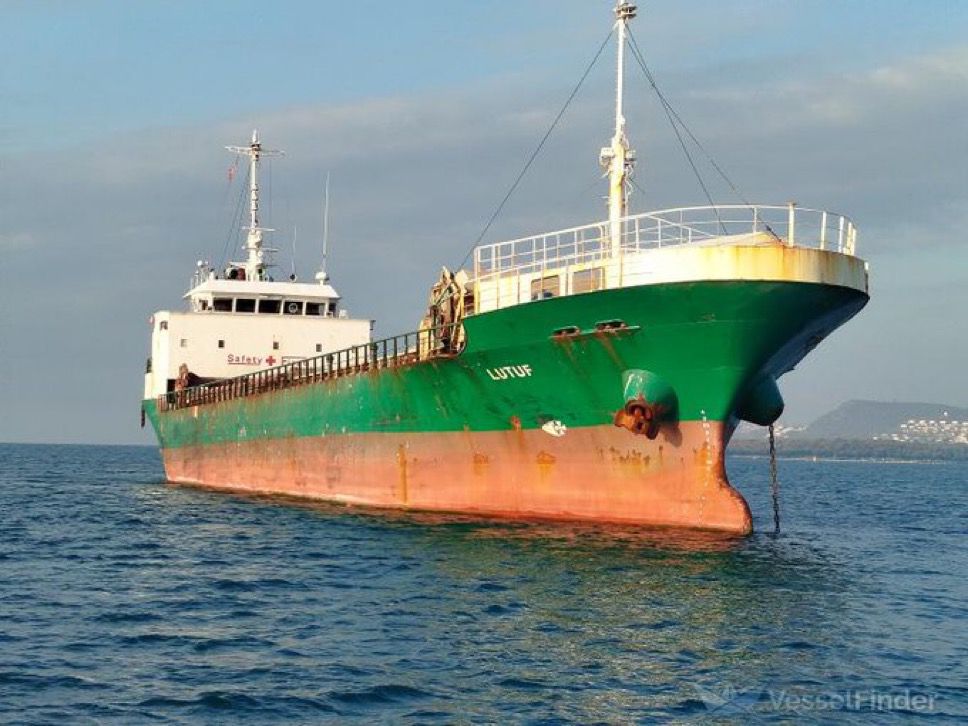
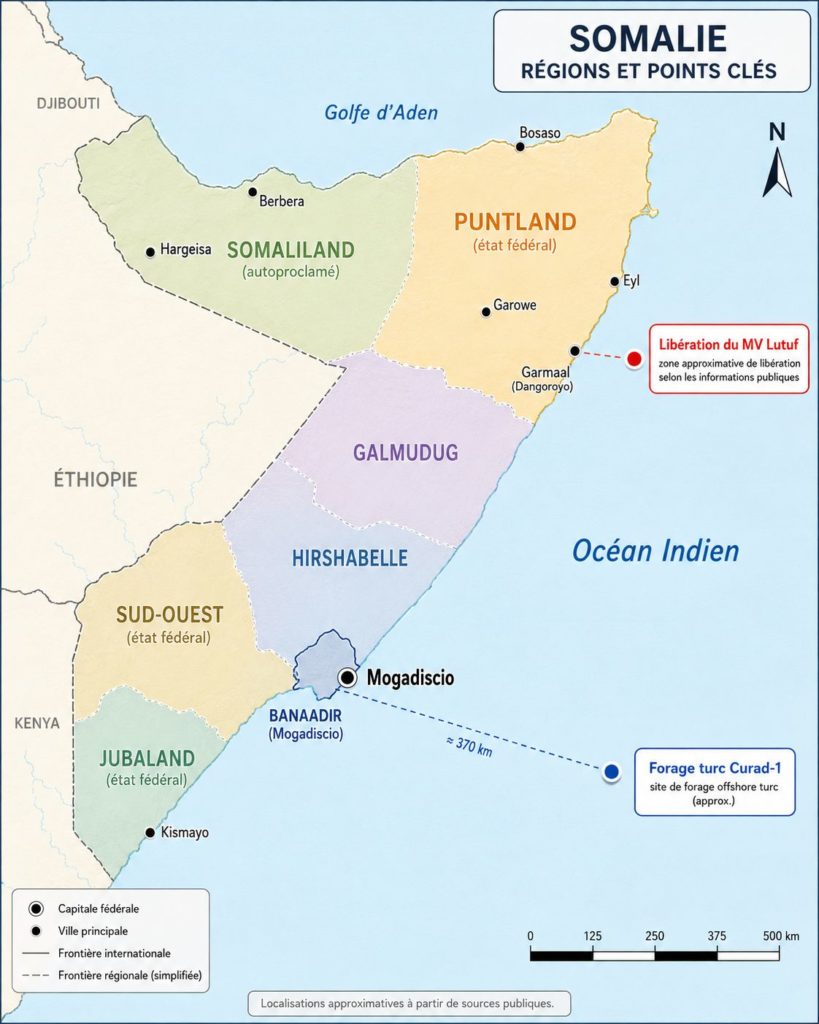
The cargo ship MV Lutuf, seized by pirates off Puntland on 17 August, has been freed after a 12-day crisis. Mogadishu says a joint operation with the Turkish navy killed 14 pirates and destroyed four boats. Puntland disputes this account and maintains that a ransom was paid, though it has so far produced no verifiable evidence. Beyond this battle of narratives, the affair reveals a more significant reality: Ankara is no longer content merely to train the Somali army. Turkey is now directly involved in securing the waters where it is also pursuing its own oil and gas ambitions.
The Cameroonian-flagged cargo ship had been seized on 17 August by eight armed men a few miles off the coast of Puntland, in north-eastern Somalia. The pirates then steered it towards the Nugaal region, according to initial information released by the maritime authorities and the Associated Press.
Twelve days later, the Somali federal government announced that the ship had been freed. According to the Ministry of Defence in Mogadishu, the Turkish navy and the Somali armed forces conducted a ten-day operation in which 14 pirates were reportedly killed and four of their boats destroyed. Military pressure is said to have ultimately forced the remaining attackers to abandon the vessel. A local elder confirmed to the Associated Press that the ship and its crew had been freed. But the story may be less straightforward.
Mogadishu and Puntland tell two different stories of the release
Within hours of Mogadishu’s announcement, Puntland’s regional government publicly disputed its account of the rescue operation. This clash of narratives comes against the backdrop of a far deeper political rift. Since the constitutional reforms adopted in Mogadishu in 2024, Puntland has refused to recognise the authority of the federal government in its current form and is demanding a constitutional settlement negotiated with the federal member states.
Tensions escalated further in August 2026: after heavy fighting, Puntland forces seized a base in Galkayo held by units aligned with the federal government, then took control of other installations. The battle of narratives over the Lutuf is therefore also an episode in the confrontation between Garowe and Mogadishu. Puntland’s Ministry of Security and Disarmament, Demobilisation and Reintegration (DDR) maintains that no Turkish-Somali military intervention directly freed the Lutuf. According to the ministry, the vessel was released after the payment of a ransom, facilitated by Somali and Turkish officials. Puntland says it monitored telephone communications between federal officials and the kidnappers, but has produced no public evidence that would allow this claim to be verified.
A few days earlier, Somali media had reported a ransom demand of around $2 million. The demand had not been officially confirmed, and at the time there was nothing to establish that any payment had been agreed. Established facts must therefore be distinguished from competing accounts. The ship and its crew have indeed been released. Turkish military pressure around the vessel before its release is also documented. But it remains unclear whether that pressure directly prompted the captors to leave or whether a financial arrangement was struck in parallel. This uncertainty does not detract from the main lesson of the affair.
What Turkey’s operation to free the ship reveals
For more than a decade, Turkey has methodically built up its presence in Somalia. Since 2017 it has operated TURKSOM there, one of its main military facilities abroad, where it trains Somali soldiers and police officers. In February 2024, Ankara and Mogadishu went a step further with a defence and economic cooperation agreement providing, among other things, for Turkish assistance in protecting Somalia’s territorial waters and developing its maritime capabilities. The Lutuf affair has given that agreement operational expression.
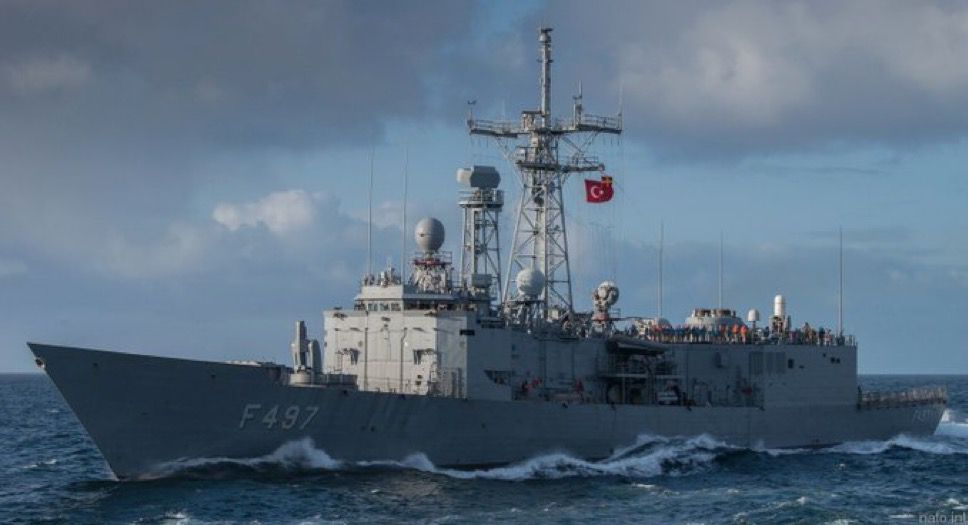
Turkey’s deployment has since changed in scale. In spring 2026, Ankara confirmed the deployment to Somalia of three F-16s, along with T129 ATAK attack helicopters and AS-532 Cougar transport helicopters. At sea, a Turkish naval group permanently escorts and protects the drillship Çağrı Bey and its support vessels. In July, this mission was carried out by, among others, TCG Göksu, TCG Gelibolu and TCG Bartın. Su Altı Taarruz (SAT) commandos, the Turkish navy’s special forces, have also been assigned directly to protecting the drilling operations. Turkey’s presence is therefore no longer merely a training mission: it now combines combat aircraft, naval assets and special forces.
Even before the cargo ship was freed, these assets had been deployed around the area where the pirates were holding it. Strikes had also been reported nearby, although it was not possible at the time to establish with certainty who had carried them out. The ship’s cargo probably explains the scale of the mobilisation.
A Somali source quoted by the Associated Press said the Lutuf was carrying Turkish weapons as well as communications and satellite equipment intended for the Turkish military facility in Mogadishu. The crew numbered ten: six Indians, one Turk, one Georgian and two Serbian security guards. Ankara has not publicly disclosed these details. In other words, for Turkey, this was not simply a cargo ship that had fallen victim to piracy.
Behind maritime security, hydrocarbons
The energy dimension gives the episode a wider strategic significance. While the Turkish navy was intervening around the Lutuf, Turkey was pressing ahead, a few hundred kilometres away, with its first deep-water oil and gas drilling campaign conducted abroad. The director general of the Somali Petroleum Authority, Abdulkadir Adan, said on 28 August that the Turkish drilling off Somalia had already reached around 3,000 metres and was progressing quickly enough for the operation to be completed by the end of September, roughly a month ahead of schedule.
Ankara makes no secret of its ambitions. The Turkish Energy Minister, Alparslan Bayraktar, had described the Curad-1 well as potentially “transformative” for the whole region. The drillship Çağrı Bey is conducting the operation in an area where the water depth reaches around 3,480 metres, before several further kilometres of drilling beneath the seabed. This changes how the maritime security agreement should be read.
Turkey is officially helping Somalia protect its coastline against piracy, illegal fishing and trafficking. But it is simultaneously becoming an economic player with a direct interest in securing those very same waters. Security and energy are thus beginning to converge.
Nor is the Turkish national oil company (TPAO) alone on this oil frontier. Official Somali investment documents list seven offshore production-sharing agreements awarded to Coastline Exploration and three blocks held by Liberty Petroleum through its affiliates, including PetroQuest Africa-I. In Somaliland, which lies beyond Mogadishu’s authority, Genel Energy holds 51% of block SL10B13 and is preparing to drill the Toosan-1 exploration well.
Somalia remains a largely unexplored oil frontier. That is precisely what gives the Turkish set-up its added value: Ankara is not merely protecting an ongoing operation, but an early foothold in a basin that other companies are also beginning to test.
A navy to protect a sphere of interests
This convergence of economic interests and military means is nothing unusual in the history of maritime powers. As a state develops economic interests overseas, protecting its citizens, ships, facilities and supply routes becomes a natural function of its defence policy. What is new lies elsewhere: Turkey is acquiring this capability far from its own shores.
On 28 August, the Turkish agency TIKA announced that it had refurbished two patrol boats for the Somali navy and coastguard to strengthen surveillance of the country’s territorial waters. The agency explicitly stated that these assets were also intended to help support and protect Turkish interests linked to activities conducted in Somali waters. The picture is becoming coherent. A military base in Mogadishu. Somali forces trained by Ankara. A maritime security agreement. Turkish ships and drones. An offshore drilling campaign. And an intervention involving a vessel hijacked by pirates. Turkey is gradually building an integrated maritime presence in the Horn of Africa.
Ankara is not, however, operating in a strategic vacuum. Somalia hosts AUSSOM contingents, supplied by countries including Uganda, Burundi, Kenya, Egypt, Djibouti and Ethiopia. At the same time, the United States is pursuing a sustained air campaign against Al-Shabaab and Islamic State, while the United Arab Emirates maintains close security and economic ties with Puntland and Jubaland.
The United Arab Emirates occupies a special place in this game. For several years Abu Dhabi has maintained close security cooperation with Puntland, particularly around Bosaso, where the United Arab Emirates (UAE) has supported and trained the Puntland Maritime Police Force. On top of this relationship come port and logistics interests. This substantial external support helps to strengthen Puntland’s room for manoeuvre vis-à-vis Mogadishu.
What sets Turkey apart is the combination of these instruments within a single set-up: a permanent base, training of local forces, combat aircraft, a naval group, special forces and the direct protection of an energy asset. It is this combination that makes the Turkish presence a tool of power projection rather than mere military cooperation.
Bab el-Mandeb, the chokepoint on Turkey’s sea lines of communication
The Somali deployment also sheds light on the importance Turkey attaches to freedom of movement in the Red Sea. For its warships, its logistics flows and its merchant vessels able to use Suez, the shortest route to Turkey follows a continuous axis: Mogadishu → Gulf of Aden → Bab el-Mandeb → Red Sea → Suez Canal → Mediterranean → Turkey. This axis is a genuine maritime line of communication — a Sea Line of Communication (SLOC). It links TURKSOM and the Somali approaches to the Mediterranean, enables equipment to be shipped and supports the Turkish naval presence in the western Indian Ocean.
Within this architecture, Bab el-Mandeb is the lock. A lasting closure of the strait, or a threat forcing Turkish ships to sail around Africa, would greatly lengthen transits and complicate logistical continuity between Somalia and Turkey. For Ankara, freedom of navigation in the Red Sea is therefore no longer merely a diplomatic principle: it is becoming a direct military interest. Should Curad-1 lead to a commercial discovery, this logic will be reinforced further. The Turkish navy would then no longer be protecting only an alliance, personnel or ships: it would be helping to secure a maritime chain tied to energy interests of its own.
A foothold that extends beyond Somalia
Ultimately, the stakes go beyond the fight against piracy. In the north-west, Somaliland and the port of Berbera occupy a strategic position on the Gulf of Aden. More broadly, the Horn of Africa has become an arena of competition between regional and external powers, while ports, bases, shipping lanes and energy prospects are increasingly intertwined. In this context, the release of the Lutuf is perhaps less the epilogue to an act of piracy than a visible demonstration of a Turkish maritime posture capable of linking military action, the protection of sea routes and economic interests.
One question remains, and it is far from trivial. Were 14 pirates really killed in a military operation, as Mogadishu claims, or did the hijackers leave after a ransom was paid, as Puntland insists? The answer will say a great deal about how effective the operation really was. But it will not change the essential point: Turkey has a military presence on a shipping route on which it is, at the same time, becoming one of the energy players.
In the new strategic geography linking the Horn of Africa, the Bab el-Mandeb, Suez and the Mediterranean, this development probably deserves more attention than the fate of the Lutuf alone.
Read more in La Tribune des Nations
After Hormuz, the Bab el-Mandeb: the new front in the energy war
After Hormuz and the Bab el-Mandeb, Somali piracy reopens a third maritime fault line
Mecca Agreement: a new defence alliance redraws the Middle East
The United Arab Emirates: the quest for strategic autonomy
Sources
Reuters — Turkey to provide maritime security support to Somalia, 22 February 2024
Turkish Ministry of Energy — details of the Curad-1 offshore well in Somalia
Turkish Ministry of Energy — first deep-water drilling campaign abroad, April 2026
Anadolu Agency — Somali Petroleum Authority: drilling reaches around 3,000 metres, 28 August 2026
Anadolu Agency — TIKA returns two Somali patrol boats to service, 28 August 2026
Hiiraan Online — Puntland says ransom was paid for MV Lutuf, 29 August 2026
Janes — Türkiye confirms aircraft deployment to Somalia, April 2026
Anadolu Agency — Turkish naval vessels escort drilling fleet off Somalia, 21 July 2026
Anadolu Agency — SAT commandos assigned to protect the Çağrı Bey, 18 April 2026
Al Jazeera / AFP — Puntland forces seize government-held camp in Galkayo, 5 August 2026
Somalia O&G Investor Guidelines — allocation of offshore blocks, February 2025
Genel Energy — Somaliland, block SL10B13 and the Toosan-1 project
Uganda Ministry of Defence — troop-contributing countries to AUSSOM, July 2026
U.S. AFRICOM — list of strikes in Somalia in 2026
Reuters — Puntland and Jubaland maintain ties with the UAE despite Mogadishu, 13 January 2026
UAE Ministry of Foreign Affairs — security cooperation in Somalia and training of the PMPF in Bosaso
Translated from French. The French original prevails.