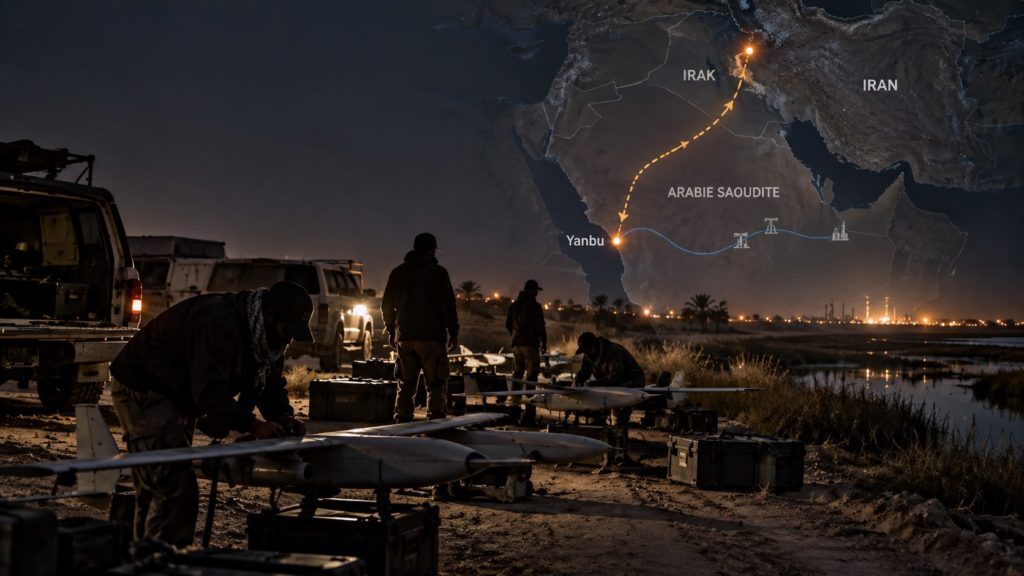
Illustration produced with AI.
More than fifteen explosive drones were reportedly prepared in Iraq’s Maysan province by operatives who had entered clandestinely from Iran, with the help of local intermediaries, before being launched against Saudi Arabia’s East–West pipeline, after which the operatives returned to Iran through unofficial crossings. That is the scenario outlined by the preliminary findings of an Iraqi investigation reported by “The New Arab”. If they are confirmed, the attack of 10 September would no longer be merely the work of a pro-Iranian militia: it would reveal a compartmentalised operation combining cross-border infiltration, local cells, Houthi coordination and plausible deniability, in the very heart of Iraqi territory.
The attack had already caused a strategic shock. During the night of 10 to 11 September, several drones launched from Iraqi territory struck Saudi Arabia’s East–West oil network, damaging three pumping stations and forcing Riyadh to shut down an infrastructure that had become essential for bypassing the Strait of Hormuz. Baghdad quickly acknowledged that the aircraft had been launched from Maysan province, on the Iranian border. Ali al-Zaïdi’s government dismissed security officials, temporarily closed several crossing points with Iran and opened an investigation. Riyadh, for its part, agreed to defer any retaliation in order to give the Iraqi government the opportunity to identify those responsible and prevent any repeat.
Two weeks on, the investigation points to an operation far more sophisticated than a simple drone strike carried out by a local faction.
A team from Iran, a launch base in Iraq
According to three Iraqi officials quoted on 28 September by “The New Arab”, more than fifteen explosive-laden drones were reportedly launched simultaneously from the Al-Tayyib area, in the south of Maysan province. This border area lies in the immediate vicinity of Iran, amid marshland, back tracks and smuggling networks where controlling the border remains difficult.
The most significant point, however, is not the launch site. Investigators say the operators themselves had allegedly entered Iraq clandestinely from Iran several days before the attack. They are said to have made their way to Al-Tayyib, prepared the drones on site and received assistance from Iraqi cells, before leaving the country after the operation and returning to Iran by routes away from the official border crossings.
A senior Iraqi military official says the investigation is based on evidence gathered on the ground and by the intelligence services: the location of the launch sites, the movements of the men involved and the routes taken by the equipment. At this stage, no public source makes it possible to establish that the Iraqi investigators received American, Israeli or Jordanian support. The final report, however, has not yet been made public. The most detailed information therefore rests on anonymous officials with access to the investigation and should be presented as preliminary findings, not as a definitive judgement by the Iraqi state.
An operation designed to leave as few signatures as possible
The pattern described by investigators looks more like a covert operation than an action claimed by a militia. The operatives are said not merely to have supplied drones to an Iraqi group: they allegedly crossed the border themselves, temporarily built up a strike capability on Iraqi soil, used local intermediaries for logistics and movement, and then exfiltrated the team after the launch.
This modus operandi reduces the number of intermediaries with knowledge of the plan as a whole. It makes it possible to use Iraq’s geography to shorten the drones’ flight path towards Saudi Arabia. Above all, it complicates immediate political attribution: the aircraft take off from Iraq, but the alleged organisers are not necessarily part of the official chain of command of a major Iraqi faction.
According to “The New Arab”, the Iraqi group that helped the operatives is reportedly linked to a well-known armed faction and is said to have coordinated with Houthi agents present in Iraq. However, one of the officials interviewed maintains that the faction’s leadership was not informed of the attack and took part in neither its planning nor its execution. If confirmed, this would suggest a system of compartmentalised cells able to borrow personnel, networks and infrastructure from the major organisations without officially involving their leadership.
The return of parallel networks
This hypothesis is not new. As early as 13 September, “The New Region”, citing three commanders of pro-Iranian factions, reported the existence in Iraq of a small armed network under the authority of a senior officer of the Islamic Revolutionary Guard Corps, Hamed Abdollahi, operating outside the usual chains of command of the major militias.
These sources had already attributed several covert operations to this network, including the attack on the East–West pipeline. That attribution remains separate from the Iraqi investigation reported on 28 September: “The New Arab” does not name Abdollahi in its preliminary findings. It would therefore be unwise to conflate the two accounts. Their convergence on one point nonetheless deserves attention: the use of small cells able to operate alongside the traditional structures of the Popular Mobilisation and thus preserve a margin of deniability for the main factions.
Hamed Abdollahi is not a name unknown to Western intelligence services. The US Treasury sanctioned him as early as 2011, describing him as a senior Quds Force official who had coordinated aspects of the plot to assassinate the Saudi ambassador Adel al-Jubeir in the United States. This obviously does not prove his involvement in the September 2026 attack, but it explains why his name now draws attention whenever Iranian covert networks in Iraq are discussed.
Why are the Houthis present in Iraq?
The other new element concerns the Houthis. Their presence in Iraq is not, however, recent. The United Nations Panel of Experts on Yemen has documented the activities of Ahmed al-Sharafi, known as Abu Idris, the Houthi representative in Iraq: purchases of equipment, the organisation of training with Iraqi armed groups, movements of Houthi fighters and leaders, the search for funding and the development of relations with faction leaders. The report mentions offices in Baghdad and Najaf. For the Houthis, Iraq thus serves as a platform for liaison with the militias of the Iranian axis, for logistical support and for regional coordination, well beyond their Yemeni base.
This foothold also enables military cooperation at a distance. As early as 2024, Abdelmalek al-Houthi publicly announced coordination with Iraqi factions for certain operations. UN experts have identified training mechanisms, military and financial assistance, and signs of operational coordination between the components of the “axis of resistance”. In this context, the presence of Houthi operatives in an operation prepared from Iraq would be entirely consistent; it would nonetheless mark a further step in the use of Iraqi territory against Saudi Arabia.
According to “The New Arab”, Baghdad is now reportedly considering asking the Houthi representative office to leave Iraq. This option would, however, run up against opposition from components of the Shiite Coordination Framework. If implemented, it would send a far stronger political signal than a mere temporary closure of border crossings.
Baghdad passes investigation findings to Tehran
Above all, the investigation places the Iraqi government in an extremely delicate position. The authorities are reported to have passed information to Iran on the identities of those involved, their external links and their movements between the two countries. At the time “The New Arab” published its investigation, Tehran had not responded, according to one of the sources cited.
Iraqi intelligence services are also reportedly searching for the facilitators who helped the operatives enter the country, move around Maysan and then return to Iran. The challenge is therefore no longer simply to seize launchers or identify a militia: it is to piece together a clandestine support network embedded within Iraqi territory.
The affair comes at the worst possible moment for Prime Minister Ali al-Zaidi. The disarmament timetable has, however, changed: 30 September now marks first and foremost the end of the international coalition’s mission, rather than the completion of the weapons handover. Zaidi has put forward a new plan providing for a 90-day halt to attacks after the coalition’s departure, followed by a gradual handover of weapons over six months, with the aim of completing the process on 30 June 2027. The attack on the Saudi oil pipeline therefore exposes a problem that may well outlast this timetable: how do you disarm or control an organisation that may not officially exist as such?
The intelligence challenge: controlling weapons is no longer enough
If the investigators’ scenario is confirmed, Baghdad will not be able to respond solely through a political agreement with the leaders of the major militias. A small, temporary and compartmentalised cell can use the same social, religious, logistical and military networks without appearing on any official organisational chart. Weapons control then becomes a matter of counter-intelligence and domestic intelligence.
Unofficial borders must be monitored, smuggling routes identified, transfers of components tracked, staging areas located and facilitators mapped, and orders issued by faction leaderships must be distinguished from operations carried out by elements that escape their control or circumvent them. This is far more complex than negotiating the handover of a missile depot or the administrative integration of a brigade.
The paradox is that the Iraqi state has substantial security services, yet some of the groups it is supposed to monitor are themselves embedded in its institutions. The Popular Mobilisation Forces enjoy official status, while certain factions retain their own chains of loyalty and capabilities, including political and military ties to Tehran. A clandestine network able to recruit inside several of these structures can exploit precisely the grey areas between state, party, militia and foreign intelligence service.
Why strike the Petroline?
Finally, the target gives the operation its full strategic significance. The East–West network links the fields and facilities of eastern Saudi Arabia to the port of Yanbu, on the Red Sea. Since the war severely disrupted Hormuz, it has been one of the main routes allowing Riyadh to export its oil without passing through the strait. The attack damaged three of the eleven pumping stations. The pipeline was able to restart on 22 September, but at reduced capacity; according to Reuters, a full return to around four million barrels per day could take six to eight weeks. The strike therefore did not merely have a military or symbolic effect: it temporarily knocked out part of Saudi Arabia’s solution to the Hormuz problem.
The choice of the Petroline thus links three theatres that had seemed separate. Iran is exerting pressure on Hormuz. The Houthis are threatening Bab el-Mandeb and Yanbu. Between the two, Iraq can provide operational depth for striking the overland infrastructure that makes it possible precisely to bypass the first strait and supply the Red Sea.
Iraq: operational depth or sovereign state?
This is where the affair goes beyond the attack itself. If foreign operatives were able to enter from Iran, prepare more than fifteen drones in Maysan, draw on local logistical support, strike a strategic Saudi infrastructure site and then leave again, the question facing Baghdad is one of its operational sovereignty.
Saudi Arabia has so far given the Iraqi government some room for manoeuvre. It agreed not to respond immediately and gave Ali al-Zaidi time to act. That restraint is probably not unlimited. A further attack launched from Iraqi territory would confront Riyadh with a far harder choice between leaving Baghdad to deal with the problem and striking the networks responsible itself.
For Tehran, by contrast, the possible use of compartmentalised cells offers an advantage: keeping up pressure on Gulf infrastructure while preventing any given operation from being immediately attributed to a major Iraqi militia or to an identifiable Iranian chain of command. For Baghdad, that is precisely the danger. Iraq risks becoming not merely a territory where foreign influences clash, but a clandestine platform from which outside actors wage their regional war.
Disarmament pushed back to 2027, but the problem is immediate
Postponing the timetable does not make the problem exposed by Maysan go away. 30 September now marks the end of the international coalition’s mission; the government is aiming for 30 June 2027 to complete the transfer of the factions’ weapons to the state. In between, an initial 90-day period is meant to see the armed groups halt their attacks, before a phase in which their arsenals are gradually handed over.
But the Petroline affair shows that the issue goes beyond the timetable for handing over arsenals. The questions are who gives the orders, who crosses the border, who supplies the components, who chooses the targets and who organises the exfiltration. In other words, the real issue is no longer simply the monopoly on weapons. It is the monopoly on the decision to wage war from Iraqi territory.
If the preliminary findings are confirmed, the attack on the Petroline will thus have exposed a vulnerability deeper than that of a Saudi pipeline: the ability of a clandestine regional network to use Iraq as an intermediate theatre between Iran, the Houthis and the Gulf monarchies. Baghdad will then have to show that it can prevent a repeat of an operation whose chief strength lay precisely in its ability to remain unseen.
The clandestine use of Iraqi territory by a foreign power is, moreover, not without precedent in this war. At the start of the conflict, Israel set up at least one forward military outpost in Iraq’s western desert, housing special forces and providing logistical support to its air force. Search and rescue teams had been prepositioned there, notably to recover any Israeli pilots shot down over Iran. When Iraqi troops tried to approach the site in early March, they came under fire: one soldier was killed and two others were wounded. A few months later, the Maysan affair thus reveals, from the other side, the same fundamental vulnerability: powers engaged in the war against Iran can use Iraqi territory as operational depth without Baghdad’s consent.
Further reading from La Tribune des Nations
Iraq: from disarmament to “weapons management”, the compromise taking shape with the militias
Iraq: Jurf al-Sakhar, the forbidden territory where Baghdad wants to restore its sovereignty
From the Gulf to Yemen: the US-Iran war reawakens the Sunni-Shia divide
After Hormuz, Bab el-Mandeb: the new front in the energy war
External links / documentation
Reuters — Saudi Arabia restarts East-West oil pipeline — 22 September 2026
U.S. Treasury — Hamed Abdollahi and the plot to assassinate Adel al-Jubeir — 11 October 2011
United Nations — Panel of Experts on Yemen, report S/2024/731
Associated Press — Iraq races to contain fallout after attack on Saudi pipeline — 12 September 2026
United Nations — Panel of Experts on Yemen: Ahmed al-Sharafi’s activities in Iraq, offices, procurement, training and coordination — S/2024/731
The New Arab — Iraq extends armed groups disarmament deadline to June 2027 — 22 September 2026
Associated Press — Officials confirm temporary Israeli staging site in western Iraq during the war — 2026
Wall Street Journal — Israel built and defended a secret Iran war base in Iraq — 2026
Translated from French. The French original prevails.