By Gaston Côté, President
Cercle Canadien Francophone d’Analyse Géostratégique

Since the start of his second term, President Trump has launched attack after attack on Canada, calling into question decades of close cooperation between the two countries. From accusations of a porous border to the fentanyl crisis and military spending deemed insufficient, the US president’s claims appear driven more by a strategy of destabilisation than by established facts. An analysis of a relationship in turmoil.
Since the advent of President Trump’s second term, he has embarked on an all-out battle against Canada. His claims are rather tenuous, while also pointing to a complete lack of understanding of the relationship between the two countries.
Among his claims, he cites Canada as having an overly porous border that allows illegal immigrants to enter the United States; yet the history of recent years tends to prove exactly the opposite. Indeed, the “Roxham Road” episode is undoubtedly the most convincing example that border porosity is an American problem. One need only retrace the route of these immigrants who arrived in the United States, made their way to the town of Plattsburgh and became passengers of a cohort of American smugglers who took them to the Canada–US border and let them enter Canadian territory illegally. The American smugglers acted with complete impunity in the face of the US police authorities.
The fentanyl crisis is another of President Trump’s claims: he accuses Canada and Mexico of not doing enough to prevent the production of this devastating drug and its entry onto American soil. The quantities coming from the two countries singled out in the President’s claim are certainly open to debate, but the fact remains that if this drug enters the United States, it is because there is also a network of dealers on American territory, which represents a logical target on which the US authorities should be focusing. It is worth noting that the fentanyl crisis also affects Canadians, who must likewise combat this scourge.
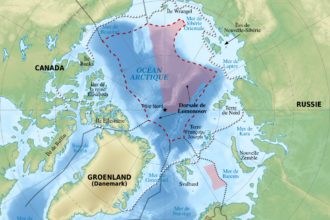
Another of the President’s claims concerns the fact that Canada is lagging behind on military spending. This is no doubt the only truthful argument President Trump can put forward, since Canada has been slow to reach the NATO target of two per cent of GDP. Beyond NATO, a new concern has recently appeared on the radar screen of American strategists, as the United States has discovered the appeal of the Far North; this new attraction stems from the presence of mineral and gas resources, but also from the interest shown in this northern region by other countries perceived as adversaries, such as Russia and China.
Another questionable claim: President Trump asserts that the United States subsidises Canada to the tune of some US$200 billion. It is hard to make sense of this claim without examining the trade balance between the two countries; Canada exports around $412 billion a year to the United States, with a trade balance of around $63 billion in Canada’s favour. That is a far cry from the $200 billion cited by President Trump. It should be stressed that the annual US trade deficit stands at around a trillion dollars, which puts Canada’s position in the equation of the United States’ trade deficit into perspective.
As far as Canada–US relations are concerned, it is clear that the President’s claims rest on arguments that are, if not non-existent, then at least very weak. These claims may well be part of a strategy of chaos aimed at destabilising Canadian politicians so as to make them accept trade terms more favourable to the US economy. What is particularly troubling about this political farce is that President Trump is resolutely turning his back on all his previous commitments, such as those set out in his presidential strategy at the outset of his first term.
Perhaps one should read The Art of the Deal (Donald J. Trump) alongside La théorie du chaos (Henri Poincaré) to shed light on President Trump’s current strategy…
Translated from French. The French original prevails.