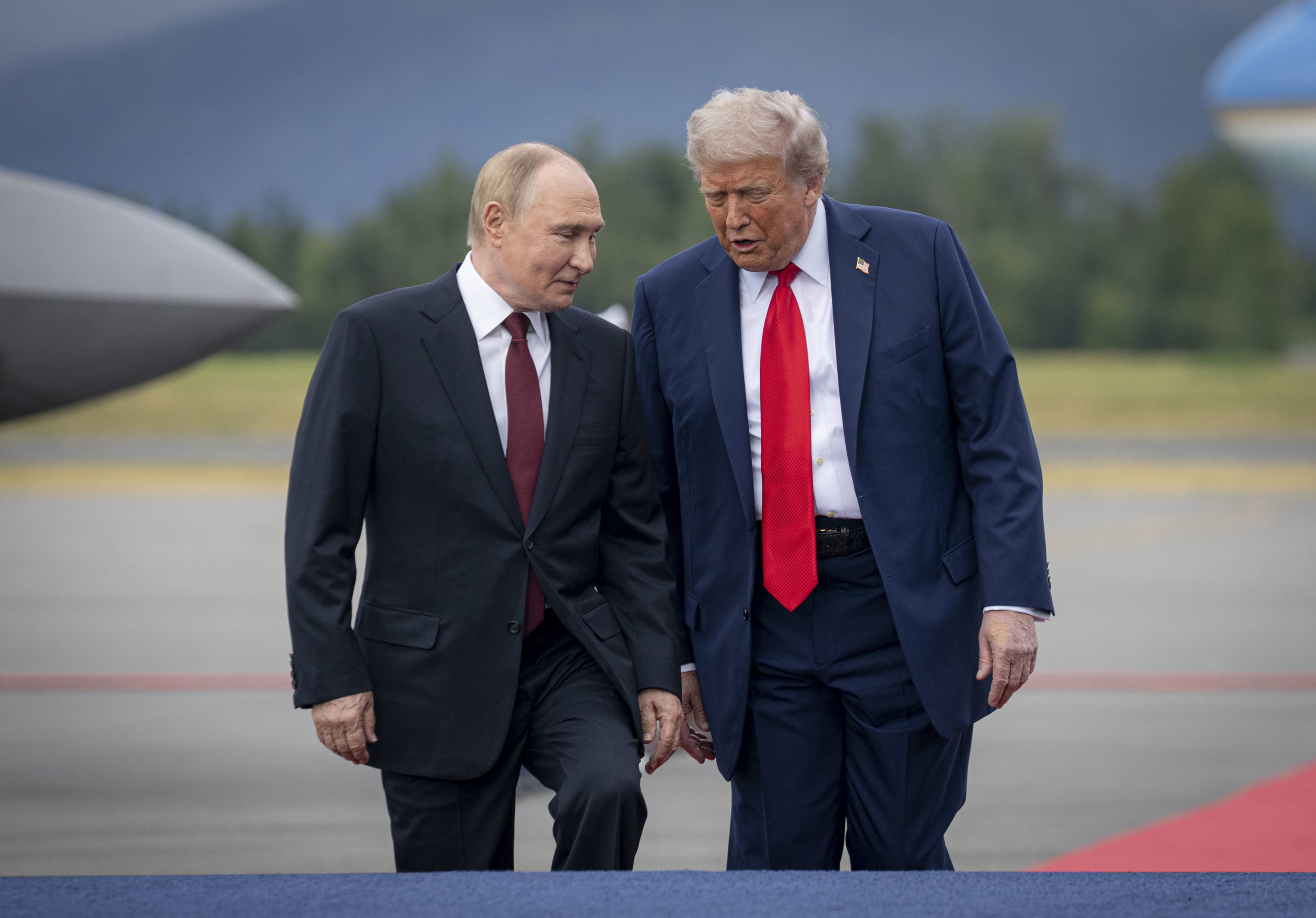
The US administration under Donald Trump and the Kremlin are stepping up their interference, backing far-right parties in Europe while threatening or attacking regimes they dislike in their own neighbourhoods.
While the master of the Kremlin seeks to destabilise public opinion in a country to the benefit of the far-right candidates he supports, the US president backs European nationalists and uses his economic and military might to threaten and blackmail South American heads of state and voters.
Their goal is the same: to dismantle the European Union by promoting the nationalist parties most hostile to Brussels, and to create a zone of influence and control in their own neighbourhoods. But the means deployed by the two regimes differ in part. For years now, Vladimir Putin has used troll farms to sway elections in European countries. They produce thousands of messages and fake news stories on social media aimed at destabilising a country by pressing on its ills to polarise its internal divisions still further. Putin also openly supports anti-European nationalist parties.
Russian interference in Europe
Moldova and Georgia, both candidates for EU membership, are the most recent examples of Russian interference in elections. In October 2024, parliamentary elections were held in both countries, pitting pro-European candidates against pro-Russian ones. In Moldova, the Kremlin is reported to have spent the equivalent of €100 million on social media disinformation campaigns and on buying nearly 130,000 votes. To no avail: the pro-European candidate narrowly won a majority of the votes.
In Georgia, although it presents itself as pro-European, the Georgian Dream party of billionaire Bidzina Ivanishvili, who lived in Russia for some twenty years, follows a policy dictated by the Kremlin (the foreign agents law, for example). It won the parliamentary elections, whose fairness was called into question by the then pro-European President, Salome Zourabichvili, who denounced “Russian interference” in her country. It is worth recalling that, following the 2008 conflict, Russia has since set up military bases in the so-called “separatist” regions of Abkhazia in the north and South Ossetia.
Only last year, in Romania, a candidate credited with 1% of the vote in early polls, Călin Georgescu, won the first round of the presidential election, to the surprise of observers. He had campaigned without a party or backing. The vote was annulled by the Constitutional Court after a disinformation campaign on TikTok in favour of the far-right candidate was identified.
These acts were directly orchestrated by the Kremlin as part of a strategy to destabilise the country.
According to the Romanian intelligence services, more than 100 influencers, with a combined 8 million followers, were mobilised to promote the image of Calin Georgescu. Many other Russian disinformation or influence campaigns conducted via social media during past elections could be cited. A British parliamentary committee, for instance, recently denounced Russian interference in favour of “Leave” in the 2016 referendum on leaving the European Union. France, Germany and the United States have also been targeted during decisive elections.
Another tool in the hybrid war Russia is waging in Europe is the deployment of commandos carrying out destabilisation operations on a country’s territory. Examples include the “red hands at the Shoah Memorial”, the “blue Stars of David tagged in Paris” and the “pigs’ heads left outside mosques and prayer halls in Paris and its suburbs”. These operations aimed to shatter national cohesion in France by making them appear to be home-grown actions against Jews or Muslims. They are methods inherited from Soviet agitprop and the KGB, which Vladimir Putin knows perfectly from professional experience.
It is now known that these acts were directly orchestrated by the Kremlin as part of a strategy to destabilise the country. The French intelligence services obtained an internal memo from the Russian presidency approving a plan to target the Jewish and Muslim communities in order to fracture society and incite civil war, writes the French online-only outlet Mediapart. The Global Risks Report 2024 by the World Economic Forum in Davos, Switzerland, ranked misinformation and disinformation as the major threats of the years ahead. That time has come.
Donald Trump’s blackmail
In Brazil, in response to the indictment of the former far-right president Jair Bolsonaro, who attempted a coup, Donald Trump decreed that an unprecedented 50 % tariff would be imposed on Brazilian goods. The US administration had also imposed sanctions on Judge Alexandre de Moraes, Jair Bolsonaro’s accuser and bête noire. But the response from Luiz Inácio Lula da Silva ultimately made him back down.
Donald Trump is acting even more directly to support far-right populist candidates in South America. People no longer speak of the Monroe Doctrine but of the Donroe Doctrine to describe the United States’ backyard, which Donald Trump calls the American hemisphere. In this “hemisphere” there are aligned countries, with hard-right, far-right or populist governments, such as El Salvador, Guatemala, Panama and Argentina, which enjoy favourable tariffs… and then there are the others.
Ahead of October’s midterm elections, the first electoral test for Argentina’s president, Javier Milei, elected in 2023, a currency swap worth US$20 billion conveniently helped to halt the slide of the peso, the Argentine economy’s chief concern. During the election campaign, the Trump administration had made itself clear: if the libertarian Milei won, he would have American support and aid; if his opponents prevailed, they would get nothing. Milei won the legislative elections hands down. The 47th president of the United States applies this kind of blackmail even more directly to regimes that are not on his side and that do not suit him.
In Venezuela, Trump’s main target, the United States has declared an air exclusion zone in complete violation of the law
In Honduras, which elected its president at the end of November, Trump issued a warning: if Nasry Asfura “does not win the election, the United States will not waste its money.” In Nicaragua, US sanctions targeted President Manuel Ortega and those close to him as early as Trump’s first term. In Venezuela, Trump’s main target, the United States has, in complete breach of the law, declared a no-fly zone, a possible prelude to a blockade, massed naval forces off the Venezuelan coast and carried out arbitrary executions against boats allegedly involved in drug trafficking. President Trump himself also authorised CIA commando operations inside the country. Finally, he offered President Maduro the chance to be spirited out of his own country along with those close to him. Maduro refused.
Two backers for the AfD
It was in Germany that the two powers each acted separately on the electoral process, even ending up treading on each other’s toes. March’s parliamentary elections provided an opportunity for interference by both powers. Elon Musk, a supporter of the Trump presidency, hosted Alice Weidel, the leader of the Alternativ für Deutschland (AfD) party, during a live session on X and was welcomed at an AfD rally. US Vice-President JD Vance, after lecturing Europeans on abortion and freedom of expression, regretted that populist parties had not been invited to the Conference, citing the AfD in particular.
Meanwhile, strange acts of sabotage were attempting to discredit Germany’s economy minister, a member of the Grünen party (the German Greens). Car exhaust pipes were blocked with expanding foam, and stickers bearing the minister’s image and the slogan “Be greener” were stuck on the vehicles.
In addition, a replica of the “Storm -1526” operation in the United States churned out fabricated scandals in Germany on websites mimicking German media outlets. To cap this twofold interference, the Alternative für Deutschland (AfD) MEP Maximilian Krah was questioned by the US Federal Bureau of Investigation (FBI) over suspicions that he had received money from Kremlin agents!
Translated from French. The French original prevails.