By Professor El Hassane HZAINE
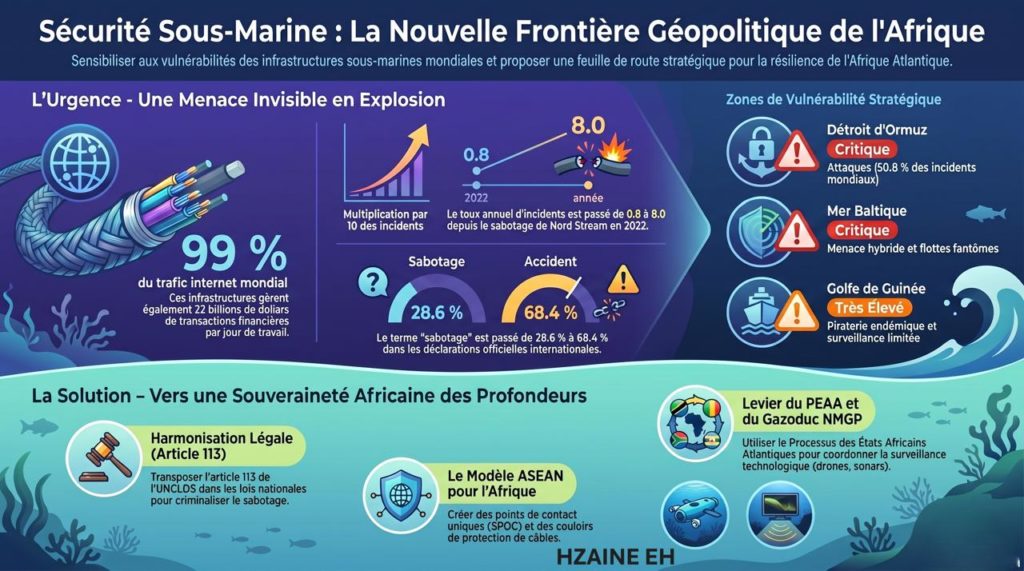
The silent backbone of the global economy, undersea infrastructure (data cables, gas pipelines, oil pipelines) carries more than 99% of internet traffic and $22 trillion in financial transactions every day (Lionel Yee, Singapore University Centre for International Law Conference 2025), while also forming the foundation of the energy transition towards green hydrogen and offshore wind.
Despite its critical importance, this infrastructure remains vulnerable not only to natural disasters and accidents, but also to deliberate sabotage, which is becoming increasingly frequent, such as the incidents recently seen on gas pipelines in the Baltic Sea and on undersea cables in the North Sea, not to mention the collateral damage to such infrastructure in the Arabian Gulf and in the Taiwan Strait.
These vital arteries suffer from a striking paradox, and from a “triple invisibility”: infrastructural, undersea and oceanic – invisible beneath the surface, forgotten in security strategies, relegated to the background of maritime policy (Bueger & Liebetrau, University of Copenhagen)
The “shadow war” (sabotage, espionage and hybrid threats) targeting undersea infrastructure is, to some extent, encouraged by the gaps in international law in this area.
The destruction of the Nord Stream gas pipelines in September 2022 served as a wake-up call. Before then, the undersea world was in a state of low intensity: 0.8 incidents a year, mostly accidental. Since then, the annual rate of incidents has jumped to 8. Hybrid warfare has descended into the depths, as NATO Secretary General Jens Stoltenberg declared: “The security of our critical undersea infrastructure has become an absolute priority for the Alliance.”
It should be stressed that the “shadow war” (sabotage, espionage and hybrid threats) targeting undersea infrastructure is, to some extent, encouraged by the loopholes in international law in this area, since the current rules, designed for states, struggle to apply to infrastructure that is often privately owned (consortia, multinationals) and, moreover, located on the high seas.
Atlantic Africa, with its planned 5,660-kilometre Nigeria-Morocco-Europe gas pipeline (NMGP), could be the next vulnerable frontier.
Legal provisions with strong geopolitical overtones
The protection of undersea cables and pipelines has its distant origins in the International Convention for the Protection of Submarine Telegraph Cables of 14 March 1884, and in the Geneva Conventions of 29 April 1958 on the High Seas and on the Continental Shelf respectively, which enshrined the freedom to lay such infrastructure.
Today, the United Nations Convention on the Law of the Sea (UNCLOS), adopted in 1982 and in force since 1994, is the principal legal framework for the protection of undersea infrastructure. As its preamble points out, it seeks to “govern all maritime spaces and their resources”.
Furthermore, under the law of armed conflict, sabotage in an exclusive economic zone, although it has the same consequences as an attack on national territory, remains difficult to classify as an “armed attack” within the meaning of the UN Charter, one that could justify invoking the right of self-defence.
Moreover, UNCLOS struggles to meet these challenges because of the exclusive jurisdiction of the flag state provided for in Article 113, which limits the ability of coastal states to act. Given that these treaties cannot be amended quickly, some experts have suggested using other, more widely ratified legal instruments, such as the International Convention for the Suppression of Terrorist Bombings, or reassessing the principle of objective territoriality so that injured states can exercise jurisdiction.
Ultimately, protecting these vital arteries requires a multidimensional approach that goes beyond the purely legal framework to include the physical strengthening of infrastructure, real-time technological surveillance and closer cooperation between governments, industry and experts. Likewise, the law should be adapted: extending the “reasonable” safety zones, left to the discretion of the coastal State, as far as possible without infringing either freedom of navigation or the “legitimate” rights of other States (consultation, impact assessment, notification) (Article 60 of UNCLOS), monitoring the seabed more closely and bringing States and private actors together in shared governance (Alexander Lott , Attacks against Europe’s Offshore Infrastructure within and beyond the Territorial Sea under Jus ad Bellum 2023).
-Article 113, which lies at the heart of the criminal framework, provides that “every State shall adopt the laws and regulations necessary to provide that the breaking or injury by a ship flying its flag or by a person subject to its jurisdiction of a submarine cable or pipeline, done wilfully or through culpable negligence, in such a manner as to be liable to interrupt or obstruct communications, shall be a punishable offence”. This article nevertheless remains largely untransposed into national legislation (UN Secretary-General).
This provision places three obligations on States: to legislate (adopt national laws), to criminalise (punish offenders) and to cooperate.
Other relevant provisions include Article 112, which guarantees the right of all States to lay cables and pipelines on the bed of the sea beyond the territorial sea; Article 114, which requires the owners of ships that have broken a cable to bear the cost of repairs if they acted wilfully or negligently; and Article 115, which provides an exemption for ships that break a cable while saving human lives.
According to several experts, UNCLOS suffers from three major limitations. The first is geographical. On the high seas, enforcement jurisdiction lies almost exclusively with the flag State. If a vessel flying a flag of convenience damages a cable or a gas pipeline, the coastal State can neither intercept it nor prosecute it. The second is temporal. UNCLOS applies in peacetime, but how it applies during armed conflict is uncertain (given the vagueness of Article 236). The third is technological. Drafted in the early 1980s, UNCLOS anticipated neither the explosion in data traffic nor the vulnerability of fibre-optic cables. As the executive secretary of the ICPC (International Cable Protection Committee) points out: “The provisions of UNCLOS date from a time when telegraph cables were the only undersea infrastructure. The world has changed; the convention has not.”
Mapping the vulnerable areas: what the figures reveal
Our analysis of some sixty incidents recorded between 2000 and April 2026 maps out underwater tensions. The Strait of Hormuz alone accounts for 50.8% of incidents – thirty recorded attacks and eleven deaths. The Red Sea comes next, with nine incidents, five deaths and the Houthis as the main actors. The Baltic Sea, with nine incidents, illustrates the threat posed by Russian shadow fleets.
The diplomatic framing of the incidents has shifted: the share of official statements describing them as “sabotage” has risen from 28.6% to 68.4%.
Not all seas, therefore, are equally exposed to the threat. The Baltic Sea and the Red Sea are rated at the critical level of vulnerability: a high density of incidents, a proven hybrid threat and little infrastructure redundancy. The Gulf of Guinea and the Strait of Malacca are rated very high: piracy is endemic there, and surveillance very limited. The North Sea and Morocco’s exclusive economic zone carry a risk that is mainly accidental, but real.
West Africa, for now, has experienced only natural incidents, in the form of underwater landslides in the Congo Canyon. The absence of incidents does not mean the absence of risk ; it may also reflect a still limited detection capacity, owing to the chronic inability of coastal states to monitor their own waters for lack of resources.
The Canaries–Morocco corridor stands out as an exception: thanks to coordinated dual surveillance by Morocco and Spain, the area enjoys effective coverage, as shown by recent interceptions of drugs and of illegal migration towards Morocco and the Canaries.
The battle of narratives over the incidents
According to qualitative data gathered mainly from Western sources (UKMTO, NATO and European media), Iran is said to be behind 51% of the undersea incidents recorded since 2000, mainly in the Strait of Hormuz and the Gulf. Russia is reportedly involved in 15% of cases, mostly in the Baltic Sea. It should be stressed, however, that these attributions rest largely on circumstantial evidence and have been consistently denied (some unconfirmed sources blame other belligerents in the Ukrainian conflict). The presumption of innocence therefore prevails as long as no international judicial body has, to date, confirmed or refuted these accusations.
A content analysis of 80 official statements and press releases (from 21 states and organisations) reveals five competing narratives ; behind every undersea incident lies a struggle to impose one’s own version of events :
✓ The position of condemnation is that of NATO. The day after Nord Stream, Denmark declared: “Denmark strongly condemns the deliberate sabotage of the Nord Stream pipelines. It is an unacceptable attack on European critical infrastructure.” NATO member states adopt this stance in 78% of their statements.
✓ The position of technical investigation commands the broadest consensus – 92.5% of statements call for an investigation. Finland, taking a pragmatic line, stated: “Finland is investigating the damage to the Balticconnector gas pipeline. Initial evidence suggests external impact. All options regarding the cause and attribution remain under consideration.” The EU High Representative for Foreign Affairs concurred: “A transparent international investigation is needed to shed light on these incidents.”
✓ The position of denial and defensiveness is that of Russia, whose rhetoric has remained unchanged since 2008: “The Russian Federation categorically rejects the unfounded accusations… We warn against the politicisation of the tragedy.”
✓ The position of legal neutrality is that of China. Its statement at the UN sums up its stance: “China advocates an international investigation based on objective evidence and opposes groundless accusations. All countries must respect the spirit of UNCLOS.” The United Nations Secretary-General called for “restraint and respect for international law”.
✓ The position of cooperation is that of the European Union: “The European Union condemns the sabotage. We call for a thorough international investigation and will strengthen EU mechanisms to protect critical undersea infrastructure.”
The polarisation between NATO and the Russian Federation is stark: NATO sees sabotage in 78% of cases. Russia never does. Conversely, Russia sees an accident in 75% of cases; NATO in only 11%. Being a NATO member makes it more than six times as likely that an incident will be described as sabotage. This is no longer a mere difference of interpretation. It is a war of narratives.
Sovereignty of the deep: which models for Africa?
The Association of Southeast Asian Nations (ASEAN) offers a model of maritime cooperation from which the PEAA can draw inspiration. With eight cross-border pipelines, more than 2,500 kilometres of submarine cables and a sea regularly beset by tensions, ASEAN has developed resilience mechanisms (SU Wai Mon Singapore 2025).
▪ First good practice: legislative harmonisation. ASEAN has adopted model provisions for the protection of cables, inspired by Article 113 of UNCLOS. Its Secretary-General stressed: “We have learnt that it is not enough to have isolated national laws. Regional harmonisation is needed.”
▪ Second good practice: the single point of contact (SPOC). Single Points of Contact coordinate the response to incidents between navies, customs and telecoms operators, reducing the Mean Time to Repair.
▪ Third good practice: protection corridors (Cable Protection Zones). ASEAN has designated no-anchoring and no-trawling zones, marked on electronic charts. “Simply informing seafarers reduces the risks drastically”, explains the ICPC.
The Atlantic African States Process (AASP)
The Atlantic African States Process (AASP), launched by Morocco and bringing together 23 countries, is the institutional response best suited to maritime vulnerabilities of every kind. Indeed, at the AU meeting in Nairobi in July 2023, Morocco reaffirmed “the centrality of regional integration in securing critical undersea connectivity corridors”.
The AASP rests on three pillars: political dialogue and security; the blue economy and maritime connectivity; and protection of the marine environment. Its light structure avoids bureaucratic gridlock. But it must turn its declarations into operational tools.
Morocco reaffirmed “the centrality of regional integration in securing critical undersea connectivity corridors”. The United Nations Economic Commission for Africa welcomed the initiative.
One of the AASP’s main future tasks, inter alia, would be to secure future projects, notably the NMGP gas pipeline, which will cross thirteen countries from Benin to Morocco and which could present certain vulnerabilities, including:
First vulnerability: the legal vacuum. None of the twelve African countries crossed has transposed Article 113 of UNCLOS. The coordinator of the YARIS programme acknowledged: “Without information-sharing and capacity-building, our seas will remain blind spots.”
Second vulnerability: inadequate coastal surveillance capabilities ; indeed, most african states lack the technical means (sonar, underwater drones, acoustic sensors) to understand what is happening in the depths of their territorial sea (12 nautical miles) and their exclusive economic zone (200 nautical miles), with the exception of Morocco and Nigeria (the Deep Blue project).
Third vulnerability: the cyber blind spot. The executive director of ENISA has warned: “Undersea infrastructure is vulnerable to cyberattacks.”
– The seabed war is not inevitable for Africa, as the Secretary-General of the Indian Ocean Commission summed up what is at stake: “We have a unique opportunity to build a maritime security architecture before crises arise.”
The PEAA holds the keys to turning individual fragility into collective resilience; in this respect, ASEAN’s experience shows that simple mechanisms can produce tangible results.
Sovereignty over the depths cannot be decreed – it must be built, through the convergence of law (Article 113 of UNCLOS), administration (SPOCs and pre-approved permits), technology (DAS), regional cooperation (PEEA) and appropriately configured naval power.
Translated from French. The French original prevails.