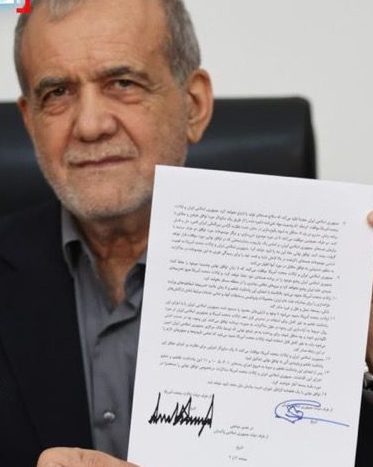
Iranian President Masoud Pezeshkian holding a Persian version of the memorandum of understanding between Iran and the United States. (screenshot)
The remote signing of the memorandum of understanding between Washington and Tehran marks a major turning point in one of the most dangerous conflicts in the Middle East in recent years. After several months of fighting that left thousands of casualties in Iran, Lebanon and Israel, the US and Iranian presidents have approved a text providing for an immediate cessation of hostilities, the reopening of the Strait of Hormuz and the opening of negotiations on Iran’s nuclear programme.
Beyond the symbolic images of the signing, the real question remains: who comes out on top in this deal?
Iran secures a vital economic reprieve
For Tehran, the deal is above all an economic lifeline. The suspension of sanctions on oil exports paves the way for a gradual return of energy revenues, which are essential for an economy weakened by years of isolation and by the consequences of the war.
The Iranian authorities can also claim to have preserved their sovereignty. Although talks are planned on the fate of the stockpiles of enriched uranium, the memorandum does not, at this stage, provide for the complete dismantling of the nuclear programme, allowing the regime to present the deal as a political victory in the face of Western pressure.
Trump claims a diplomatic victory
On the American side, President Donald Trump can claim to have secured what no military operation could guarantee: an Iranian commitment on the nuclear issue and the securing of the Strait of Hormuz, a strategic passage for the global oil trade.
The White House is presenting the agreement as proof that a hardline policy, combined with military and economic pressure, succeeded in bringing Iran to the negotiating table. With key US political deadlines approaching, this sequence of events could strengthen the image of a president able to deliver results without committing to a long and costly war.
Markets and Europe breathe a sigh of relief
The first indirect beneficiaries of the agreement are the international markets. The prospect of a lasting reopening of the Strait of Hormuz has already pushed oil prices down, easing fears of a fresh surge in energy prices.
For European countries, which are heavily exposed to the economic fallout of regional crises, the agreement offers hope of stabilised energy supplies and a return to greater geopolitical predictability.
France, which hosted several of the diplomatic stages that led to the agreement, also sees its role as a mediator strengthened on the international stage. It should be noted that the agreement was signed by Donald Trump at the gala dinner hosted by France at the Palace of Versailles.
Versailles: a majestic palace as a symbol of peace
The Palace of Versailles was chosen for the signing of the letter of intent between Donald Trump and Iran because of its powerful symbolism. A venue associated with the great diplomatic occasions of history, it embodies dialogue and reconciliation between nations. Taking advantage of the US president’s presence in France for the G7, the organisers also sought to give the agreement a historic and high-profile dimension. The prestigious setting of Versailles was thus intended to underline the importance of this diplomatic initiative and the desire to ease tensions between Washington and Tehran.
Cautious relief in Lebanon
In Lebanon, where fighting between Israel and Hezbollah has caused extensive destruction and thousands of casualties, the ceasefire has been greeted with relief.
The challenges nonetheless remain considerable. Internal divisions over Hezbollah’s role, the reconstruction of devastated areas and the negotiations under way with Israel will continue to fuel political tensions in the months ahead.
Questions in Israel
The agreement could draw mixed reactions in Israel. Its supporters will see it as an opportunity to end a war of attrition and to subject Iran’s nuclear programme to tighter international oversight.
Its critics, on the other hand, may argue that Tehran retains significant nuclear capabilities and secures sanctions relief without permanently abandoning its strategic ambitions.
Two decisive months
Despite the upbeat announcements, the memorandum of understanding is only a first step. The negotiations scheduled over the next sixty days will have to set out the precise arrangements for handling the enriched uranium, the timetable for lifting sanctions and the international verification mechanisms.
It is on these technical issues that the agreement will stand or fall. If they are resolved, the Middle East could enter a phase of lasting détente. If not, tensions are likely to resurface quickly.
For now, each side is claiming victory. But in a region accustomed to fragile agreements, only their implementation will show whether this proclaimed peace can stand the test of time.
Translated from French. The French original prevails.