International conference seeks to put people back at the heart of energy policy in North Africa
On 25 June, on the sidelines of the 62nd session of the United Nations Human Rights Council, Geneva will host a conference that aims to address one of the great challenges of the 21st century: how can the energy transition, governance and respect for human rights be reconciled in North Africa’s development paths?
Organised at the Geneva Press Club by the International Observatory of Geneva for Peace, Democracy and Human Rights (IOPDHR), in partnership with Alliance Suisse-Maroc and the international NGO PDES, the event will bring together experts, academics and international officials around a theme that reaches far beyond regional borders.
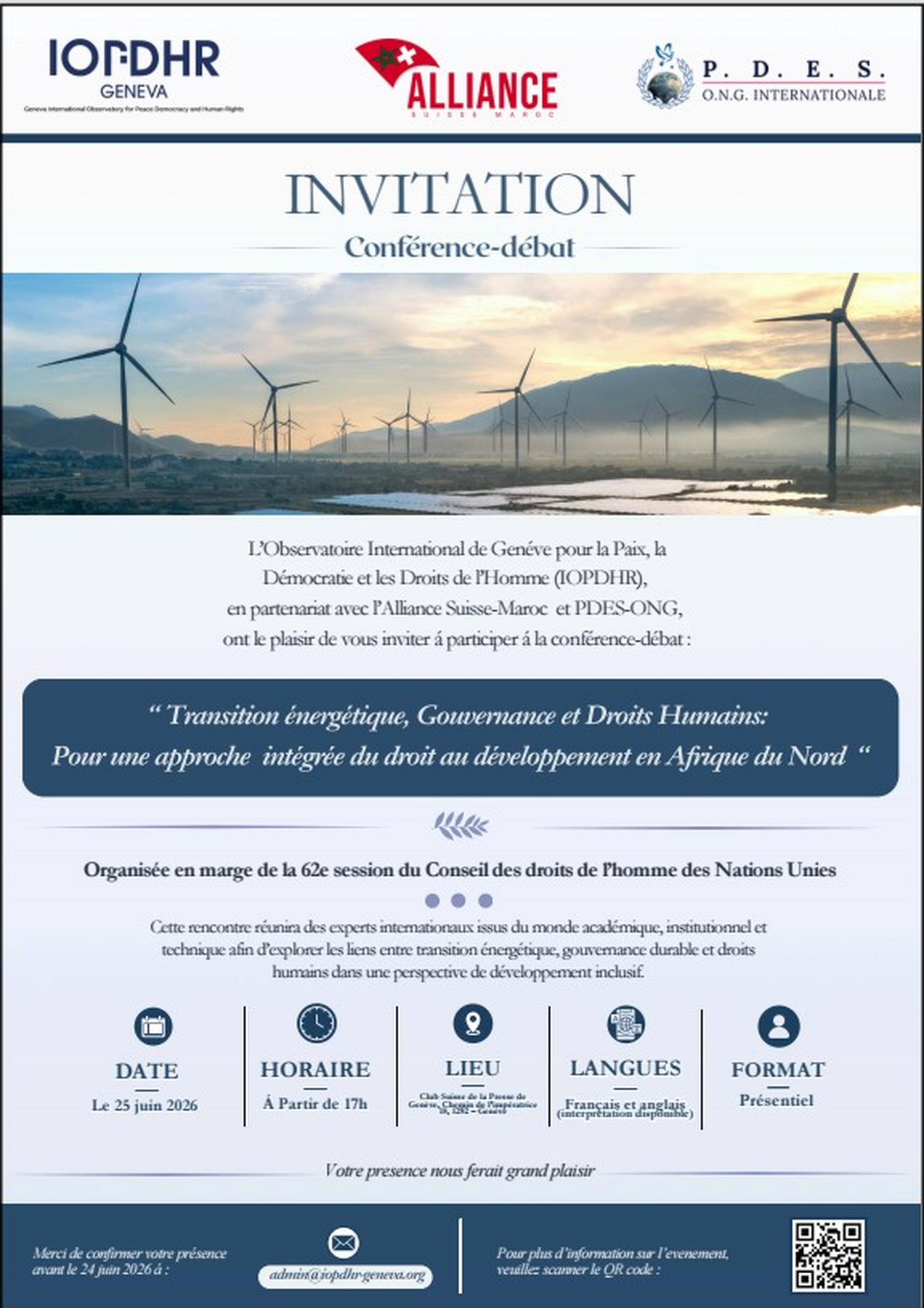
Under the title “Energy transition, governance and human rights: towards an integrated approach to the right to development in North Africa”, the organisers hope to open a dialogue on the profound transformations now sweeping through Mediterranean and African societies.
An energy transition under high tension
North Africa is among the regions of the world with the greatest potential for renewable energy. Large-scale projects are emerging in Morocco, Egypt, Tunisia and Algeria, with the stated ambition of becoming major players in the production of green energy and low-carbon hydrogen.
But this shift also raises fundamental questions: how can it be ensured that these investments genuinely benefit the population? How can transparent governance of resources be guaranteed? How can economic imperatives, social justice and environmental protection be reconciled?
At a time when energy transitions are reshaping the international balance of power, these questions are becoming central.
Geneva, capital of multilateral dialogue
The choice of Geneva to host the conference carries strong symbolic weight. As the multilateral system goes through a period of unprecedented weakening, the city on Lake Geneva remains a privileged forum for dialogue between states, international organisations, researchers and civil society.
The conference aims precisely to highlight the often-overlooked links between energy development, democratic governance and human rights. For behind major energy projects lie issues of equitable access to resources, public participation, the redistribution of economic benefits and respect for fundamental rights.
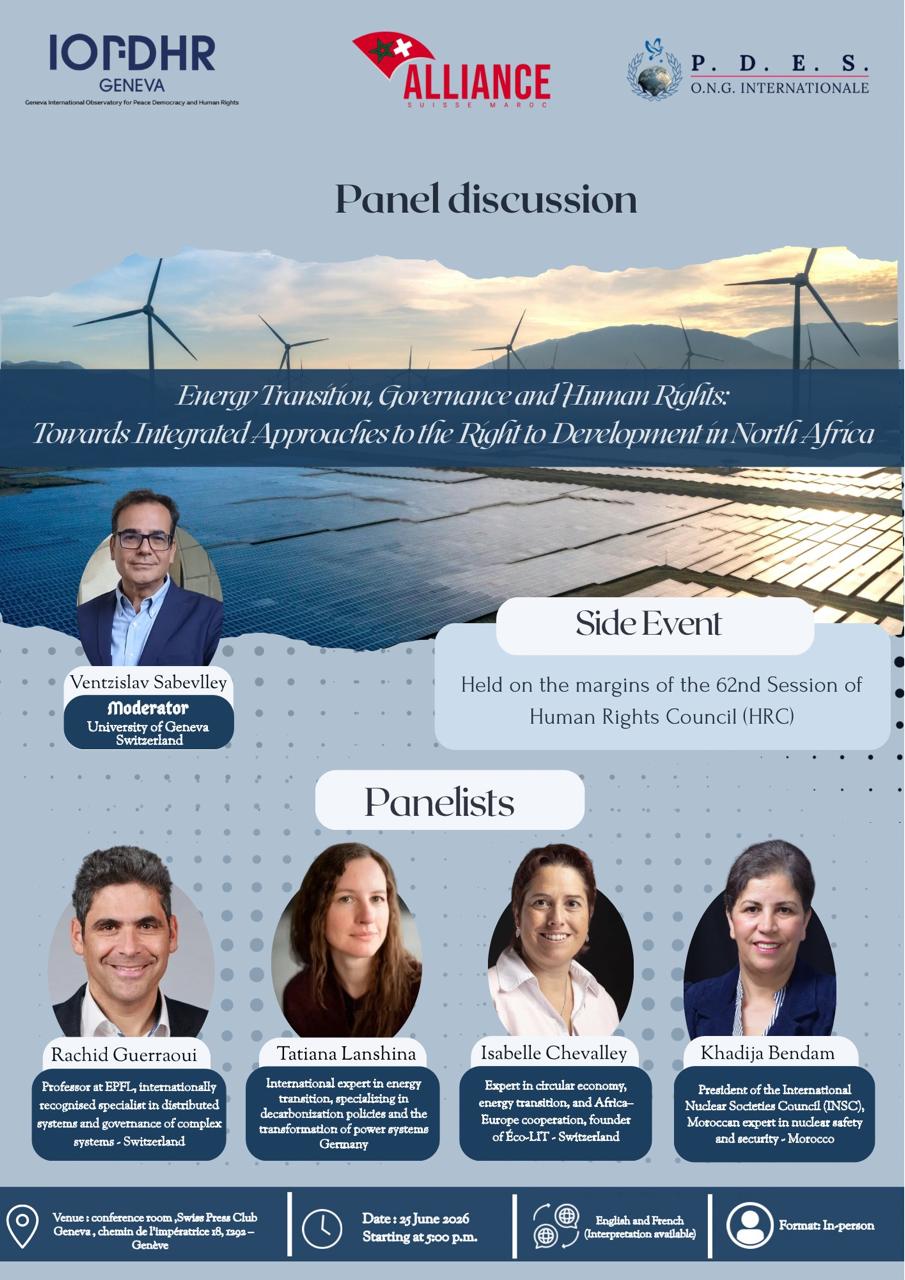
The discussion will be moderated by Ventzislav Sabev, of the University of Geneva, who will guide exchanges between figures recognised in their respective fields. Among them is Rachid Guerraoui, professor at the École polytechnique fédérale de Lausanne (EPFL) and one of the most influential researchers in the field of distributed systems and digital architectures.
His work on the governance of complex systems has particular resonance today, at a time when energy networks are becoming increasingly dependent on artificial intelligence, data management and digital infrastructure.
The energy dimension will be represented by Tatiana Lanshina, an economist and international expert on energy transition policy. An advocate of accelerating the deployment of renewable energy, she recently stressed:
“True resilience in a fragmented world lies not in cheap hydrocarbons, but in accelerating the transition to domestic renewable energy and supporting clean technological innovation.”
This vision strikes a particular chord in a region seeking to reduce its energy dependence while strengthening its economic sovereignty.
Rethinking economic models
Switzerland will also be represented by Isabelle Chevalley, a recognised expert on the circular economy and founder of Eco-LIT. A former member of the National Council, she has argued for many years that the ecological transition cannot be separated from a far-reaching transformation of production and consumption models.
For her, the challenge goes far beyond energy alone: it is about building economies capable of preserving natural resources while creating value and jobs. This approach echoes current thinking on the sustainability of development models in emerging countries.
Another strategic issue, energy security, will be addressed by Khadija Bendam, President of the International Nuclear Societies Council and a specialist in nuclear safety. As several African countries consider diversifying their energy mix, the question of nuclear power is returning to public debate.
But its development raises sensitive questions of security, governance, transparency and social acceptability. Khadija Bendam’s contribution will shed light on these issues, which are often absent from discussions on the energy transition.
The right to development at the heart of the discussions
Beyond the technical aspects, the conference aims to bring back to the fore a concept central to the UN system: the right to development. Enshrined by the United Nations in 1986, this principle holds that economic development must benefit all peoples and respect fundamental rights.
At a time marked by the climate emergency, geopolitical tensions and sweeping technological change, the concept is once again highly relevant. For the energy transition can only be sustainable if it is also socially just. It is precisely this link between economic growth, responsible governance and respect for human rights that participants will seek to explore in Geneva.
While North Africa is the starting point for the discussions, the issues at stake in fact concern the whole of the Global South. How can tomorrow’s infrastructure be financed without widening inequalities? How can people’s participation in the decisions that affect them be guaranteed? How can the benefits of the energy transition be shared fairly?
These are all questions that transcend regional borders and now sit at the heart of international agendas. In Geneva on 25 June, experts and decision-makers will seek to provide some answers to these challenges, which are already shaping the world of tomorrow.
Translated from French. The French original prevails.