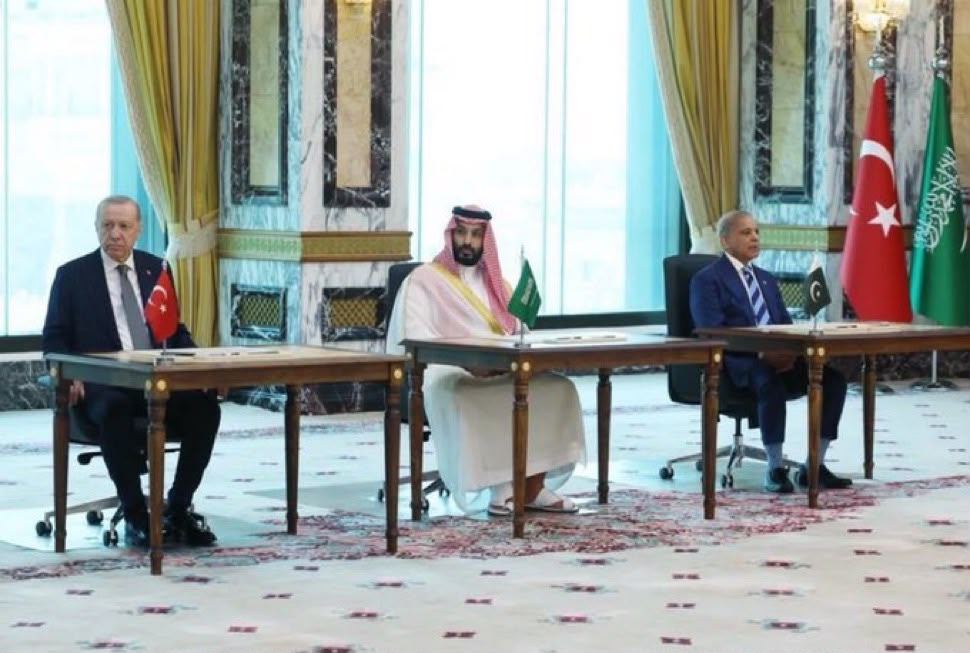
Saudi Arabia, Turkey and Pakistan have signed the Mecca Agreement, which establishes a principle of collective defence: an armed attack on any one of the three countries will be considered an attack on all. The pact extends a rapprochement already visible on Red Sea security, Syria and the defence of the Kingdom. It could become the core of a new regional security architecture.
The trilateral summit bringing together Saudi Crown Prince Mohammed bin Salman, Turkish President Recep Tayyip Erdoğan and Pakistani Prime Minister Shehbaz Sharif produced an agreement that goes further than a mere framework for military cooperation. According to Reuters, the Mecca Agreement stipulates that an armed attack on any one of the three signatories will be considered an attack on all. The three governments present the pact as strictly defensive and maintain that it is not directed at any country. The joint declaration, however, specifies neither the nature of the military commitments nor the exact conditions for their implementation. The political significance of the clause nonetheless remains considerable: Riyadh, Ankara and Islamabad are crossing the threshold of collective defence.
Until now, the three capitals had been stepping up military rapprochement and political support for one another. They now have a formal commitment that turns this convergence into a joint deterrence mechanism.
A structure under way before Mecca
The agreement was not born of the Mecca meeting alone. Reuters reports that it is the culmination of nearly a year of negotiations, made more urgent by the regional war. Saudi Arabia has at the same time launched a multinational naval coalition intended to protect shipping in the Red Sea, the Bab el-Mandeb Strait and the Gulf of Aden. Turkey and Pakistan have officially backed it. Islamabad had already made the security of the Kingdom a major strategic priority.
Meanwhile, Ankara has stepped up its cooperation with the new Syria and considers that any lasting challenge to the country’s territorial integrity bears directly on Turkish security. Riyadh and Ankara have also sharpened their warnings over Israeli moves in Syria and Jerusalem. Taken individually, these signals could still have been seen as one-off reactions. The Mecca Agreement now gives them strategic coherence.
Between Iranian pressure and concern over Israel
The new pact responds to two flashpoints of a different nature. For Saudi Arabia, the most immediate threat comes from Iran-linked forces. Riyadh faces the Houthis to the south and blames pro-Iranian Iraqi militias for several attacks on the Kingdom. Reuters reported on the eve of the summit that the Saudi authorities feared a coordinated offensive from Iraq and Yemen against civilian and economic infrastructure.
In the Levant, the logic is different. Turkey condemns Israeli strikes in Syria and maintains that the country’s stability is a direct matter of its own national security. Saudi Arabia, for its part, is issuing a growing number of warnings over Jerusalem and respect for the status quo at the holy sites. The alliance can therefore be reduced neither to an anti-Iranian front aligned with Israel, nor to an anti-Israeli front converging with Tehran. Rather, it seeks to form a regional pole capable of setting its own limits in the face of several competing powers.
From the Red Sea to Mecca, a single security logic
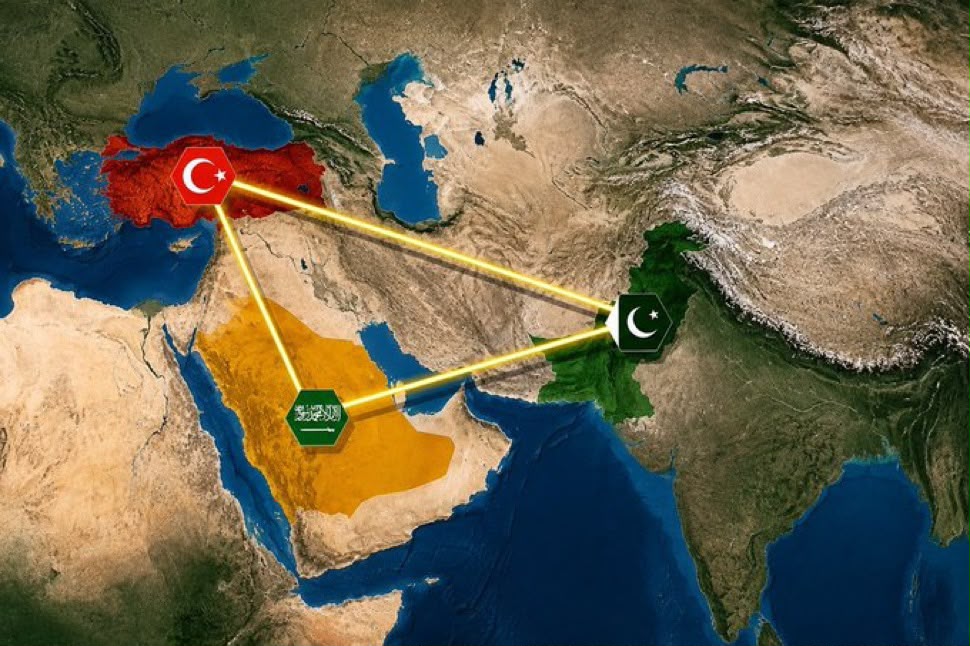
The maritime coalition led by Riyadh and the Mecca Accord are not legally the same arrangement. Their logic, however, converges. The former protects a strategic space and freedom of navigation. The latter organises the collective defence of three states. The Houthi threat links these two levels directly: the capabilities used against shipping can also strike Saudi territory and infrastructure. The naval coalition and the Mecca Accord thus appear as two tiers of a single architecture: securing the strategic routes, then strengthening the defence of the states that protect them.
This interplay has become more important since pressure on Hormuz shifted part of the energy stakes towards Yanbu and the Red Sea. The defence of sea routes is becoming inseparable from the territorial defence of the Kingdom.
An alliance with considerable military depth
The strength of the new bloc lies less in the sheer sum of its arsenals than in how they complement one another. Saudi Arabia brings its financial muscle and a modern air force. Turkey has NATO’s second-largest army by troop numbers and a fast-growing defence industry. Pakistan adds a robust air force, substantial ballistic missile capability and the Muslim world’s only declared nuclear deterrent.
Between them, the three signatories thus cover a very broad military spectrum, extending to long-range strike capability. Reuters notes, however, that the pact is presented as defensive, that it does not spell out each party’s operational obligations and that it makes no provision for nuclear cooperation. The collective defence clause therefore lends this complementarity a political dimension. It does not mean that all these capabilities will be committed automatically in every crisis, but it does increase the deterrent value of the whole.
Washington remains central, but is no longer alone
The Mecca Agreement does not mean a break with the United States. Turkey remains a member of NATO, Saudi Arabia is still a key military partner of Washington and Pakistan maintains a long-standing strategic relationship with it. But the 2026 war exposed the limits of relying exclusively on American protection. US forces are stretched across several theatres, while their partners have discovered that they can be struck directly despite the American military presence in the region.
The tripartite pact can therefore be read as a complementary strategic insurance policy. It does not replace Washington; rather, it gives three of its partners the means to organise a regional response when American priorities diverge or when their interests do not entirely coincide. The paradox is plain. In the face of Iranian-backed armed groups, the arrangement may strengthen the security of US partners. With regard to Israel, by contrast, it could complicate Washington’s calculations should Riyadh and Ankara set their own red lines in Syria or in Jerusalem.
Washington thus remains the reference power, but is no longer the sole architect of regional security.
Iraq at the heart of the future balance
One question remains: that of Iraq. Baghdad is seeking to strengthen the state’s monopoly on arms, while attacks on Saudi Arabia attributed to pro-Iranian militias are a reminder that Iraqi territory remains one of the main arenas of confrontation between competing influences. How the relationship between the Iraqi state and the armed groups evolves will be decisive. An Iraq able gradually to regain control of its territory could move closer to this new grouping without breaking with Tehran. Conversely, the persistence of autonomous armed structures would keep the country in the position of a buffer zone and a field of confrontation. It is probably in Iraq that the true reach of the new regional balance will be measured.
The beginnings of regional institutionalisation
The Mecca Accord probably marks not the culmination of the regional realignment but the beginning of its institutionalisation. The 2026 war is not merely redrawing the military balance of power. It is pushing the states of the region to build their own security mechanisms, alongside their traditional alliances. This development extends the strategic realignment already under way.
The Red Sea naval coalition and the Mecca Accord could thus form the first two pillars of a multi-tiered arrangement: a core of collective defence centred on Riyadh, Ankara and Islamabad, complemented by a broader maritime framework around the Bab el-Mandeb.
The first test, however, could come from Yemen. The Houthis have already declared a maritime blockade against Saudi Arabia, struck Najran and this week claimed attacks on Saudi oil tankers. The Mecca Accord now places this front in a new framework: a further attack on the Kingdom would no longer concern Riyadh alone.
If they continue their strikes on Saudi territory or its energy routes, the Houthis could be the first to bear the brunt of this new arrangement. Nothing, however, guarantees an automatic military response from Turkey or Pakistan: the published text does not set out each party’s obligations. But the uncertainty is already changing the calculations in Sanaa, which must now factor in the risk of more direct support from Ankara and Islamabad.
The responses of Iran, Israel and the United States, as well as developments in Iraq, Syria and Yemen, will show how far this system can extend. A threshold has nonetheless been crossed: three major Muslim powers have turned their strategic convergence into a formal commitment to collective defence.
External sources to consult
• Reuters, 6 August 2026 – Saudi expects imminent two-pronged attack from Iran’s allies, official says
• Reuters, 30 July 2026 – Saudi Arabia unveils plans for multinational maritime defence coalition
• Reuters, 6 August 2026 – Gulf shipping traffic down after Houthis say they attacked Saudi tanker
Further reading from La Tribune des Nations
• Hormuz: Iran holds the strait, Trump holds the purse strings
• After Hormuz, Bab el-Mandeb: the land front that could reshuffle the deck
• After Hormuz, Bab el-Mandeb: the new front in the energy war
• Saudi Arabia and the Houthis: a war of two encirclements
Translated from French. The French original prevails.