Part one
Whereas the world had until now placed its faith in law, dialogue and development, Russia is attempting to return to the age of empires. Its propaganda repeats like a mantra the idea of a “Crimea that has always been Russian”. But history is not a collection of convenient quotations: it is a factual reality that cannot be replaced by a narrative staged on state television.
One need only examine the peninsula’s past, not through political slogans, but through real events, documents and the will of the peoples who have lived there. Crimea was under Russian rule for only a very short period of its history spanning thousands of years — and always as a result of military conquest, never as a result of a genuine choice by its inhabitants.
Crimea as a centre of civilisations
Crimea is a land of cultures, civilisations and peoples, among whom the Russians appeared much later than the Greeks, the Scythians, the Genoese, the Crimean Tatars and the Ukrainians. Crimea was never a periphery. It was a centre — of trade, sea routes, cultures and human destinies.
When Russian propaganda speaks of a “historically Russian Crimea”, it glosses over the essential point: the peninsula’s history began thousands of years before Russia even came into being, and it was closely bound up not with the North, but with the ancient Mediterranean world.
As early as the 7th to 5th centuries BC, Greek cities began to appear along the coasts of Crimea. These were not mere temporary trading posts but genuine city-states with their own government, laws, economy and diplomacy.
Panticapaeum (present-day Kerch), capital of the Bosporan Kingdom, controlled the trade routes between the world of the steppes and Greece. Gold coins were minted there. It had working theatres and temples, and international alliances were concluded there.
The Bosporan Kingdom lasted more than 900 years — one of the most stable states of the ancient world, having come through dozens of wars and the transition from the classical Greek era to the Roman Empire.
Tauric Chersonesus (present-day Sevastopol) had a democratic system of government, popular assemblies and written laws — long before centralised states emerged in Eastern Europe. The surviving text of the “Oath of the Citizens of Chersonesus” is one of the most striking testimonies to the political culture of antiquity in the region.
Theodosia (now Feodosia), Nymphaeum (near present-day Kerch) and Kerkinitis (present-day Yevpatoria) were major ports integrated into international trade.
Crimea was the “breadbasket” of the ancient world: its grain was exported to Athens and other Greek cities, enabling them to survive wars and poor local harvests. In return, Crimean ports received goods from three continents — wine, olive oil, ceramics, textiles and metal objects.
At that time, Crimea was not on the periphery but at a crossroads between Europe, Asia and the Mediterranean — part of the civilised world, where money, law, architecture and education existed.
Crimea was never an “empty land” that someone “colonised”. It had an urban, political and cultural tradition stretching back thousands of years. The ancient cities of Crimea lived by written laws, concluded international treaties and were political actors in their own right, not the periphery of foreign empires.
The ruins of Chersonesus are inscribed on UNESCO’s World Heritage List, confirming the outstanding universal value of Crimea’s ancient heritage.
Chersonesus became a major centre of early Christianity, long before Kyiv and Moscow. It was there, in 988, that Prince Volodymyr the Great, Prince of Kyiv, was baptised. According to the chronicle, Volodymyr came to Chersonesus – then the Byzantine centre in Crimea – where he was baptised by the Byzantine clergy. He then returned to Kyiv and ordered the baptism of the entire people, thereby inaugurating Christianity in Rus’.
Medieval Crimea: a crossroads of cultures and trade routes
When the ancient Greek cities vanished from the historical stage, Crimea did not become a desert. On the contrary, the peninsula became a new crossroads of peoples, languages and religions, a bridge between Europe and Asia. The steppe and the sea have always coexisted there: trade and military campaigns, crafts and urban traditions shaped a unique cultural mosaic.
In the Middle Ages, the peninsula was home to Byzantine colonies, Gothic principalities, Armenian communities and Genoese trading posts. One of the largest ports on the Black Sea was Caffa (present-day Feodosia). In the 14th and 15th centuries, the city was a genuine financial centre: banks, consulates and trading houses operated there, and its harbours received ships from Italy, the Ottoman Empire and the Caucasus. Its population numbered tens of thousands — a veritable megalopolis for the time.
The Genoese made Crimea a central hub of their Black Sea trading network. They built fortresses, ports and warehouses there, organising safe routes for the trade in grain, wine, silk and spices. Yet the Crimean towns were not mere colonies: local authorities retained genuine autonomy, and communities managed many of their internal affairs themselves.
Solkhat (today Stary Krym) remained a major religious and political centre, where the elite of the future Crimean Khanate was formed. It had madrasas and mosques, scholars and poets, and its young people studied history, law and religion. The town linked the peninsula to the Silk Road, opening up the distant markets of Asia to Crimean merchants.
In the Middle Ages, Crimea remained deeply multinational and multicultural. Greeks, Tatars, Genoese, Armenians, Karaite Jews, Israelites and even Scandinavian merchants lived side by side there. The markets overflowed not only with goods but also with languages and traditions: every corner of the port breathed cultural diversity. The diplomacy of the local authorities took account of this diversity and of the complexity of this environment.
It was in medieval Crimea that the cultural and political foundations of the future Crimean Khanate gradually took shape. Urban institutions and traditions of self-government, justice and education developed there, giving rise in the 15th century to an independent Crimean Tatar state.
Medieval Crimea shows that the peninsula was never a periphery of foreign empires. It was always a centre of civilisations, a meeting point of cultures and trade routes, a living space in which the history of the Black Sea region was forged.
In the 14th and 15th centuries, Caffa had between 30,000 and 40,000 inhabitants, making it one of the largest ports on the Black Sea. It was home to banks, shops, consulates and customs houses, and its harbours received ships from Italy, the Ottoman Empire, the Caucasus and Crimea.
- Gezlev (present-day Yevpatoria) was an important port city through which Crimea traded with the Balkans and the Ottoman Empire. The city was renowned for its mastery of seafaring trades and its fishing traditions.
- Solkhat (Stary Krym) was a religious and educational centre, home to madrasas, libraries and courts, where law, religion and history were studied. It was there that the political and spiritual elite of the future Crimean Khanate was formed.
Crimea under the Giray dynasty: a state that shaped the region
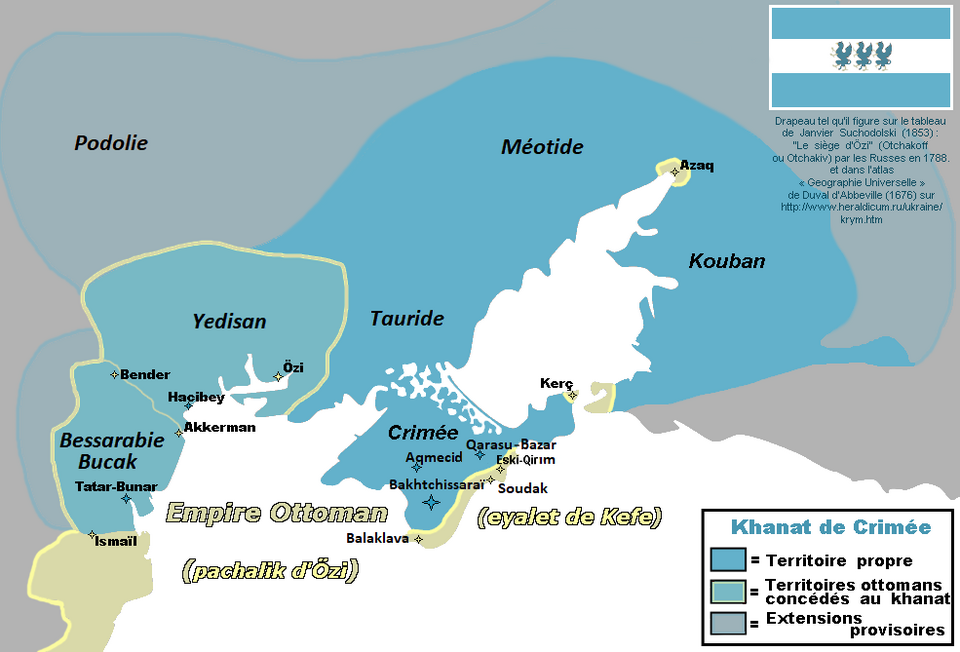
The history of Crimea as a state came fully into its own from the 15th century onwards, with the emergence of the Crimean Khanate — an independent polity ruled by the Giray dynasty. It was neither a temporary formation nor a “vassal periphery”, as imperial historiography seeks to portray it, but a fully fledged state with its own elite, diplomacy, law and culture.
The Giray dynasty ruled Crimea for more than three and a half centuries — from 1441 to 1783. In this respect, the Crimean Khanate was one of the most enduring states in Eastern Europe. The Girays claimed descent from Genghis Khan, which lent their rule a legitimacy recognised in the political world of the time — by the Ottoman Empire as much as by the Polish-Lithuanian Commonwealth and the Muscovite state.
The Crimean Khanate was a fully fledged actor in international politics. The khans concluded treaties, conducted diplomatic correspondence and received foreign ambassadors. Diplomatic missions operated in Bakhchysarai, and the khan’s court influenced the balance of power across the entire Black Sea region. Crimea was not merely a “buffer” between empires — it was a player to be reckoned with.
For the Giray dynasty, the principal long-term strategic threat was the Muscovite state, which was steadily advancing southwards. That is why the Crimean Khanate had an objective interest in the existence of an independent Cossack Ukraine serving as a buffer zone. Weakening the Polish-Lithuanian Commonwealth and containing Moscow served Crimea’s geopolitical interests. Alliances with the Cossacks were part of a deliberate strategy, not a matter of chance. It is precisely for this reason that the Crimean Khanate did not seek to destroy the Cossacks, unlike the policy pursued by Muscovy.
The Khanate’s political system was far more complex than simplistic accounts suggest. The khan’s power was limited by the council of the nobility — the beys and murzas. Courts functioned, sharia was applied in combination with local customary law, and the education system was developing vigorously. Madrasas trained theologians, jurists and administrators. Crimea had its own intellectual tradition, its own historiography and a distinctive poetry.
The Khanate’s towns — Bakhchysarai, Solkhat, Gözlev, Karasubazar — were genuine urban centres, not military settlements. As the capital, Bakhchysarai combined the roles of political centre, cultural hub and symbol of the state. The Khan’s Palace was not merely a residence but a place where state decisions were taken, diplomacy was conducted and culture flourished. It was there that the image of Crimea as a distinct civilisational community took shape.

The Great Mosque of Bakhchysarai.
The khanate’s economy was integrated into international trade networks. Crimea maintained its commerce with the Ottoman Empire, the Balkans, the Caucasus and the Middle East. The khanate’s ports were open to merchants of different nations and faiths. Crimea’s multinational and multi-faith character was not a weakness — it was the very foundation of its stability.
It is essential to stress that it was under the Girays that the Crimean Tatar people definitively took shape as a political nation. The Crimean Tatars were not simply an ethnic group, but a people with their own state, their own land, their own law and their own historical memory. This fundamentally contradicts the imperial narrative that seeks to portray them as “newcomers” or a “secondary” population.
The destruction of the Crimean Khanate in 1783 was not a mere territorial annexation. It was the obliteration of an alternative political tradition, one that demonstrated that Crimea could exist outside Russia — and successfully so. It is precisely for this reason that the Empire, after the occupation, did not merely change the administration but set about systematically destroying the memory of the khanate, its cities, its elite and its cultural heritage. Crimea under the Giray dynasty followed its own historical path. That path was cut short not by some “historical inevitability”, but by the military force of an empire that could not tolerate the existence on the peninsula of a model for the future independent of its control.
The 1783 annexation: a violation of international law
The Russian Empire occupied Crimea in 1783 in violation of the 1774 Treaty of Küçük Kaynarca, which guaranteed the independence of the Crimean Khanate. Russia abolished Crimean sovereignty by force. The treaty, concluded between the Russian Empire and the Ottoman Empire, explicitly recognised Crimea as an independent state and prohibited any interference in its internal affairs. Russia gained access to the Black Sea, the right to maintain a fleet and new territories — but Crimea was not on that list.
Russia officially recognised the independence of Crimea.
• The annexation of 1783 was illegitimate even by the standards of 18th-century law.
• This demolishes the myth of a Russian “historical right” to Crimea.
• It shows the continuity of imperial policy: recognition of the law, followed by its violation by force.
Just nine years after the treaty, Russia sent troops into Crimea, overthrew the legitimate authority of the khanate and published Catherine II’s manifesto on the “incorporation” of the peninsula. Even by the legal standards of the 18th century, this act was regarded as aggression.
The liquidation of the Crimean Khanate in 1783 did not simply mean a change of flag over the palace at Bakhchysarai. It marked a decisive turning point, after which Crimea ceased to be a subject of history and was forcibly turned into an object of imperial policy. What was lost then has never been fully restored.
Above all, Crimea lost its own sovereignty. The Crimean Khanate was one of the few states in the region to have existed for centuries, with a legitimate dynasty — the Girays — recognised by the international community of the day, and a coherent political tradition. Its destruction broke the continuity of Crimean political culture: the right to decide for itself, to choose its alliances and its path of development.
The second blow was the loss of the political elite. The Crimean nobility — beys, murzas and religious leaders — was either physically eliminated or forced into emigration. Those who remained lost their status, their property and all influence. The Empire deliberately eliminated the holders of local power, replacing them with officials who had no connection whatsoever with Crimea — a classic colonial practice.
Crimea also lost the urban culture of the khanate. Bakhchysarai, Solkhat, Gözlev and Karasubazar ceased to be political and cultural centres. Towns once alive with learning, craftsmanship, diplomacy and trade were reduced to mere provincial settlements. Bakhchysarai, once a vibrant capital, was gradually turned into an “exotic museum”, stripped of all political power.
One of the most profound losses was the demographic catastrophe. After 1783, a mass and prolonged exodus of Crimean Tatars began. As a result of persecution, land confiscations, religious restrictions and economic pressure, hundreds of thousands of people were forced to leave their land. According to historians, more than 300,000 Crimean Tatars were driven out between the late 18th and the late 19th century. This was not migration — it was forced exile.
Crimea lost its cultural continuity. Mosques were closed or destroyed, madrasas ceased to function, place names were changed and history was rewritten. The land was gradually “cleansed” of all traces of the Crimean Tatar state in order to create the illusion of an “empty land” that the Empire had supposedly colonised and “civilised”. Thus a myth was born that later became an instrument of political manipulation.
Economic autonomy was destroyed as well. Crimea ceased to be an active player in Black Sea trade, oriented towards a range of markets. Its economy was subordinated to the military and colonial needs of the Empire. The peninsula was no longer developed but exploited as an instrument of regional control.
Finally, Crimea lost the right to its own historical narrative. The history of the khanate was belittled, simplified or passed over in silence. The memory of a Crimea that had possessed its own state, its own cities and its own political culture became dangerous for the Empire, because it shattered the myth of the “eternity” of foreign rule.
That is why the struggle for Crimea today is not merely a struggle for territory. It is a struggle for the right to be oneself. For the restoration of a historical justice destroyed as far back as the 18th century.
Crimea in the Russian Empire: military colony and “seaside idyll”

In the 19th century, the Russian Empire definitively turned Crimea not into “part of the national space” but into a colonial region. The peninsula had a clear function: a military base, a bridgehead for controlling the Black Sea and a resort for the imperial elite. The local population — above all the Crimean Tatars — had no place in this model.
One of the principal instruments of imperial control was the Black Sea Fleet. Sevastopol was founded as a closed military fortress city. Until the mid-19th century, civilian life there was virtually non-existent: the city lived entirely to the rhythm of the army and the navy. This shows clearly that Crimea was not seen as a “homeland”, but as a strategic asset to be held by force.
The Crimean War of 1853–1856 was a moment of truth. The Russian Empire dragged the peninsula into a war against a coalition made up of Britain, France and the Ottoman Empire. The fighting reduced much of Crimea to ruins. Hundreds of villages were destroyed, the economy was wiped out and the population was left exhausted. The interests of the local inhabitants were never taken into account: for the Empire, Crimea was merely a theatre of geopolitical confrontation.
After Russia’s defeat, the situation of the Crimean Tatars deteriorated sharply. They were accused of “disloyalty”, stripped of their rights, and their access to land was restricted. It was after this war that the second mass wave of Crimean Tatar emigration to the Ottoman Empire took place. In the 1860s, tens of thousands of people left the peninsula, leaving entire regions depopulated.
The land thus vacated was actively distributed to settlers from the interior provinces of the Russian Empire as well as to foreign colonists — Germans, Bulgarians and Greeks. The demographic make-up of Crimea was altered deliberately and according to plan. This was not a natural process, but a state policy of population replacement.
At the same time, Crimea was “discovered” by the imperial aristocracy as a seaside resort. Yalta, Alupka and Livadia were covered with palaces and residences intended for the imperial family and the high nobility. Crimea became a place of leisure for a foreign elite, not a space for the development of the indigenous population. The Crimean Tatars had virtually no place in this new “seaside idyll”.
Even the imperial cultural policy of the 19th century did not aim at integration. Crimea was not conceived of as a distinct historical region with its own tradition. It was either militarised or exoticised — as a convenient “southern periphery” for imperial fantasies and rest.
The 19th century definitively fixed Crimea’s status as a colony within the Empire. Not as a homeland, not as an “ancestral land”, but as a territory administered without regard for the will of its indigenous people. This model — military control, demographic engineering and the marginalisation of local inhabitants — would be reproduced by Russia in the 20th and 21st centuries.
Translated from French. The French original prevails.