We are living through far more than a succession of crises. We are probably at one of those rare moments in history when a civilisation changes course.
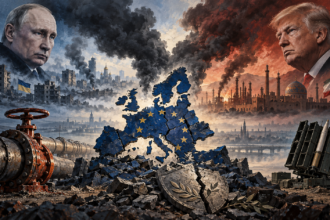
Climate disruption is upsetting the planet’s balance. Wars are redrawing the international balance of power. Former empires are seeking their place in a world that has become multipolar. Multinational companies now wield economic, technological and informational power that is sometimes comparable, or even superior, to that of many states. Artificial intelligence is already transforming the way we work, learn, create and govern and, tomorrow, perhaps the way we make decisions.
On top of this acceleration comes another, more insidious dynamic: the fragmentation of our societies.
Public debates are becoming permanent battlefields. The most sensitive issues – immigration, security, identity, purchasing power, the environment – are often reduced to binary clashes in which everyone is called upon to pick a side. Social media accelerate this mechanism by rewarding the most immediate reactions rather than the most nuanced analyses. Speed becomes a value in itself, even though it is often the enemy of reflection.
This acceleration is also fuelling another phenomenon: the proliferation of conspiracy narratives. The anonymity afforded by social media and digital platforms allows baseless theories to circulate at unprecedented speed. Yet behind their apparent novelty, they are merely the resurgence of very old mechanisms. In every period of major upheaval, history has seen the emergence of simplistic explanations, of scapegoats singled out for public vilification and of imaginary narratives claiming to reveal hidden truths. When the world grows complex, the temptation is strong to prefer a reassuring fiction to a reality that is hard to understand. The more a society doubts itself, the more vulnerable it becomes to discourses that claim to explain everything by pointing to a single enemy or a single cause. Yet the great historical transformations have never conformed to simple explanations; they are always the product of a multitude of economic, technological, political, cultural and human factors. To give in to such easy answers is to abandon the intellectual rigour on which every democratic society is founded.
This polarisation is not merely a consequence of the current upheavals; it can also become a major obstacle to our collective ability to understand them.
Yet times of tipping point demand exactly the opposite.
They demand composure when emotions hold sway. They demand depth when everything pushes towards instant reaction. They demand a long-term vision when the news cycle traps us in a state of permanent urgency.
Resisting this acceleration has become an act of responsibility.
This is not about denying the difficulties, nor about playing down the rifts running through our societies. It is about refusing to let fear, anger or hatred become the sole drivers of our decisions. History shows that great transitions have always been periods of tension. But it also shows that the societies that come through them best are those that manage to preserve their capacity for dialogue, discernment and understanding.
We probably need genuine intellectual discipline more than ever: stepping back, checking the facts, listening before condemning, understanding before judging. At a time when anyone can instantly publish an opinion, a rumour or a certainty, the responsibility of those who inform, analyse and debate is all the greater. Discernment is no longer one quality among others; it is becoming a democratic necessity.
In a world that pushes everyone to pick a side, true courage may lie in defending nuance. In a universe saturated with certainties, it lies in accepting complexity. And in an age fascinated by speed, it sometimes lies in slowing down in order to think better.
For tipping points are not only periods of danger. They are also moments when the world that comes after is invented.
That still requires the clear-sightedness not to be swept away by the turmoil, and the will to build rather than divide.
The 21st century will not be won through invective, one-upmanship or absolute certainties. It will be built through our collective ability to rediscover what gives great democracies their strength: methodical doubt, critical thinking, informed debate and the relentless pursuit of truth. That, perhaps, is ultimately the real challenge of our time: to make discernment not an intellectual luxury, but a civic duty.
Translated from French. The French original prevails.