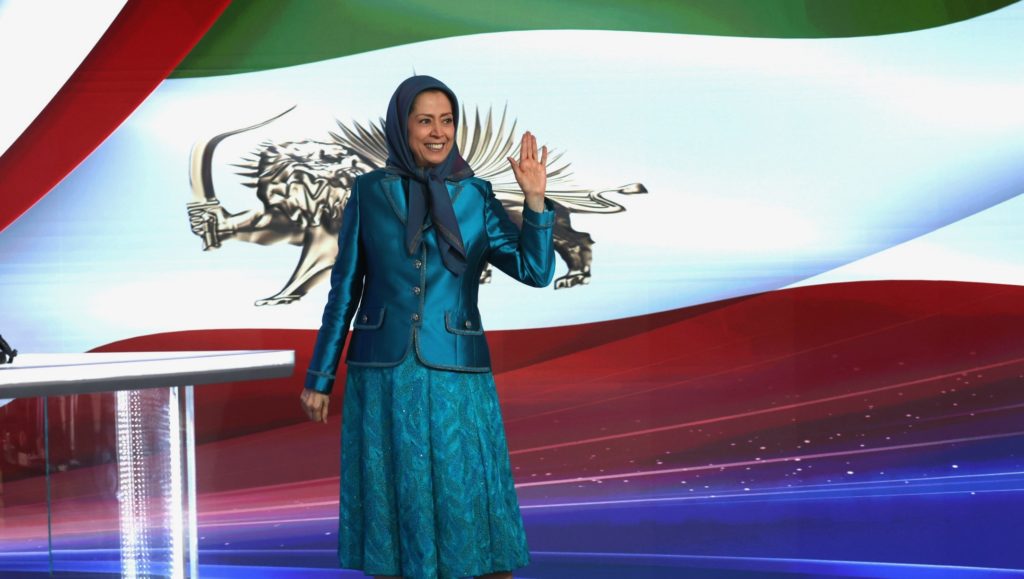
Maryam Rajavi, leader of the People’s Mojahedin Organisation of Iran, at the Free Iran summit in Paris last June.
By calling on Italy and the European Union to officially recognise the “Iranian Resistance”, Fabio Rampelli has crossed a threshold. In France, Ireland, the United Kingdom, the United States and Canada, elected representatives already support the National Council of Resistance of Iran and Maryam Rajavi’s ten-point plan. But removing the People’s Mojahedin Organisation of Iran (PMOI) from terrorist lists, supporting its principles, engaging in political dialogue and granting diplomatic recognition are four very different things.
Rampelli calls for a shift from support to recognition
In an interview broadcast by Simay-e Azadi following a conference held on 16 July 2026 at the Italian Chamber of Deputies, Fabio Rampelli, Vice-President of the Chamber and a member of “Fratelli d’Italia”, called on Italy and the European Union to officially recognise the “Iranian Resistance” and to establish diplomatic relations with it. The meeting in Rome brought together Italian parliamentarians and Maryam Rajavi, leader of the National Council of Resistance of Iran (NCRI) and of the PMOI.
The remarks must be attributed with precision. Simay-e Azadi is the Persian-language satellite channel of the National Council of Resistance of Iran (NCRI), of which the PMOI is the main organised force. The available account therefore comes from the movement concerned itself. Above all, Rampelli was speaking as a parliamentary leader: his call constitutes neither a decision of the Italian government nor a position of the Council, the Commission or the European Parliament.
His statement nonetheless marks a shift in vocabulary. Western elected representatives who support the NCRI generally champion the rights of the Iranian people, Maryam Rajavi’s ten-point plan or the opening of a dialogue. Rampelli is calling for a further step: granting an organised component of the opposition explicit political status and entering into an institutional relationship with it.
France: cross-party support, but no decision by the state
In France, a declaration presented to the media on 20 June 2023 had already given the NCRI exceptional parliamentary visibility. The National Assembly’s petitions platform refers to “more than 290 deputies and around a hundred senators” who declared that they shared the values of Maryam Rajavi’s ten-point plan. An NCRI press release, for its part, put forward the more precise figure of 294 deputies and 76 senators. This discrepancy in the count should be pointed out rather than glossed over.
Among the signatories named at the time were André Chassaigne, Olivier Marleix, Bertrand Pancher and Cyrielle Chatelain, then leaders of parliamentary groups in the National Assembly, as well as Éric Ciotti, Olivier Faure and Fabien Roussel. In the Senate, those mentioned included Claude Malhuret, Guillaume Gontard and Laurence Rossignol. Support therefore cut across several political families, from the communist and socialist left to the right, by way of the Greens, the centrists and members of the presidential majority.
The text set out the main commitments of the Rajavi plan: free elections, freedom of expression and assembly, separation of religion and state, equality between women and men, abolition of the death penalty, recognition of minority rights, peaceful coexistence and a non-nuclear Iran. But it was neither a draft resolution adopted by the National Assembly, nor a vote of Parliament, nor official recognition of the NCRI by France. It was a political declaration by parliamentarians, publicised by the backers of the Parliamentary Committee for a Democratic Iran.
Ireland: highly committed lawmakers, a government that keeps its distance
Ireland offers the clearest example of the gap between parliamentary mobilisation and government caution. In May 2025, four Fianna Fáil TDs — Pádraig O’Sullivan, James O’Connor, Peter “Chap” Cleere and Tony McCormack — along with Senators Erin McGreehan, Mary Fitzpatrick and Teresa Costello attended an NCRI gathering in the Paris region. The independent Senator Gerard Craughwell was also present.
According to an investigation by RTÉ, the declaration presented on that occasion bore the signatures of 18 members of the Dáil and 12 senators. James O’Connor called on the European Union to change its policy and to open a dialogue with the NCRI. Mary Fitzpatrick highlighted the ten-point plan. The former Taoiseach Enda Kenny had also attended an earlier event held by the movement. As early as 2023, the NCRI had announced that 36 of the 60 members of the Seanad had backed a declaration in support of a democratic and secular republic.
The response of the Irish Department of Foreign Affairs was, however, unambiguous: Dublin has no engagement with the NCRI or the PMOI, citing concerns about certain aspects of their organisation and activities. The Irish position thus sums up the Western paradox: a genuine, at times substantial, parliamentary following, but no move towards government recognition.
United Kingdom: opening a dialogue without recognising a government in exile
In the United Kingdom, Early Day Motion 3022, tabled on 23 March 2026 by Bob Blackman and supported by, among others, Jim Shannon, describes the NCRI as an organised political coalition advocating a democratic republic and calls on the British government to engage in dialogue with it. It also supports Maryam Rajavi’s ten-point plan. As of 14 April 2026, the motion had eight signatories.
An Early Day Motion is, however, a non-binding motion, often used to draw attention to a cause. It amounts neither to adoption by the House of Commons nor to a government position. The United Kingdom, too, therefore remains at the stage of political support and calls for dialogue, not diplomatic recognition.
NCRI, PMOI, MEK: what exactly are we talking about?
The National Council of Resistance of Iran is an opposition coalition in exile founded in 1981. The PMOI — the People’s Mojahedin Organization of Iran — is its main organised force. In English, the organisation is known by the acronyms PMOI or MEK, for People’s Mojahedin Organization of Iran or Mujahedin-e Khalq. According to Reuters, the NCRI is generally described as the political wing of the PMOI; the movement, for its part, defines itself as a pluralist coalition intended to prepare a democratic transition.
Founded in the mid-1960s, the PMOI initially fought the Shah’s monarchy. It took part in the revolutionary movement of 1979, then violently opposed the rule of Ayatollah Khomeini. After its leadership went into exile, the organisation established itself in Iraq and received the backing of Saddam Hussein during the Iran–Iraq War. This alliance with the enemy in wartime lastingly damaged its image among part of Iranian society. After the US intervention of 2003, its members were disarmed and then gradually transferred to Albania.
The PMOI long appeared on Western terrorist lists. The United Kingdom removed it in 2008, the European Union in January 2009, the United States in September 2012 and Canada in December 2012. These delistings ended the legal consequences of the designation. They do not mean that the governments concerned endorsed the movement’s history, methods, representativeness or programme.
The PMOI is therefore both one of the most disciplined and most visible organisations of the Iranian opposition in exile and one of the most controversial, owing to its armed past, its alliance with Saddam Hussein and allegations concerning its internal workings. Its supporters point to its formal renunciation of violence, its clandestine network inside Iran and its democratic programme; its critics question how representative it is within the country.
The NCRI-PMOI does not, however, represent the Iranian opposition as a whole. Its relations with Reza Pahlavi, son of the last shah, have historically been fraught. The PMOI, which fought the monarchy before taking part in the 1979 revolution, rules out any Pahlavi restoration and champions a republic; Reza Pahlavi, for his part, presents himself as a unifying figure for the transition and says Iranians will have to choose by referendum between a republic and a parliamentary monarchy. This rivalry is evident even in the British Early Day Motion 3022, which states that Iranians have rejected both the shah’s monarchical dictatorship and the mullahs’ theocracy, and explicitly criticises Reza Pahlavi. Despite their shared opposition to the Islamic Republic, the two camps compete for political legitimacy, the backing of the diaspora and international recognition. Reza Pahlavi claims to have won over former PMOI members, but there is no alliance between his movement and the organisation as it stands today.
Who is Maryam Rajavi?
Maryam Radjavi — the French spelling; Maryam Rajavi in English-language sources — is the leading public figure of the NCRI and the PMOI. The movement describes her as its “president-elect for the transitional period”. The title refers to an internal post envisaged in the event of the Islamic Republic’s fall; no state recognises it as an official office.
She champions a ten-point plan that provides for, among other things, universal suffrage, a pluralist and secular republic, the separation of religion and state, equality between women and men, an independent judiciary, the abolition of the death penalty, the protection of minority rights, peaceful coexistence and the renunciation of nuclear weapons. This programme accounts for much of her standing among Western parliamentarians. It does not, however, settle the central question of how representative the NCRI really is inside Iran, which remains difficult to gauge independently.
United States: massive support in Congress, no recognition from the executive
In the United States, the key legal decision remains the removal of the PMOI from the list of Foreign Terrorist Organizations on 28 September 2012. The State Department cited at the time the group’s public renunciation of violence, the absence of any confirmed act of terrorism for more than a decade and the movement’s cooperation in the closure of Camp Ashraf. Washington nevertheless made clear that the decision erased neither the organisation’s past nor the continuing concerns about it.
Support is far more pronounced in Congress. Resolution H.Res.166, introduced on 26 February 2025, has 229 co-sponsors in addition to its author. It supports the Iranian people’s desire for a democratic, secular and non-nuclear republic and explicitly cites Maryam Radjavi’s ten-point plan. However, as of 3 August 2026, it remains at the stage of introduction and committee consideration: it has not been adopted by the House and is not binding on the US administration.
Numerous former US officials, and at times figures set to take up official posts, attend NCRI rallies. Their presence gives the movement significant political and media access, but these appearances are generally presented as personal contributions. The US executive’s line remains to put pressure on the Islamic Republic while maintaining that the country’s political future must be chosen by Iranians. The United States has recognised neither the NCRI as a government in exile nor Maryam Radjavi as Iran’s legitimate representative.
Canada: Judy A. Sgro’s support and Ottawa’s caution
In Canada, the Liberal MP Judy A. Sgro told the House of Commons on 28 March 2023 that she had met NCRI representatives and supported the goal of a free, democratic and secular Iran, as well as its ten-point plan. Her statement nonetheless contained a crucial caveat: the NCRI is one option among others, and it will be for the Iranian people to choose their political future.
Canada removed the MEK from its list of terrorist entities on 20 December 2012. Since then, Ottawa has considerably tightened sanctions against Iranian officials and added the Islamic Revolutionary Guard Corps to its list of terrorist entities in June 2024. But its official policy of “controlled engagement” limits contacts with the Iranian opposition to consular, nuclear and regional matters and human rights. It makes no provision for any official relationship with the NCRI.
Canada’s position is therefore comparable to that of the United States in legal terms, but parliamentary support for the NCRI there is less overwhelming. Ottawa fights the Iranian regime through sanctions, counter-terrorism law and human rights diplomacy, without recognising an opposition organisation as an alternative government.
Four levels not to be confused
| 1 | Removal from terrorist lists | A legal decision lifting a designation and its sanctions. It does not amount to political support. |
| 2 | Support for principles | Parliamentary backing for a secular republic, human rights or the ten-point plan. |
| 3 | Political dialogue | Calls for structured contacts with the NCRI as an organised component of the opposition. |
| 4 | Institutional recognition | Official recognition and diplomatic relations: the threshold demanded by Fabio Rampelli. |
The United Kingdom, the European Union, the United States and Canada have taken the first step. Several hundred Western parliamentarians stand at the second, and some British and Irish lawmakers are calling for the third. Fabio Rampelli is now proposing the fourth. None of the governments examined has yet agreed to recognise the NCRI as Iran’s official representative or as a transitional government.
What is new, then, is not the existence of Western support for the NCRI: that support is long-standing, organised and cross-party. What is new is the desire expressed by a vice-president of the Italian Chamber of Deputies to turn this parliamentary sympathy into political recognition of the NCRI. The question now is whether this call will remain an individual position or herald a broader debate on preparing for the post-Islamic Republic era.
Further reading from La Tribune des Nations
Iran: internal fault lines reawaken — 10 July 2026
Europe faces the risk of a covert war waged by Iran — 27 July 2026
Iranian threat in Europe: Tehran outsources its covert war — 28 July 2026
Iran–United States: who can still stop the war? — 30 July 2026
External articles and sources
Camera dei deputati — sitting chaired by Vice-President Fabio Rampelli — Italian institutional source
Radio Radicale — “Iran del Futuro” — recording of the conference held in Rome on 16 July 2026
NCRI / Simay-e Azadi — remarks attributed to Fabio Rampelli — the movement’s own source, to be read as such
French National Assembly — petition by the Parliamentary Committee for a Democratic Iran — 2023 French declaration and names of signatories
RTÉ — “Dept has concerns about Iranian opposition group” — 23 June 2025, Irish elected representatives and the government’s position
UK House of Commons — Early Day Motion 3022 — motion on the NCRI and the ten-point plan, 2026
Reuters — Maryam Rajavi and the NCRI — independent profile of the leader and her programme
Reuters — interview with Reza Pahlavi — transition, referendum and former members of the PMOI — 28 July 2026
US Department of State — removal of the MEK from the terrorist list — 28 September 2012
United States Congress — H.Res.166 — text, co-sponsors and status of the procedure
Public Safety Canada — removal of the MEK from the terrorist list — 20 December 2012
House of Commons of Canada — speech by Judy A. Sgro — 28 March 2023
Global Affairs Canada — policy of controlled engagement with Iran — official document, 3 February 2026
Court of Justice of the European Union — removal of the PMOI from the list in 2009 — legal background
Translated from French. The French original prevails.