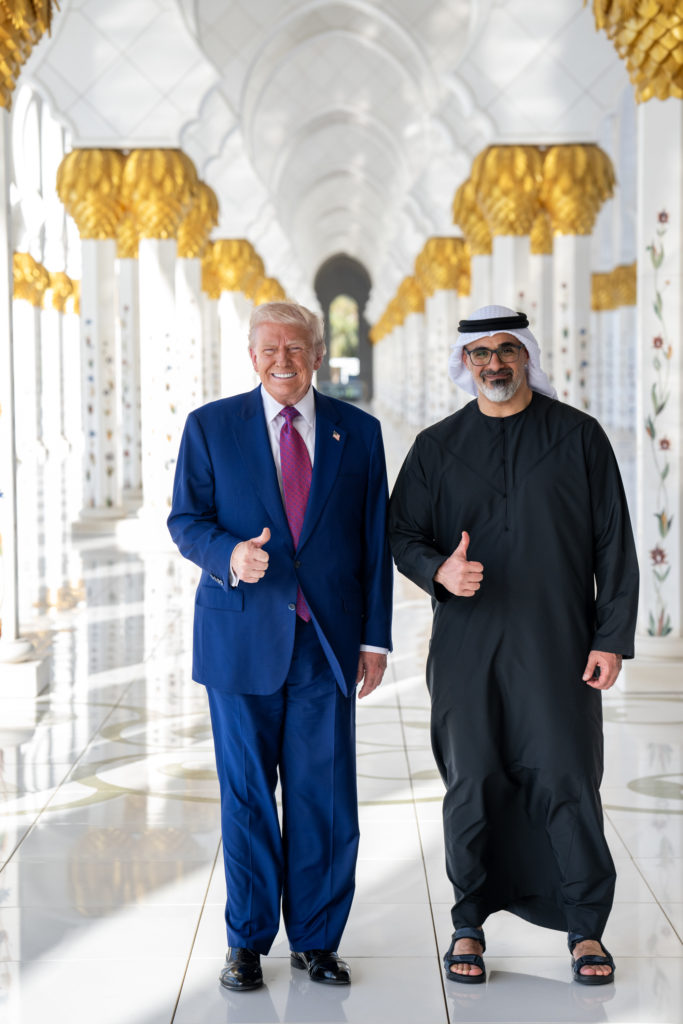
President Donald Trump’s surprising threats against the Sultanate of Oman fit a clear pattern of organised Emirati influence within the US administration. The statement, circulated through official US channels, reflects intertwined financial and personal interests and is not merely an improvised position.
At a cabinet meeting on 27 May 2026, President Trump stated explicitly that “Oman will behave like everyone else, otherwise we will be forced to blow them up. They understand that, and they will be fine.” This unusual rhetoric comes at a sensitive moment, when commercial and political interests are intertwined to an unprecedented degree.
The financial and personal network: the World Liberty Financial deal
At the heart of this dynamic is Marty Edelman (Martin Edelman), general counsel of the company G42 and personal adviser to Sheikh Tahnoon bin Zayed, an influential member of the royal family. According to a report in the “Wall Street Journal” (January 2026), Edelman signed a deal under which Aryam Investment (linked to Sheikh Tahnoon) acquired 49% of World Liberty Financial (the Trump family’s crypto venture) for $500 million, just days before Trump’s inauguration.
The deal was signed by Edelman with Peng Xiao, the chief executive of G42. Edelman also sits on the company’s board of directors. This direct financial link makes the success of the Emirati partnership a direct personal interest for President Trump and his family. (wsj.com)
Abu Dhabi’s man in Manhattan
Steve Witkoff (Trump’s negotiator) has described Edelman as a “problem solver”. In May 2025, Bloomberg published a detailed report entitled “Abu Dhabi’s Man in Manhattan”, portraying Edelman as the key figure facilitating Abu Dhabi’s access to Trump’s circles and playing a pivotal role in major deals.
The Abu Dhabi visit and the artificial intelligence project
In May 2025, President Trump travelled to Abu Dhabi to announce in person the “US-UAE Artificial Intelligence Acceleration Partnership” and the largest AI campus outside the United States (5 gigawatts). The White House announced business deals worth more than $200 billion, while the Emirati ambassador, Yousef Al-Otaiba, had announced them in the same terms before the visit. These agreements deepen mutual dependence and increase Abu Dhabi’s influence. (whitehouse.gov)
Lobbying and public relations
Abu Dhabi relies on a network of professional lobbyists: Akin Gump Strauss Hauer & Fel has received tens of millions of dollars from the Emirates over several years and is among the leading firms working for them in Washington. FGS Global bills millions of dollars a year for reputation management and media coverage (a $5.6 million contract running until 2026, for example). These firms shape the media narrative and open doors in Congress and in the administration.
The Gaza case
According to US and Egyptian officials cited by Middle East Eye (17 March 2025), the UAE is lobbying the Trump administration behind the scenes to abandon the Gaza plan drawn up by Egypt and endorsed by the Arab League. The Emiratis “could not have openly opposed the Arab League, but they are attacking the plan with the Trump administration in private”. This confirms the use of influence to settle regional scores. (middleeasteye.net)
Why is Trump more vulnerable to this influence?
Objective factors make him a special case:
- The absence of any separation between private interests and presidential decisions: the 49% deal turns any favourable stance towards the UAE into a direct financial interest.
- His improvised style: he often speaks off script, which allows positions formed in private meetings to leak out.
President Trump’s statement is not an isolated individual position but the natural outcome of a professional, multi-layered Emirati influence system:
- Personal financial level (WLFI deal)
- Direct access level (Edelman)
- Major official level (AI agreements)
- Professional level (lobbying and public relations)
This system has turned US policy into an effective tool for achieving regional objectives, given that the US administration is fully aware of Oman’s position on the Strait of Hormuz, namely that the Sultanate condemns its use for political and military purposes and regards it as an international passage, which points to the UAE’s involvement in pressing Trump to threaten the Sultanate of Oman. Muscat is, moreover, furious that the United States launched an offensive with Israel while it was conducting negotiations that were making progress.
There are grounds for tension between the Emirates and Oman. For several years the Emirates have been seeking to increase their economic and strategic influence in the Arabian Peninsula. Oman, for its part, has traditionally pursued a more neutral foreign policy, particularly towards Iran. Oman often acts as a regional mediator, whereas the Emirates sometimes take a more interventionist approach to regional crises.
Another reason concerns the Strait of Hormuz. Together with Iran, Oman controls the shores of the strategic Strait of Hormuz, through which a major share of the world’s oil passes. The Omanis are suspected of not opposing a transit toll on ships since, like Iran, Oman controls the exit of the strait. Oman’s relations with the Emirates remained broadly good until Donald Trump lost his temper and threatened Oman following rumours of a possible deal between Iran and Oman to impose a toll for passage through the strait, which Oman has always denied. “Oman will behave like everybody else, otherwise we’ll have to blow them up,” Donald Trump said, a remark that sparked a major diplomatic controversy and took everyone by surprise.
The Emirates, for their part, are seeking to reduce their dependence on this route by developing alternative ports, pipelines and logistics corridors. Oman’s geographical position, particularly around Duqm and the Arabian Sea coast, is therefore of great importance in regional strategic calculations.
The two countries are also economic rivals. They are competing to attract foreign investment, to become logistics hubs and to diversify their economies beyond oil. The Emirates enjoy a considerable lead thanks to Dubai and Abu Dhabi, while Oman is developing rival projects in ports, logistics and green hydrogen.
Finally, the Emirates would reportedly like to bring Oman closer to the positions of the Gulf Cooperation Council (GCC), limit Iranian influence in the region and secure greater alignment on security and trade issues.
Translated from French. The French original prevails.