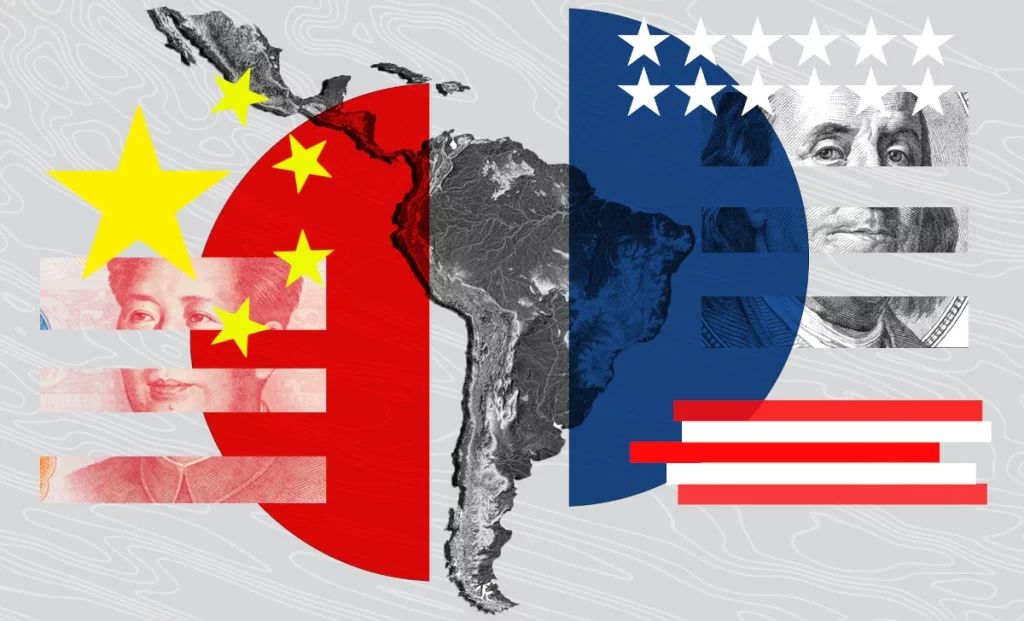
Since the Monroe Doctrine of 1823, the United States has regarded Latin America (made up of 33 countries, according to the UN) as its natural sphere of influence. Today, this region, long the object of European ambitions, is attracting particular interest not only from the United States but also from China, which has been turning its attention there since the early 2000s, following its accession to the World Trade Organization (WTO) in 2001.
The battle for influence in Latin America is driven by the presence of major natural resources such as lithium, oil and copper, but also by the establishment of military bases that give strategic control over an area of almost 20 million km2 with more than 650 million inhabitants.
The Panama Canal, an essential maritime crossroads for world trade, is also fiercely contested in this competition for influence. China’s exponential economic growth is gradually undermining the United States’ grip on the region. In keeping with its policy of economic expansion, the People’s Republic of China is seeking to strengthen its influence in Latin America, notably through the “New Silk Road”, launched in 2013, which more than 23 Latin American countries have already joined.
With the second term of Donald Trump, re-elected at the end of 2024, the popularity of the United States is tending to decline among part of the local population, which may make a stronger Chinese presence more acceptable. Is Latin America thus becoming the new theatre of Sino-American rivalry?
The economic stakes of influence
One reason for this rivalry lies in access to strategic natural resources such as lithium, which is needed to manufacture batteries and other electronic components.
Bolivia is believed to hold the world’s largest lithium resource, amounting to almost 23 million tonnes according to the United States Geological Survey. By 2035, Bolivia’s share of the global lithium market is estimated at between 25 and 30%.
Its neighbours, such as Chile and Argentina, also have significant resources. Together, these three countries are thought to account for between 50 and 60% of the world’s lithium resources. Chile, Bolivia and Argentina form what is known as the “Lithium Triangle”. There are three strategic minerals for battery production: graphite, lithium and cobalt. In 2024, China produced between 70 and 80% of the world’s graphite, while the United States has virtually no domestic production of natural graphite. China is also one of the world’s leading importers of lithium, graphite and cobalt.
These figures point to an economy far more geared towards the import, production and export of batteries and related minerals in China than in the United States, which is also reflected in their interest in these resources in Latin America. The management of these three minerals in particular is strategic in the short, medium and long term alike. Demand is set to keep rising in the coming years, underlining how important it is for the world’s major powers to invest in Latin America. The presence of very large quantities of oil (among the largest deposits in the world) in Venezuela and Brazil also stirs energy interests for the two global powers, particularly China, which imports much of its oil, whereas the United States enjoys a high degree of energy self-sufficiency thanks to its hydrocarbon production.
In this context, securing access to critical minerals is becoming a central issue in the strategic rivalry between Beijing and Washington. According to Jean‑Louis Martin, a researcher at the French Institute of International Relations (IFRI) and a specialist in Latin American economic and political affairs, “There are a number of countries where the Americans cannot gain a foothold, because there is already a market controlled by companies they cannot get their hands on“. This is the case, for example, with Petrobras in Brazil’s oil sector.
Military presence and control of the Panama Canal
Military presence in Latin America also plays a key role in controlling influence over the region. The United States is the world’s leading military power, with a budget of $921 billion in 2025, according to the International Institute for Strategic Studies. It has around twenty military bases and plans to return to some former bases that had been abandoned. At the same time, the United States also says it is fighting drug trafficking at sea with air strikes targeting boats at various locations off South America and the Caribbean, killing eleven people on 16 February.
China, for its part, has a defence budget of $251.3 billion (PPP $531.4 billion) in 2025 but officially has no military base in Latin America, again according to the International Institute for Strategic Studies. For Jean-Louis Martin, “The Chinese are well aware that it would be a provocation towards Trump“, and he does not foresee a broader Chinese military presence, at least as long as Donald Trump is president. However, some infrastructure raises questions about its intended and actual use.
In Argentina, in the province of Neuquén, a facility presented by China as a civilian space exploration station, in operation since 2017, is arousing suspicion because its management is closely linked to the army. Besides Neuquén, an analysis by the House Select Committee mentions ten other similar facilities in Venezuela, Bolivia, Chile and Brazil.
These facilities, whose real purpose remains opaque, are a source of concern in Washington, where Donald Trump is being urged to “stop this expansion”. The presence of American and Chinese facilities on soil that is not their own also raises questions about the national sovereignty of Latin American countries. In November 2025, Ecuador voted against the establishment of foreign bases on its territory by 60.82% in a referendum on the issue. This shows that the political will of foreign powers sometimes diverges from that of local populations.
The Panama Canal is also a crucial stake in the race for influence in Latin America. It connects the Pacific Ocean and the Caribbean Sea. Control of the canal is perhaps the very epicentre of tensions between China and the United States in Latin America. The dispute centres on two ports located at either end of the canal: the port of Cristóbal and the port of Balboa. Although the canal itself belongs to the country, the two ports are operated by a Hong Kong-based company, “CK Hutchison”. At the end of January, Panama’s Supreme Court ruled this operating arrangement unconstitutional. China, for its part, has denounced the outcome of the inquiry as the result of pressure from the United States, which Panama denies.
This decision objectively strengthens the position of the United States, which hopes to have the ports run by an American company. At the request of the United States, Panama has also withdrawn from the “New Silk Road” initiative, making it the first Latin American country to back away from Chinese ambitions.
Instruments of influence and regional policies
Beyond natural resources and military infrastructure, the rivalry between China and the United States is also playing out through economic influence. China is stepping up loans, investment and infrastructure projects, particularly in the energy, transport and telecommunications sectors. In El Salvador, for example, it has financed major construction projects such as a national stadium, a national library and coastal infrastructure. China has also signed agreements with several Latin American countries to export Huawei and ZTE surveillance tools to combat organised crime.
At the same time, the United States is trying to preserve its influence in the region. Its trade with Latin America amounted to nearly $1,200 billion in 2024. However, almost two-thirds of that trade is in fact concentrated on Mexico. China, for its part, recorded nearly $500 billion in trade for the same year. China thus dominates a large share of trade in South America.
Economic investments are strategic and reflect a desire to establish a long-term foothold. China, for example, sources more than 65% of its soya supply from Brazil. This is destabilising US soya farming, which was previously China’s main supplier.
Jean-Louis Martin observes that “the United States has lost ground in Latin America, even though it was still overwhelmingly dominant as recently as 25 years ago”. The die is not yet cast for Latin America, however, where a trend in favour of the United States ebbs and flows with the electoral successes of the subcontinent’s right. Far from being a marginal space, Latin America now appears to be a central stake in the rivalry between Beijing and Washington, where resources, infrastructure and economic and political influence are intertwined.
Bibliography:
Wesley Alexander Hill, “China And America Clash Over Latin American Energy”, Forbes, 30 April 2025,
Gavin Clark, “China dominates global trade of battery minerals”, U.S. Energy Information Administration, 21 May 2025, https://www.eia.gov/todayinenergy/detail.php?id=65305;
Mónica Cordero, “China is investing billions in Latin America, potentially sidelining US farmers for decades to come”, Investigate Midwest, 15 December 2025,
Evan Ellis, “China isn’t retreating in Latin America — it’s recalibrating“, UPI News, 20 February 2026,
Diana Roy, “China’s Growing Influence in Latin America”, Council on Foreign Relations, 6 June 2025,
Alice Wu, “How The U.S. Government Can Support The Development Of Domestic Production Capacity For The Battery Supply Chain”, Federation Of American Scientists, 9 July 2024,
Yeling Tan, “How the WTO Changed China: The Mixed Legacy of Economic Engagement”, Foreign Affairs 100, no. 2 (2021): 90‑102;
Raisina Debates, “Latin America’s Tug-Of-War: The Pulls of the U.S. – China Rivalry“, Observer Research Foundation, 17 April 2025,
Dylan Duan, Jackson Lewis and Tomasz Janowski, “Lithium Surges in China after Local Authorities Announce Plan to Revoke Mining Licences”, Reuters, 17 December 2025,
Wang Wen, “The US Cannot Push China out of Latin America“, The Diplomat, 17 January 2026,
Nicholas Slayton, “The US military’s plan to revive old bases in Latin America“, Task and Purpose, 14 November 2025,
Abhijeet Kumar, “Why US and China are contesting for influence in Latin America now”, Business Standard, 2 January 2026,
Translated from French. The French original prevails.