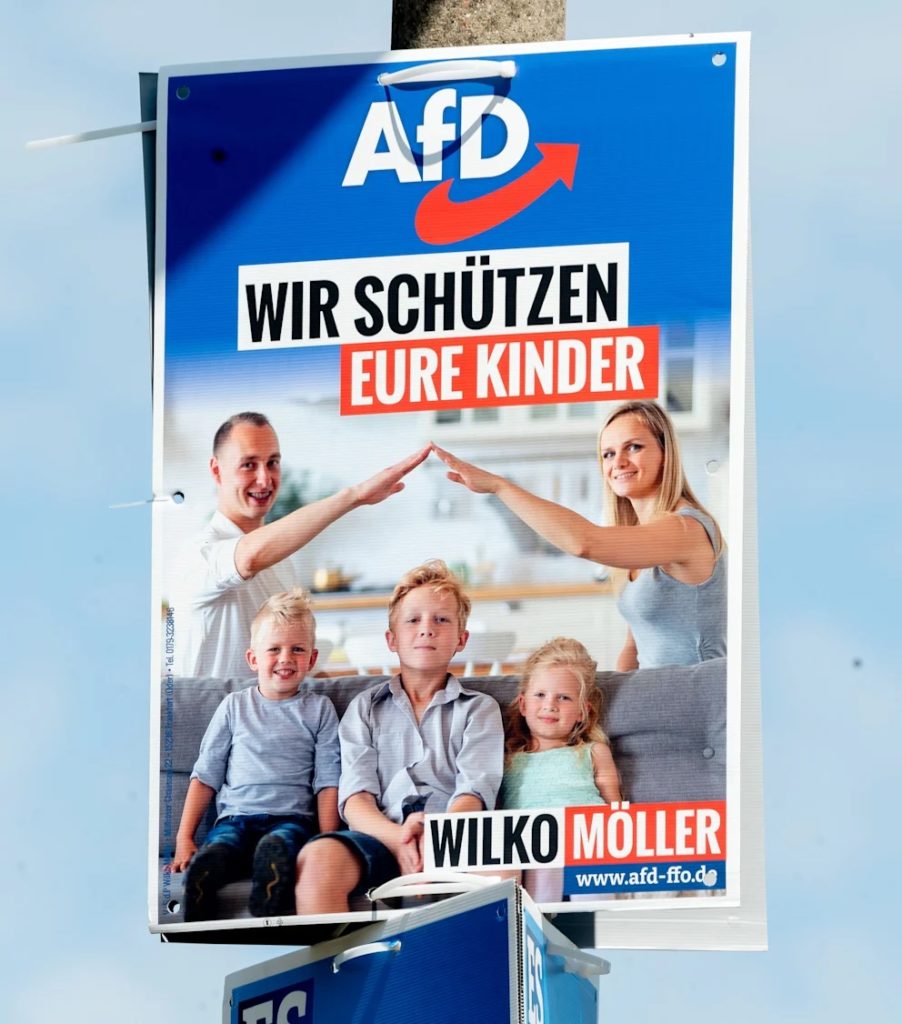
An example of symbolic renazification.
The shadow of the Second World War is shrinking under the blazing sun of our times. Germany – the crucible of Nazism, which ended up reducing the country to ruins before dividing it for almost 41 years – is watching a far-right party settle comfortably into its political landscape.
The AfD’s triumph in Saxony-Anhalt marks a further advance, accompanied by a kind of hypocritical renazification of Germany. On this subject, the Brussels daily Le Soir, cites the work of a researcher at the University of Duisburg-Essen, Sophie Schmalenberger: “The AfD does not deny the Shoah: it constructs a narrative in which it no longer really counts.” A sort of stone in Germany’s shoe that needs to be shaken out. Björn Höcke, the AfD’s leader in the state of Thuringia, put it very plainly when he railed against the Holocaust Memorial in Berlin: “The Germans are the only people in the world to have erected a monument of shame in their capital. This ridiculous policy of coming to terms with the past is paralysing us. Our politics of remembrance needs to make a 180-degree turn.”
By comparison, even Jean-Marie Le Pen, with his “detail of history”, looks half-hearted, (outstretched) arm and all. The moral (if one dare call it that): let us quickly forget this Hitler so that we can quietly finish his work of purging Germany of all its undesirable elements.
The normalisation of Nazi symbolism
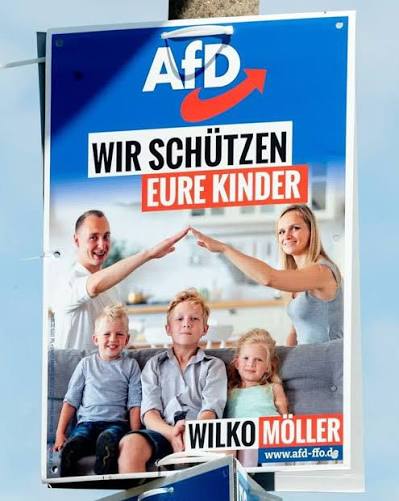
This normalisation of Nazi symbolism crops up regularly on AfD election posters (see the photo at the top of this article). Its flagship slogan – Alles für Deutschland (everything for Germany) – seems as inane as others of the same ilk. That is to forget that it was the battle cry of the SA, the Nazi party’s storm troopers, who bellowed it relentlessly as they meted out violence on the streets, notably during theKristallnacht (“Night of Broken Glass”) of 1938.
In its sly way, the AfD plays it down by saying: “What self-respecting German could object to giving everything for Germany?” But the Nazi nostalgists will have got the nod to an era when “everything ran better because everyone toed the line”, that exhilarating era when motorways sprang up beneath swastika flags.
Nazi nostalgia and Ostalgie in synergy
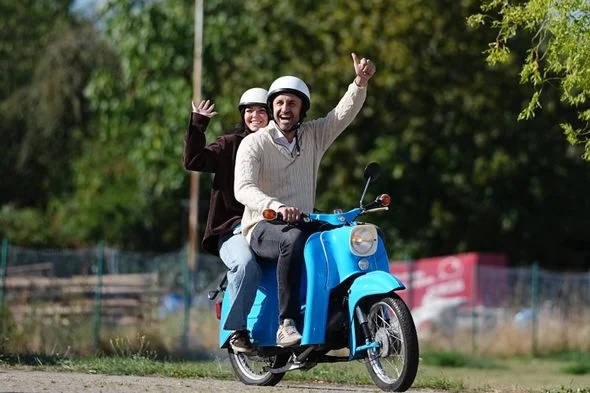
Ulrich Sigmund (with his wife riding pillion) perched on his ostalgic steed.
The AfD, most parties and quasi-fascist leaders such as Vance-Trump wield to great effect the two sentiments that have become the hallmark of our age: nostalgia and confusion.
In this respect, the German far right proves a virtuoso at combining two seemingly opposed nostalgias: one for triumphant Nazism and one for East Germany, the former Sovietised territory that is home to the bulk of the AfD’s electorate.
We have seen the Nazi nostalgia of the slogans and posters. Ostalgie(1) was staged with just as much skill. Thus Ulrich Siegmund, the party’s lead candidate in Saxony-Anhalt, campaigned astride the blue Simson Schwalbe(2) scooter, one of the chief symbols of the defunct German “Democratic” Republic. Naff but effective. Effective because naff. This eyesore drew smiling tears from many of his voters, who saw themselves some thirty years younger. This Marxist-Leninist moped was also a snook cocked at all those Westerners with their two-bit democracy(3).
Both the party of foreign interests and nationalist
The AfD is not troubled by contradiction: it proclaims itself nationalist while being the true party of foreign interests, vigorously backed by two sworn enemies of Europe, namely Putin and Trump. Who thus have a pawn inside our democratic system. All it would take is for Marine Le Pen to propel herself into the Elysée for the Putin-Trump party to be complete.
In the medium term, the most optimistic will point to the smallness of the state of Saxony-Anhalt, which can hardly represent the whole of Germany. They will also cite the strength of its democratic institutions, well defended by the Federal Office for the Protection of the Constitution (Bundesamt für Verfassungsschutz – BfV).
The most realistic will add this AfD success to the long list of electoral triumphs that have brought the far right, in one form or another, to power in many states.
From liqueur chocolates to the reformed alcoholic?
As for the more pessimistic, they may have in mind the current massive rearmament of the German army, as well as the famous quip, dating back to the 1990s, by Oskar Lafontaine, leader of the SPD and later of Die Linke, on the possibility of sending German soldiers abroad: “It would be like giving liqueur chocolates to a recovering alcoholic”. Indeed, a German army restored to strength alongside an AfD in fine fettle may well give neighbouring countries a few nightmares.
There remains the hope that history does not serve up the same dish twice. Or else, as Karl Marx wrote in his The Eighteenth Brumaire of Louis Bonaparte, it appears in two forms: “the first time as tragedy, the second time as farce”.
1 Nostalgia for East Germany, beautifully captured in Wolfgang Becker’s film “Good Bye Lenin!”.
2 In a grim irony of fate, the family of the founder of Simson motorcycles is of Jewish origin and is currently fighting to stop the AfD from using the scooter in its propaganda.
3 Since we are in the “nod and a wink” section: a reference to the German title of Bertolt Brecht’s “The Threepenny Opera”, “Die Dreigroschenoper”, literally the opera of three pennies.
Translated from French. The French original prevails.