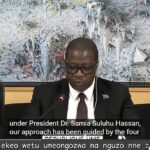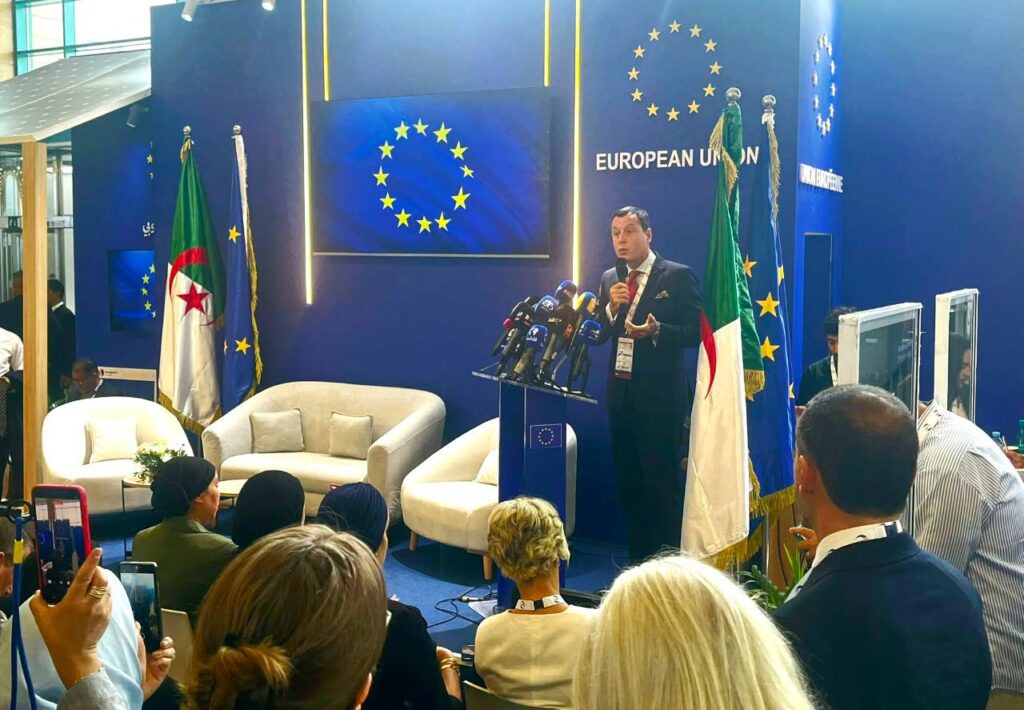
Diego Mellado, the European Union’s Ambassador to Algeria, at a press conference at the NAPEC 2026 energy exhibition in Oran on 6 October 2026.
Rather than locking our relations into sterile arbitration proceedings, let us together modernise the 2002 Association Agreement to meet the challenges of industrial sovereignty and the green transition.
In recent weeks, voices in Brussels and in some European capitals have called for an escalation of the trade dispute with Algeria, brandishing the threat of retaliatory measures under the Algeria–EU Association Agreement. This confrontational approach rests on a reading of economic relations that belongs to another era and ignores a fundamental reality: the Algeria of 2026 is no longer that of 2002, and Europe itself has profoundly changed its strategic doctrine.
When the Euro-Mediterranean Association Agreement was signed in Valencia on 22 April 2002 as part of the Barcelona Process – it entered into force on 1 September 2005 – it rested on a classic vision of free trade. Twenty-one years after its entry into force, the verdict is clear. While European exports have benefited greatly from tariff dismantling, the treaty has neither achieved its stated objective of co-development nor fostered the emergence of a competitive Algerian industrial base. Algeria has remained confined to the role of hydrocarbon supplier and consumer market.
Today, Algeria is undergoing a historic economic transformation. It is investing heavily in its rail and port infrastructure, in developing its mineral resources, in Saharan agro-industry and in local industrial integration. Just as the European Union and its member states are now doing to reindustrialise their continent and secure their value chains, Algeria is exercising its legitimate right to protect its infant industries and preserve its financial balances – mechanisms that are, moreover, expressly provided for in the safeguard clauses of the Association Agreement.
To pit Algeria’s industrialisation against Europe’s interests is an economic misreading. The country is not closing itself to business: it is changing its model. It now favours partners who invest, produce and transfer their know-how on Algerian soil over the mere import of finished goods. The facts bear this approach out. The major European groups that have bet on co-production in Algeria – in energy, the automotive sector, agro-industry and engineering – are now reaping the rewards, even making our country an export platform to African markets under the African Continental Free Trade Area (AfCFTA).
At the same time, even as the global energy crisis has highlighted the fragility of the European continent’s supplies, Algeria has confirmed its status as a safe and predictable partner. Accounting for more than a fifth of the European Union’s gas imports, it has honoured all its commitments and increased its deliveries to Europe, while launching with its Italian, German and Austrian partners the strategic SoutH2 Corridor project, which will in future supply European industry with a major share of its green hydrogen.
What logic, then, would there be in stirring up a trade dispute at the very moment when Algeria’s strategic interests converge so closely with Europe’s? At a time when the entry into force of the Carbon Border Adjustment Mechanism (CBAM) is imposing new constraints on more than 80% of its industrial exports to Europe, dialogue is more necessary than ever.
Why not explore the possibility of constructive mediation and undertake a pragmatic, clause-by-clause review of the Algeria–EU Association Agreement?
Let us modernise this text to incorporate the priorities of the 21st century: industrial decarbonisation, renewable energy, technology transfer and co-investment. Between neighbours bound by geography and history, lasting prosperity will never come from coercion, but from co-production and mutual respect.
Translated from French. The French original prevails.