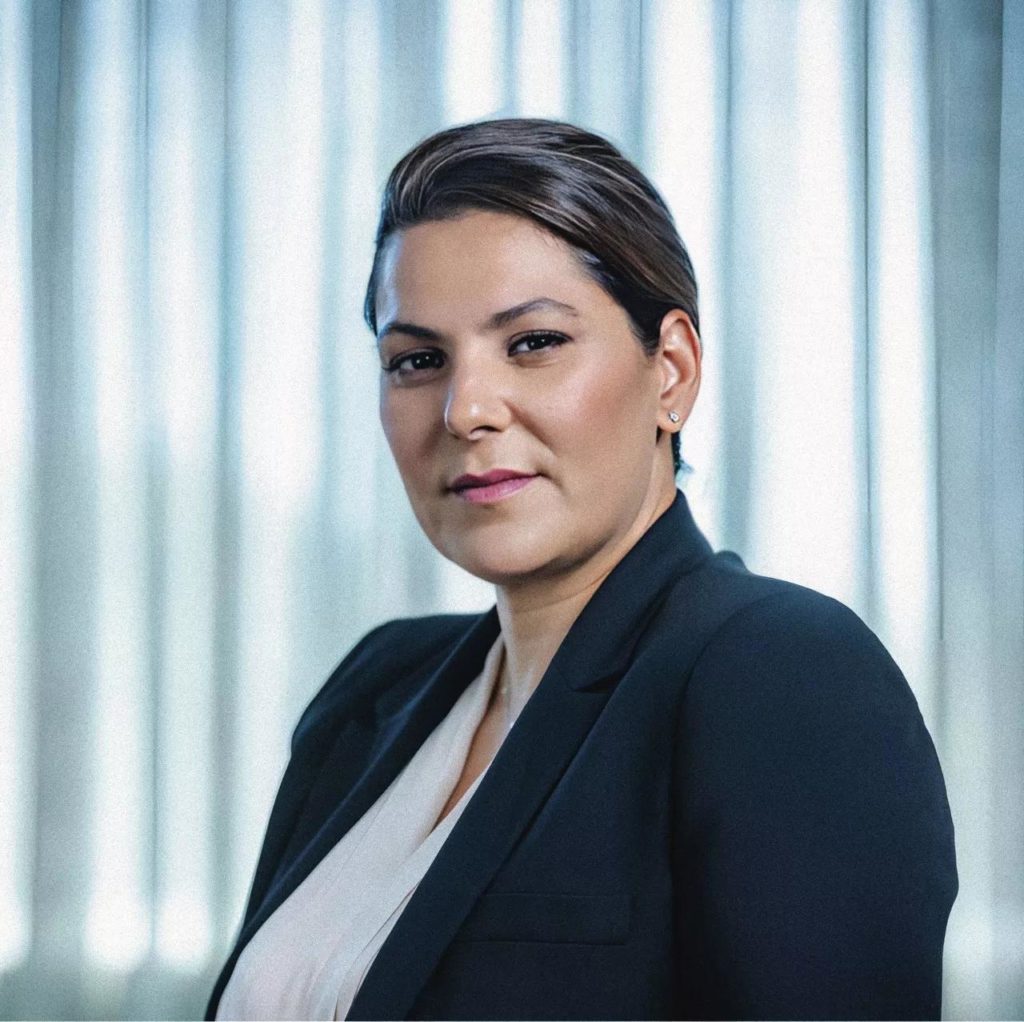
Fatima Ezzahra El Mansouri could become Morocco’s first female head of government.
The rumours in Rabat are growing ever more insistent. Over the past few hours, several Moroccan media outlets have reported that Fatima Ezzahra El Mansouri has been appointed head of government by King Mohammed VI. The news has yet to be officially confirmed by the Royal Palace, but if it is, it would be a historic event: for the first time, a woman would lead the Kingdom’s government.
Only a few weeks ago, the scenario might have seemed bold. Today it looks more credible than ever. And the possible appointment of Fatima Ezzahra El Mansouri would, in the end, be no bolt from the blue. Everything in her recent political career was gradually pointing towards this outcome. The victory of the Authenticity and Modernity Party (PAM) in the legislative elections of 23 September naturally changed the picture. With 97 of the 395 seats in the House of Representatives, the PAM came first, ahead of the RNI, which won 66, and Istiqlal, with 65. Under Article 47 of the Constitution, the head of government must be chosen from the party that comes first.
That left the King’s choice. And for several days, one name had been coming up with growing insistence: that of Fatima Ezzahra El Mansouri. National coordinator of the PAM’s collegial leadership, a minister for the past five years and mayor of Marrakesh, she naturally featured among the figures likely to take over the Prime Minister’s office. She herself had stated, the day after her party’s victory, that if the King entrusted her with this responsibility, it would be “a great honour” for her.
If the reports now circulating are confirmed, Mohammed VI would usher Morocco into a new political chapter. But to reduce this possible appointment to its symbolic dimension alone would be to miss the point. Behind the woman, the minister, the mayor and the leader of the PAM, a genuine profile of a head of government has gradually taken shape.
From Marrakesh to Rabat: legitimacy built on the ground
Fatima Ezzahra El Mansouri did not emerge on the Moroccan political scene on the back of the 2026 elections. A lawyer by training, born in Marrakesh in 1976, she built a crucial part of her legitimacy in her home city, which she first led between 2009 and 2015 before returning as president of the municipal council in 2021. This local dimension carries considerable weight. In a political landscape where voters are quick to accuse national leaders of being out of touch with realities on the ground — as they are in a good many countries — El Mansouri can point to hands-on experience of running things. Marrakesh has, in a sense, served as her political laboratory and as a genuine national showcase.
Her record as mayor is considerable in the sheer scale of the projects undertaken: 423 projects representing more than 15 billion dirhams of planned investment, of which 311 have been completed or launched. The transformation covers mobility, roads, green spaces, parking, security and public facilities alike: 349 buses, 130 kilometres of roads, 85 redeveloped junctions, 7,200 parking spaces, 738 cameras and more than 228 hectares of green space.
This approach now runs through her national message. For several months El Mansouri has stressed the “Morocco of the interior”, territorial disparities, closeness to citizens and the need to start from the needs voiced on the ground rather than from policies devised solely in Rabat. She has placed reducing territorial divides and reconciling with young people at the heart of the PAM’s project.
It is precisely this that gives her profile a national dimension: she can speak to the big cities without appearing exclusively urban, champion modernisation without upsetting the country’s balances, and lay claim to a culture of results rather than a purely ideological politics.
A minister with a genuine record to defend
Her second asset lies in her time in Aziz Akhannouch’s government. Since 2021, Fatima Ezzahra El Mansouri has held the portfolio of National Territorial Planning, Urban Planning, Housing and Urban Policy.
She could therefore take the helm of government without disowning the previous five years. This is perhaps one of the most interesting features of her recent career: the PAM has owned its participation in government while putting forward a new political chapter.
El Mansouri also repeated throughout the campaign that the 2026 battle would be first and foremost about policy. She refused to artificially disown the RNI-PAM-Istiqlal coalition in which her party had taken part, while championing a political offer that was identifiable, costed and measurable. The distinction from her former partners was to be drawn through proposals, not through an opportunistic rewriting of the past five years.
She has results to show for it. More than 120,000 people have benefited from direct housing assistance. The “Cities Without Slums” programme reached 81,809 families during the term, with the pace of processing raised to around 18,000 households a year, compared with 6,200 between 2018 and 2021. Since 2004, 384,000 families have benefited from the programme and 62 cities have been declared slum-free.
In urban planning, 90% of local authorities are now covered by planning documents, and 62 development plans were approved during the term, compared with 27 during the previous one. The effort put into urban policy is, moreover, 58% greater than what had been achieved over the previous eleven years. The Emerging Rural Centres programme, for its part, covers 36 centres and nearly 479,000 inhabitants.
This obviously does not mean that Morocco’s problems of housing, territorial inequality or urbanisation have been solved. But politically, the distinction matters: El Mansouri can point to public policies, budgets, achievements and figures to back her up.
Above all, she champions a fairly clear line: continuing to build the welfare state while placing greater emphasis on jobs, purchasing power, private investment, youth entrepreneurship, administrative simplification, digital technology and reducing territorial inequalities.
PAM comes first: a new political landscape
What was still one of the big questions of the campaign has now been settled. In 2021, Aziz Akhannouch’s RNI won 102 seats in the House of Representatives, ahead of the PAM and Istiqlal. Five years on, the balance of power has been reversed.
The PAM won 97 seats, against 66 for the RNI and 65 for Istiqlal. The PJD, for its part, staged a significant comeback with 54 seats. Turnout stood at around 38%, a sign too of the distrust of politics that persists among part of Moroccan society.
The PAM’s strategy has therefore paid off. The party had restructured itself around a collective leadership, of which El Mansouri became national coordinator in 2024. The victory of 23 September has placed it at the centre of Moroccan politics.
But 97 MPs obviously do not make a majority in a chamber of 395. The next government will therefore have to be a coalition. This is where, for El Mansouri, should her appointment be officially confirmed, what is probably the most delicate part of her new role would begin: turning an electoral victory into a stable political majority.
The PAM has already said that it is setting no “red lines” in talks with the other parties. It will need to find partners capable of supporting a government programme for five years, at a time when social expectations are high and the Kingdom is entering a particularly strategic period.
A first woman at the head of government?
For the first time, a woman will lead the Kingdom’s government. The symbolic significance would be considerable, both in Morocco and abroad. The country has had women ministers, parliamentarians, mayors, heads of institutions and political leaders. Never before, however, had a woman risen to the office of Head of Government.
But the symbolism would last only so long. The realities of power would soon follow: forming a majority, arbitrating between coalition partners, meeting social expectations, pressing ahead with major investments, preparing for the 2030 World Cup and, above all, trying to narrow the territorial and generational divides that run through the country.
At 50, Fatima Ezzahra El Mansouri has front-rank municipal experience, five years of ministerial experience and a solid political base. She also embodies a broader transformation of Morocco: a country that is modernising rapidly, asserting its international ambitions and investing heavily, but which must now share the fruits of that transformation more evenly.
Only a week ago, the question was: could Morocco have its first female Head of Government? Today, the question is different: has Fatima Ezzahra El Mansouri already been chosen to write this new chapter in Moroccan political history? The royal communiqué, now awaited, should provide the answer.
Translated from French. The French original prevails.