France’s next presidential election will take place against a tense domestic backdrop and a hazardous international environment.
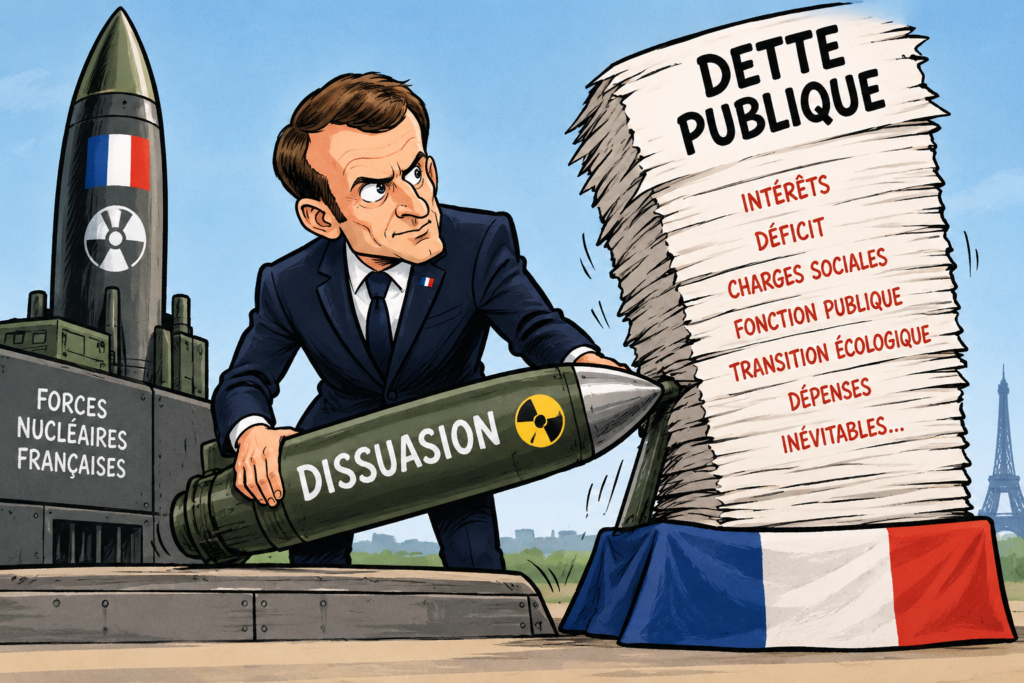
On the home front, despite a plethora of candidates and, according to the polls, public anxiety, the issue of the national debt is perceived in very different ways. Although politicians are aware of it, they avoid tackling it head-on. In a society where, in Jacques Attali’s phrase, people strike out of solidarity with one another’s entitlements ‒ I defend my neighbour’s so that nobody comes after mine – they know full well that raising the issue and offering answers means calling privileges and/or hard-won social rights into question. It means running the risk of displeasing everyone, when it is so easy to promise the moon…
Yet many voters, no doubt alarmed by the worrying statistics published in recent weeks, believe the time has come to act. But since the botched dissolution of 2025, France has settled into a paralysing political instability worthy of the Fourth Republic. In a climate where everyone is pulling in opposite directions, setting a budget – even a provisional one, even a forecast – has become an ordeal. On top of the budget deficit come the primary deficit (public accounts excluding debt interest payments) and the trade and balance-of-payments deficits. As no reform has been undertaken, unlike in more heavily indebted countries, room for manoeuvre is shrinking and the wall is drawing closer. Probably not the wall of default, but rather the one erected by international financial institutions and by investors who are now reluctant to buy 30-year French debt.
This difficult situation does not spare the international front, where only one form of multilateralism now prevails: that of tensions. The hybrid war waged by Russia shows no sign of abating, and Moscow plans to devote increasing resources to it for at least the next three years. Meanwhile, American foreign policy has become unreadable and chaotic. In these circumstances, Europeans are caught in a vice between a bellicose imperial power and a protective ally that is increasingly indifferent to their fate. It constantly brandishes the threat of leaving NATO on the grounds that member countries do not spend enough on buying American military equipment. And in this affair, the cost of NATO insurance is at stake almost as much as the American nuclear umbrella.
Last March, President Emmanuel Macron tried to seize the political opportunity offered by this new state of affairs by invoking the autonomy of French deterrence which, while retaining sovereign decision-making, could be extended to interested European countries. Nine expressed interest: Germany, Poland, the Netherlands, Belgium, Greece, Sweden, Denmark, Norway and even the United Kingdom. The latter has its own nuclear weapons, yet depends on the United States in this field. This strengthening of the European pillar could drive a wedge into the NATO system, which the same president had previously, and in other circumstances, described as “brain-dead”. Given the decision-making autonomy and sovereignty being claimed, financing an expanded arsenal would have to rely on French budgetary efforts alone.
Given the current state of the national debt, one may question the wisdom of this stance. Indeed, in view of France’s external pressures and internal constraints, the prospect of a European contribution to this programme cannot perhaps be ruled out. What form might the deal take? From a kind of “nuclear levy” to some special tolerance of budgetary slippage, opportunities could emerge to organise nuclear insurance for the Old Continent while offering France ways out that would allow it to return to budgetary stability in a more controlled setting.
This question, which falls squarely within the president’s sovereign functions, seems for now to have found no political echo in the debate under way ahead of the presidential election. And in a twist of historical irony, the prospect of a French nuclear umbrella spread over Europe comes from the very country that in 1954 torpedoed the idea of the famous European Defence Community which, admittedly, would have come under US supervision…
Translated from French. The French original prevails.