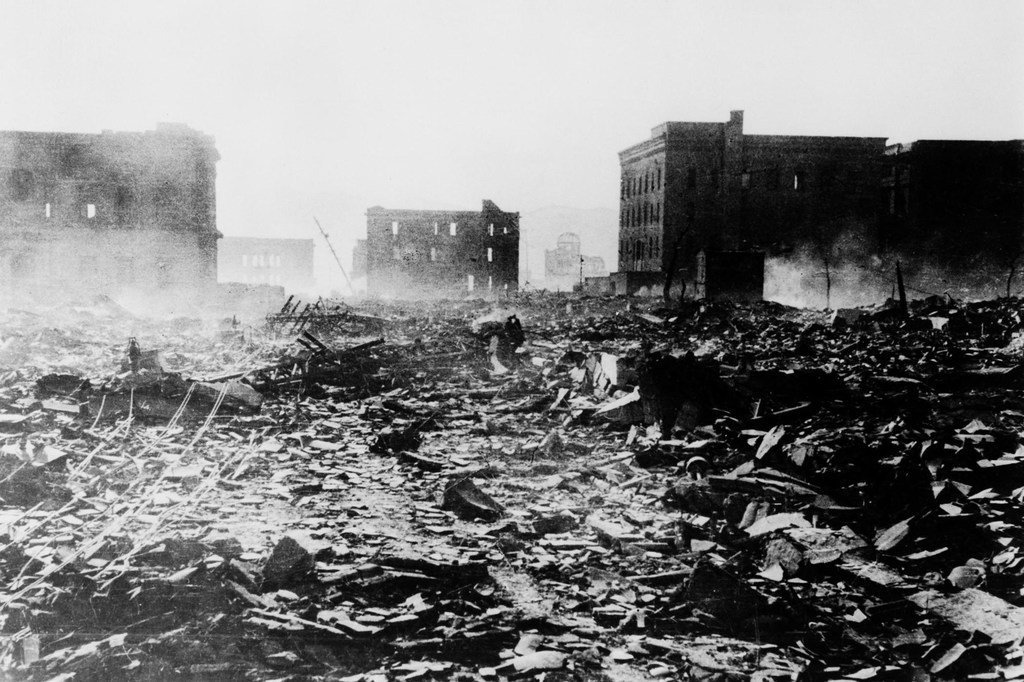
Hiroshima, shortly after the United States dropped a nuclear bomb on the Japanese city in August 1945.Photo: UN/Mitsugu Kishida
For the first time in more than half a century, the world finds itself without any legally binding ceiling on the strategic nuclear arsenals of the two leading nuclear powers.
The expiry of the New START treaty on Thursday 5 February marks “a grave moment for international peace and security”, the UN Secretary-General warned in a solemn statement issued on Wednesday evening in New York.
Signed in Prague in 2010 and in force since the following year, the treaty capped the number of strategic nuclear weapons deployed by the United States and the Russian Federation, which between them hold the overwhelming majority of the world’s stockpile. Its demise leaves behind a bare landscape, with no verifiable safeguards, at a time when nuclear rhetoric has regained a central place in contemporary conflicts.
A patiently built legacy, now dissolved
“Throughout the Cold War and its aftermath, nuclear arms control between these governments helped to prevent catastrophe,” recalled António Guterres.
This is no ritual formula. From the SALT agreements of the 1970s to the first START treaties of the 1990s, thousands of warheads were withdrawn from arsenals, inspection mechanisms were put in place and red lines were clarified. The architecture was imperfect, but it narrowed the scope for error and misunderstanding.
“The risk of a nuclear weapon being used is the highest in decades”
This painstakingly built edifice is now collapsing all at once. “For the first time in more than half a century, we face a world without any binding limits on strategic nuclear arsenals,” the UN chief observed, stressing that this rupture comes “at the worst possible time”, when “the risk of a nuclear weapon being used is the highest in decades “.
The lure of the void
The danger is not only one of numbers. Without a common framework, every modernisation becomes suspect and every military exercise a signal that may be misread. The absence of rules breeds mistrust, and mistrust speeds up rearmament spirals. “When combined with other measures, arms control has prevented devastating miscalculations,” Mr Guterres insisted, recalling that nuclear stability rests as much on transparency as on deterrence.
In a world fractured by geopolitical rivalries, the legal vacuum acts like a draught pulling in air. Nothing now obliges Washington and Moscow to account for the number of warheads they deploy, and nothing formally governs how their strategic forces develop.
Turning words into deeds
Yet the Secretary-General refuses to give in to fatalism. “Even in this moment of uncertainty, we must seek hope,” he said, seeing in this rupture “an opportunity to reset” arms control and to build “a regime suited to a rapidly evolving context”. He welcomed the fact that the leaders of the two countries had recognised “the destabilising impact of a nuclear arms race” and the need to avoid one.
The appeal is direct: “The world now looks to the Russian Federation and the United States to translate words into action.” António Guterres urges them to “return to the negotiating table without delay” in order to agree on “a successor framework that restores verifiable limits, reduces risks and strengthens our common security”.
Failing that, the era now beginning would be one of disarmament in reverse: fewer rules, more suspicion, and a world facing the rule of the unchecked.
Translated from French. The French original prevails.