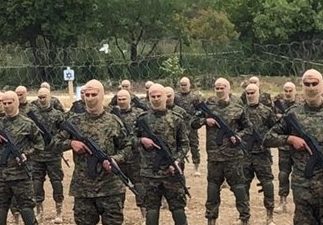
A parade by Hezbollah’s armed militia in southern Lebanon.
As talks continue on a possible easing of sanctions against Iran, several diplomatic and regional sources believe that Tehran could step up its financial support for its armed allies in the Middle East, notably Lebanon’s Hezbollah.
According to Reuters, Iranian officials have reportedly assured Hezbollah that it would receive greater financial aid if some of the Iranian assets currently frozen abroad were released. Lebanese sources cited by the agency also say that Tehran has pledged to provide funds swiftly to its main regional partner.
A weakened Hezbollah, but still vital to Tehran
Hezbollah has emerged severely weakened from the recent clashes with Israel. Loss of life, the destruction of infrastructure and the erosion of its military capabilities have taken their toll on the Lebanese Shia organisation.
Before the conflict, Western estimates put Iran’s direct aid to Hezbollah at between 700 million and one billion dollars a year. These resources funded fighters’ salaries, social services and the movement’s media, as well as part of its military activities.
Hezbollah remains a central element of Iran’s regional strategy. Founded with the backing of the Revolutionary Guards in the 1980s, it is generally regarded as Tehran’s main armed proxy in the region.
The axis of resistance, a pro-Iranian network spanning the entire region
Hezbollah is part of a network of allied groups known as the “axis of resistance”.
In Yemen, the Houthis have for years received Iranian support in the form of military training, drones and missiles. Their ability to disrupt shipping in the Red Sea has made them increasingly important strategically in Tehran’s eyes.
In Iraq, several Shia militias close to Iran, including Kataib Hezbollah, Asaib Ahl al-Haq and Harakat Hezbollah al-Nujaba, have received funding, weapons and operational support from the Quds Force, the branch of the Revolutionary Guards responsible for operations abroad.
In the Palestinian territories, Hamas and Palestinian Islamic Jihad have also received Iranian financial and military support. Relations between Tehran and Hamas have, however, gone through periods of tension, notably during the Syrian civil war.
Until the fall of Bashar al-Assad’s regime, Syria also occupied a key place in this regional set-up, serving as a logistics corridor between Iran and Hezbollah.
What is at stake in a possible unfreezing of Iranian assets
The exact amount of frozen Iranian assets remains difficult to establish and varies from one estimate to another. In recent years, some Iranian officials have cited figures in excess of $100 billion. Several Western analyses, however, suggest that the sums actually available would be far lower, as part of the funds is already committed or held in the form of illiquid assets.
Among the assets most often mentioned are oil revenues blocked in several countries, notably South Korea, Iraq, China and Japan. In 2023, an agreement allowed the transfer of some $6 billion of Iranian funds held in South Korea to supervised accounts in Qatar. Under that agreement, the funds were to be used exclusively for humanitarian purchases, under the oversight of the authorities concerned.
According to several observers, Iran’s ability to bolster its regional influence once again will depend largely on how negotiations with the United States develop and on access to a portion of these frozen assets.
In Washington, this prospect is a source of concern. US officials regularly reiterate that any released funds must not be used to finance armed groups allied with Tehran. Under previous mechanisms for transferring or unfreezing funds, the United States has generally imposed restrictions limiting their use to humanitarian goods, such as medicines, food or medical equipment.
Tehran argues, however, that money is fungible: even when certain funds are earmarked for specific uses, easing financial pressure can make it possible to channel other budgetary resources towards strategic priorities.
The terms of any future unfreezing will depend on the agreements reached between the various parties. Several experts believe that Washington will seek to maintain control mechanisms or sectoral restrictions in order to limit the risk of these resources directly benefiting Iranian-backed armed groups. The real effectiveness of such measures nonetheless remains a matter of debate among specialists.
For their part, the Iranian authorities reject these accusations and insist that the funds rightfully belong to the Iranian state. Beyond the diplomatic discussions, one question remains: if sanctions are eased and the frozen assets are indeed released, how much of these resources will go to the Iranian economy and how much will be used to support Tehran’s regional allies?
For many analysts, the answer to that question could have a lasting impact on the strategic balance of the Middle East in the years ahead.
Translated from French. The French original prevails.