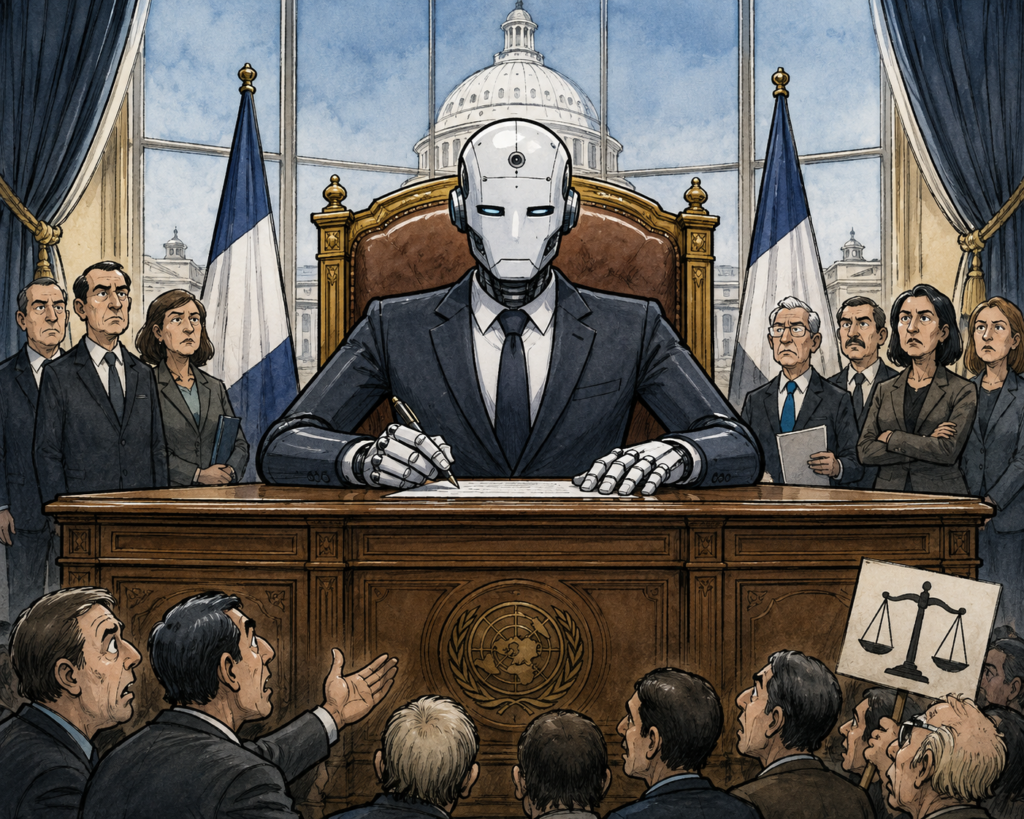
Illustration created with AI.
We may be living through a political revolution as profound as the one that gave birth to representative democracy more than two centuries ago. Having gradually replaced physical force with law, and then law with technocracy, our societies could tomorrow be tempted to replace those who govern them with artificial intelligences. The idea seems absurd. Yet it is less far-fetched than it appears.
For never have Western democracies harboured such doubts about those who lead them. Abstention rates are rising, traditional parties are collapsing, coalitions are becoming unstable, and changes of government often seem to produce the same public policies with different faces. Meanwhile, hundreds of millions of people turn to an artificial intelligence every day to draft their letters, solve their problems, weigh up their decisions or organise their work. We already trust machines to think alongside us. Why would we one day refuse to let them govern alongside us?
The machine at the helm
We already ask artificial intelligence to write speeches, diplomatic notes, corporate strategies, administrative decisions, expert reports, military analyses, medical diagnoses and even preparatory judgments. Why should we go on electing leaders who are supposed to produce for themselves what algorithms can now accomplish in a matter of seconds?
An artificial intelligence even possesses qualities that have become rare in politics. It does not embezzle public funds, create fictitious jobs, or have a patronage network, a shadowy adviser or a secret bank account abroad. It does not age, never tires, and never governs out of anger, ego or personal ambition. It works without a break and can instantly analyse millions of pieces of data that no human being could ever absorb. At first glance, the ideal leader. It already knows the parties’ manifestos, commands volumes of information beyond the reach of a human brain and responds, in theory, without yielding to the passions of the moment.
Leaders already largely stripped of power
Yet the provocation reveals a far deeper reality. What do we still really expect of a head of state? In much of the Western democratic world, national room for manoeuvre is shrinking. Financial markets impose their constraints, central banks steer monetary policy, and international organisations, supranational courts and economic or climate commitments constrain a growing share of political choices. Governments administer more than they truly lead.
Election campaigns, moreover, look increasingly alike. The slogans change, the posters evolve, the candidates come and go, but the promises remain almost identical: more security, slightly lower taxes, better-controlled immigration, greater purchasing power, a pragmatic green transition, a more efficient state. There are differences, of course, but the overriding impression is of a politics that has become essentially managerial. Yet management is precisely what algorithms excel at. Some will therefore inevitably end up wondering whether an artificial intelligence might not outperform politicians whose freedom of action appears ever more limited.
Global governance assisted by artificial intelligence?
The real question now goes far beyond national elections. As crises become global — climate, pandemics, cyberattacks, artificial intelligence, finance, hybrid conflicts or migration — the responses, too, demand ever more global coordination. Why should some not eventually conclude that an artificial intelligence would be better placed than national leaders to arbitrate between these conflicting interests?
An AI could model thousands of diplomatic, economic or military scenarios before each decision, anticipate the side effects of a reform, measure the budgetary consequences in real time, calculate environmental impacts or detect geopolitical risks with unprecedented processing power. It would become less a leader than a vast system for steering complexity. In some highly technological states, this prospect might even appear to be a logical evolution rather than a dystopia.
But can a democracy survive without embodiment?
Yet this is where the real obstacle arises. A democracy is not merely a system of optimisation. A people does not elect a manager alone. It also chooses an embodiment. A president, a prime minister or a constitutional monarch represents a history, a memory, a continuity. They offer reassurance, take responsibility for failures, carry the nation’s grief, celebrate its victories and speak when everything is faltering. Between a people and the person who leads it there exists an almost physical bond, made of emotion, trust and sometimes affection. No algorithm, however powerful, is likely ever to replace this profoundly human dimension entirely. Nations do not live on statistics alone; they also live on narratives, symbols and a certain idea of themselves.
The paradox of our age
The irony may lie elsewhere. It is probably not machines that will replace humans; it is humans who will end up governing like machines. By steering their decisions through dashboards, indicators, predictive models, constant polling and talking points, many politicians already give the impression of having become the executors of a vast algorithmic logic. The line between human and artificial governance is gradually blurring, all the more so as artificial intelligence tools are themselves becoming actors in public decision-making, military planning, the running of administrations, health policy and even judicial systems. The question is therefore no longer whether artificial intelligence will play a part in governing democracies: it already does. The real question is how far we will be willing to delegate our sovereignty to it.
One fundamental contradiction remains. The most powerful artificial intelligence systems are today being developed by a handful of private companies, mostly American. They are neither politically neutral nor sovereign. The day a democracy delegated a decisive share of its power to an artificial intelligence designed elsewhere, it would also be surrendering part of its strategic autonomy. The question of digital sovereignty would then become as essential as that of political sovereignty.
Perhaps the future lies neither in a democracy run by machines nor in a democracy that stubbornly refuses them. It will probably lie in a new balance in which artificial intelligence assists those in power without ever being able to replace them entirely. For governing is not merely a matter of calculating the best decision. It also means accepting uncertainty, bearing moral responsibility and sometimes choosing against the numbers, in the name of values, of a culture or of a certain idea of humanity.
Artificial intelligence systems will doubtless become the best advisers that leaders have ever had. It remains to be hoped that democracies will continue to produce women and men capable of shouldering, alone, the ultimate burden of decision. For the day a people prefers to entrust its destiny to a machine rather than to one of its own, it will probably not be a victory for artificial intelligence. It may, above all, be an admission that our democracies are exhausted.
Translated from French. The French original prevails.