© WHO India/Rajiv Solanki. A health worker in India uses a mercury-free device to check a patient’s blood pressure.
The World Health Organization is emerging bruised but determined from a year that its Director-General does not hesitate to describe as one of the most gruelling in its history. “Significant cuts to our funding left us with no choice but to reduce the size of our workforce,” Tedros Ghebreyesus acknowledged in Geneva on Monday.
Behind the activity report presented to the UN agency’s Executive Board, a deeper transformation is taking shape: that of a WHO forced to rethink its economic model, its independence and its place in a global health ecosystem that is being reshaped.
On paper, 2025 brought major advances, from the adoption in May of the WHO Pandemic Agreement and the entry into force in September of amendments to the International Health Regulations (IHR) on cooperation in public health emergencies, to a further increase in the spring in the assessed contributions of the agency’s Member States.
But in the corridors of the organisation, the reality has been harsher. Abrupt reductions in bilateral aid have weakened entire health systems and caused “major disruptions” in many countries, the Director-General stressed, recalling that WHO was only “one part of a much bigger picture”.
An independence still incomplete
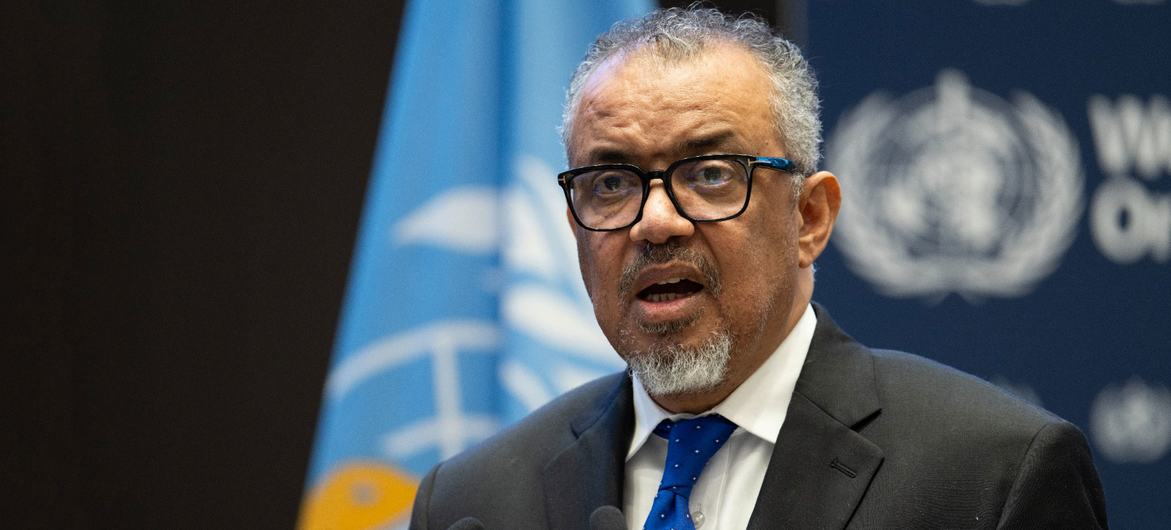
The Director-General of the World Health Organization (WHO), Tedros Adhanom Ghebreyesus, delivers his opening address at the 156th session of the agency’s Executive Board in Geneva.
At the heart of the speech lay one conviction: the crisis had been foreseen. “When we launched the transformation of WHO more than eight years ago, we identified our over-reliance on a handful of donors as a major risk,” Mr Ghebreyesus explained. Since then, the organisation has embarked on a path aimed at raising states’ assessed contributions to 50% of its base budget by 2031. The reform is considered vital to preserving what the WHO chief calls its “independence”.
“Our over-reliance on a handful of donors as a major risk”
“When I speak of independence, I do not mean independence from member states,” he said. “I mean not being dependent on a handful of donors; not being dependent on rigid and unpredictable funding; a WHO that is no longer a subcontractor for the biggest donors; an organisation that is impartial, grounded in science, free to say what the evidence says, without fear or favour.”
Thanks to the reforms under way, WHO says it has secured 85% of the resources needed for the 2026-2027 base budget. The figure is deceptively reassuring, as most voluntary contributions remain earmarked, leaving “pockets of poverty” in areas that are nonetheless strategic, such as health emergency preparedness, antimicrobial resistance and climate resilience.

© UNICEF/Josue Mulala
Emergency aid is ready to be delivered to Kasai province, in the Democratic Republic of the Congo (DRC), in response to an Ebola outbreak.
Doing more with less
This financial strain runs through all of the organisation’s work. In 2025, despite the constraints, WHO claims concrete results, including support for the vaccination of hundreds of millions of people, the fight against outbreaks of Ebola, cholera and polio, and support for health systems in Ukraine, Gaza and Sudan, where nearly 3,000 tonnes of medical supplies have been delivered since the start of the conflict.
“But WHO cannot do everything, and it should not try to,” Mr Ghebreyesus insisted, calling for the organisation to refocus on its core business, namely normative, scientific and technical expertise. “Our superpower is our convening power,” he stressed, citing the more than 800 collaborating centres that can be mobilised to bring governments, researchers, civil society and the private sector into dialogue.
Reforming governance, overhauling the ecosystem
This transformation cannot succeed without a parallel reform of governance, the Director-General warned. “If we want an agile, efficient and effective secretariat, we need agile, efficient and effective governance,” he told member states, calling on them to clarify their priorities and fund them accordingly.
Beyond WHO, the entire “global health ecosystem” is being called on to change, in order to reduce duplication and allocate roles more effectively. The organisation is proposing to launch a joint process to build a system that is “leaner, more collaborative and more impactful”, serving national priorities
“A story of resolve, not austerity”
Tedros Ghebreyesus paid tribute to the organisation’s staff, who have borne the full brunt of the restructuring. “I will remember 2025, as we all should, for them,” he said, praising their commitment despite “the uncertainty of not knowing whether they would still have a job”.
He concluded with a clear political message: “The story of 2025 is not one of austerity, but one of resolve.” It is a resolve that now falls to the member states themselves. “This is your WHO. Its strength is your unity. Its future is your choice.”
Translated from French. The French original prevails.