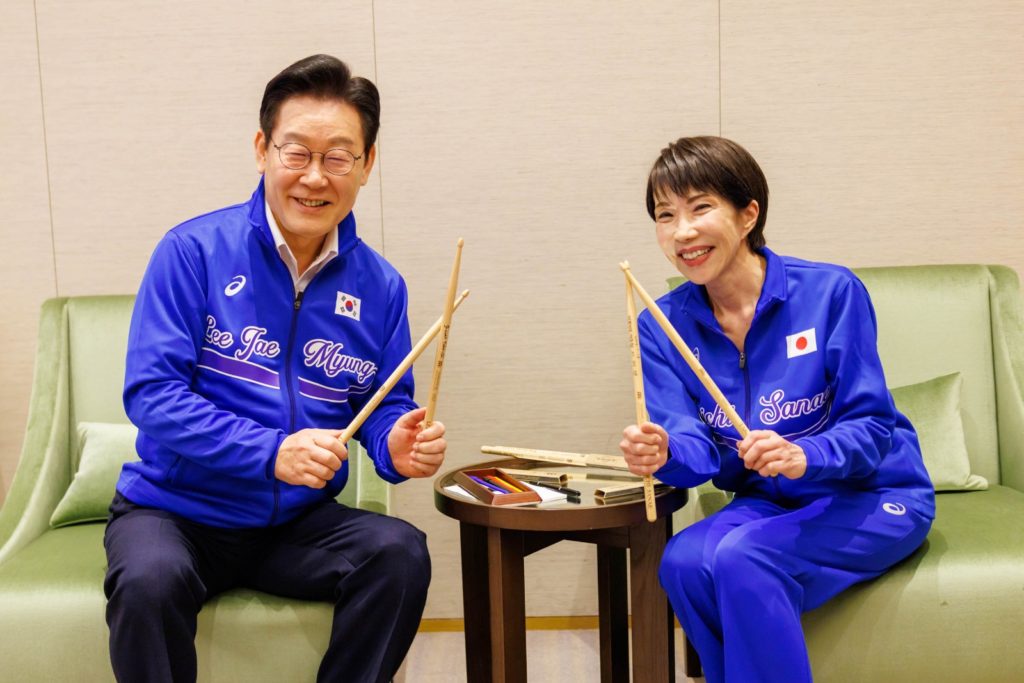
South Korean President Lee Jae Myung and Japanese Prime Minister Sanae Takaichi on 14 January. Photo: Prime Minister’s Office of Japan via AP.
On Wednesday 14 January 2026, South Korean President Lee Jae Myung travelled to Nara Prefecture, Japan, for bilateral talks with his Japanese counterpart, Sanae Takaichi. Their meeting caused a stir on social media and in the press after Lee Jae Myung and Sanae Takaichi both took part in a “drum” session, playing the drums together to the beat of the famous South Korean hits “Golden” (K-Pop Demon Hunter, 2025) and “Dynamite” (BTS, 2020).
This staged moment is a communication strategy that sends a clear message of peace and friendship between the two countries. Such messaging is no accident, coming just days after Lee Jae Myung stood alongside Xi Jinping in Beijing, amid mounting tensions between China and Japan over the Taiwan question.
Beijing’s pressure on Seoul
A week earlier, on Monday 5 January, Lee Jae Myung was in Beijing for talks with Xi Jinping. South Korea maintains partnerships with both Japan and China. Its relations with Japan are particularly well developed owing to their mutual alliance with Washington. Their cooperation extends to military and strategic matters.
However, Beijing remains a crucial trading partner for Seoul. As China is South Korea’s largest trading partner for both exports and imports, maintaining good relations with Beijing is essential for Seoul.
However, its trilateral alliance with Tokyo and Washington obliges it to show restraint towards Beijing. At their meeting in Beijing, Xi Jinping stressed the need to “stand firmly on the right side of history and make the right strategic choices”, referring to the “enormous sacrifices” that led to victory “against Japanese militarism” and adding that “China and the Republic of Korea must join forces to safeguard the fruits of victory in the Second World War and protect peace and stability in North-East Asia”.
Xi Jinping is deliberately using the memory of Japanese militarism to tighten his ties with Seoul and to stoke renewed tension between Tokyo and Seoul.
Xi Jinping’s speech naturally suggests that Beijing expects South Korea to take a stance on Japan. Sanae Takaichi had indeed threatened military intervention in the event of a Chinese invasion of Taiwan. According to the official position of the People’s Republic of China, Taiwan falls under its territorial sovereignty. Japanese military intervention would therefore necessarily be seen as a violation of its territorial integrity and as an act of war. Xi Jinping’s reference to Japan’s colonial past is also a shrewd communication manoeuvre aimed at singling out Japan as a threat to regional stability.
South Korea also has a painful history with Japan. The Japanese occupation of the Korean peninsula in the 20th century was violent, and Japanese soldiers committed numerous war crimes against civilians. This dark chapter in their shared history still taints their present-day relations. It is reasonable to assume that Xi Jinping is deliberately using the memory of Japanese militarism to tighten his ties with Seoul and to stoke renewed tension between Tokyo and Seoul.
Moreover, the United States has military bases in Japan and South Korea. This American military presence close to China is a strategic asset for the United States, but it remains dependent on its strategic alliances with Tokyo and Seoul. Beijing would therefore have every interest in fuelling tensions that would weaken the trilateral alliance between Tokyo, Seoul and Washington.
Japan–South Korea cooperation remains “fragile”
In reality, Xi Jinping would not need to revive the old rivalries between Japan and South Korea. They persist, giving rise to frequent minor diplomatic incidents and also contributing to Japan’s unflattering image in South Korea. Historical and societal issues weaken these diplomatic relations.
Japan’s occupation of Korea from 1905 to 1945 saw crimes committed against South Korean civilians by the Japanese army, and memories of that period remain deeply rooted in Korean culture. Issues linked to the occupation remain sensitive today and weaken diplomatic relations between the two countries. Japan has never issued an official apology for the crimes committed, notably regarding the “comfort women”, Korean women who were forced to serve Japanese soldiers as sex slaves. The question of financial compensation for Koreans who were forced to work for Japan also remains a source of discord.
Lee Jae Myung’s visit to Nara was a significant event in the context of shuttle diplomacy.
The Liancourt Rocks also remain a recurring source of tension. The foreign ministries of both countries regularly issue statements accusing each other of laying claim to the Liancourt islets. This tiny archipelago in the East Sea, halfway between the Korean Peninsula and Japan, is uninhabited and poor in natural resources, yet it has been disputed by Seoul and Tokyo since 1953.
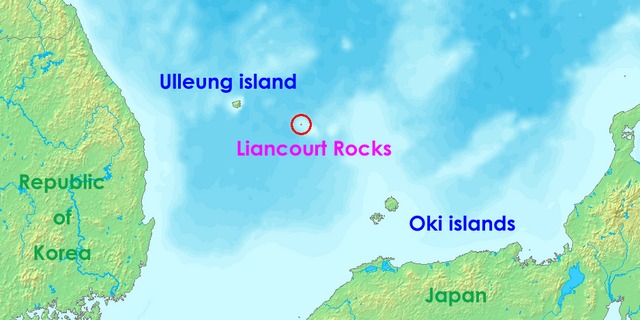
Map showing the location of the Liancourt Rocks.
Lee Jae Myung’s visit to Nara was seen as a significant event in the history of relations between South Korea and Japan, and for what is known as “shuttle diplomacy”: regular meetings between Japanese and South Korean leaders intended to keep diplomatic relations stable and consistent.
This custom is all the more vital given that diplomatic relations between the two countries are relatively recent. The 1962 Japan–South Korea treaty “normalised” relations between the two states after two decades without relations following decolonisation in 1945.
The pressure exerted by Xi Jinping on South Korea, amid Sino-Japanese tensions, is aimed at undermining the regional diplomatic balance in order to weaken rival powers, notably the United States.
Translated from French. The French original prevails.