In March 2025, Geneva was transformed for a few days into a global platform for the Baloch people. The president of the Baloch National Movement (BNM), Dr Naseem Baloch, led an intensive diplomatic campaign there, marked by the 6th International Conference on Balochistan, a demonstration at the Broken Chair monument and a prominent presence outside the United Nations headquarters. His aim was clear: to break the wall of silence surrounding what he described as a “slow and methodical genocide” perpetrated by the Pakistani state against the Baloch.
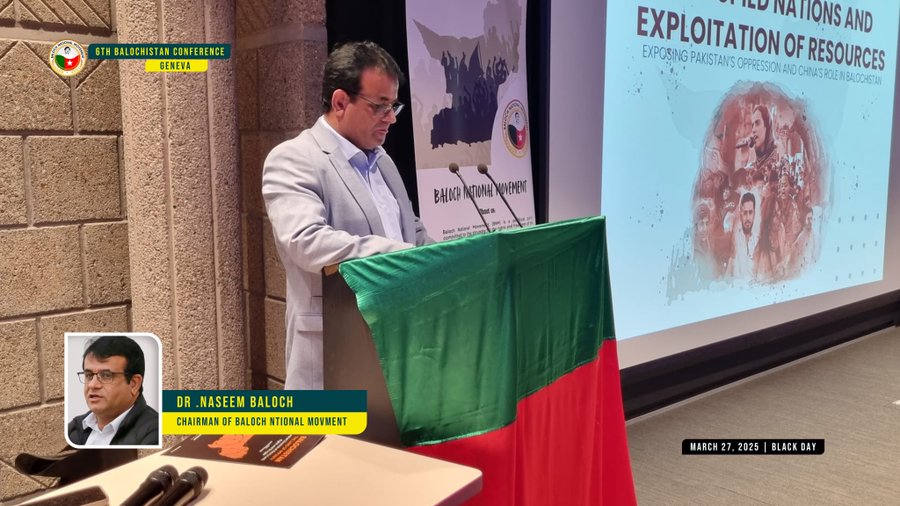
In his opening speech, Dr Baloch spoke words heavy with memory and grief. “Our land is bleeding. The ‘kill and dump’ policy has turned our homeland into a graveyard,” he told an international audience of parliamentarians, intellectuals, activists and journalists. He was referring to the unofficial policy, widely documented by NGOs, under which Baloch civilians – activists, students, doctors, journalists – are abducted, tortured, then executed and dumped in desert areas as a warning to others. “Thousands of our brothers, sisters and children have been abducted, tortured, then left lifeless in the most remote areas. Those who remain live in endless wait for a return, or for a body,” he stressed.
The conference, organised by the BNM, was part of a long history of Baloch resistance. Since 1948, when Pakistan annexed Balochistan — what Dr Baloch calls a “colonial power grab” — the local population has waged an unbroken struggle for recognition of its rights, its autonomy and even its independence. The BNM president repeatedly reminded the audience: “It was not a voluntary union, it was a conquest. Ever since, we have been living under occupation.”
But today’s violence is not merely a distant echo of the past. In March 2025, just days before the conference, a large-scale attack on the Jaffar Express, a train linking Quetta and Peshawar, shocked the country. The Balochistan Liberation Army (BLA), an armed separatist group, claimed responsibility for the assault, in which tracks were blown up and passengers taken hostage. According to the official toll, at least 33 militants were killed, 21 passengers died and more than 400 hostages were freed at the end of a 30-hour military operation. The problem, according to BNM representatives, is that this information cannot be verified. Journalists’ access to the region is strictly forbidden to any independent press. “Everything you read about us passes through the prism of our oppressors,” Dr Baloch lamented. “No free media can get in. The cameras that are filming belong to those who oppress us.”
This stifling of information is, in his view, part of a strategy of narrative control and disinformation. Incidents are presented as terrorist acts without context, and the victims as enemies of the state. Dr Baloch was emphatic on this point: “The repression we are experiencing is not a series of mistakes or isolated abuses. It is a policy. And it is a crime against humanity.”
The Baloch leader’s address also cast a sharp light on the situation of women. Historically, Baloch women have been central figures in the resistance — as protesters, educators, doctors and poets — but today they are becoming prime targets. “Women such as Dr Mahrang Baloch, abducted and imprisoned without trial, or Sammi Deen Baloch, beaten for protesting peacefully, embody our courage. And for that, they are being attacked with redoubled violence.”
Beyond the testimonies, the Geneva conference produced a call to action. Dr Baloch addressed Western democracies directly: “How can you preach human rights while supporting a state that systematically violates them? Silence is not neutrality. It is complicity.” He called on the UN to dispatch an independent fact-finding mission to Balochistan, on international NGOs to step up their coverage of the region, and on democratic countries to reassess their relations with Pakistan. “We are not asking you for charity. We are asking you to be consistent with your own values.”
The conference ended on a note of hope, carried by the words of the BNM president: “Despite the disappearances, the massacres, the pain, we are still here. We will not give up. We will not be silenced. Our freedom is not an aspiration — it is a right.” He concluded: “May this meeting not be a mere interlude. May it mark the beginning of a renewed commitment. For our martyrs. For the mothers searching for their children. For our daughters who are no longer afraid of guns.”
The event also brought together many voices of solidarity: the British MP John McDonnell, the intellectual Reed Brody, the activist Eleonora Mongelli, the Baloch veteran Mir Mohammad Ali Talpur, as well as representatives of the Sindhi and Pashtun movements. Together, they asserted that the Baloch cause was not an isolated one but emblematic of the struggles for the rights of oppressed peoples around the world.
Translated from French. The French original prevails.