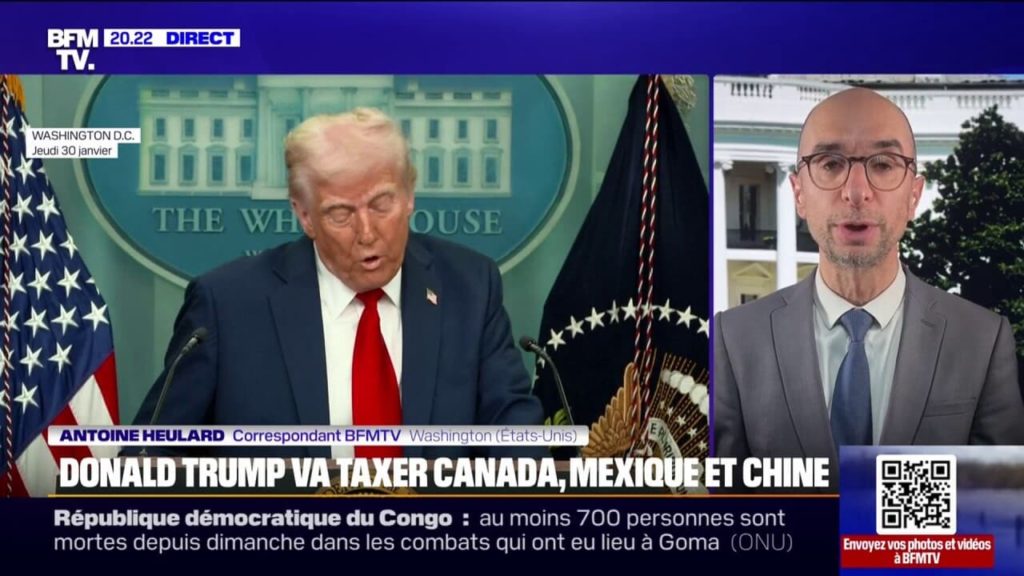
Donald Trump’s return to the American political stage is reshuffling the deck of global diplomacy and confronting Canada with new challenges. The former president, known for his protectionist approach and his rejection of multilateral commitments, has already hinted that he could call several bilateral agreements with Ottawa into question. “If Trump comes back, we must prepare for a diplomacy of confrontation,” warns Roland Paris, a former foreign policy adviser to Justin Trudeau.
Since the end of the Cold War, Canadian diplomacy has developed under the banner of multilateralism, respect for international law and the promotion of human rights. However, the geopolitical shifts of recent years, marked by rising tensions between great powers, the erosion of the multilateral system and a proliferation of international crises, are confronting Canada with new challenges. Against this backdrop, Canadian diplomacy must tread carefully to safeguard the country’s interests and its influence on the international stage.
Historically, Canada’s foreign policy has rested on several fundamental pillars: a strong commitment to multilateralism, particularly within the United Nations and NATO; the promotion of human rights and democratic governance; a policy of peace and stabilisation, with active involvement in peacekeeping missions; and a strategic relationship with the United States, the country’s leading trading partner and military ally. Today, however, these principles are being tested by an increasingly polarised international environment.
The strategic confrontation between China and the United States directly affects Canada, which must balance its relations with the two superpowers. The Meng Wanzhou affair illustrated the risks of this fragile diplomatic balancing act, not least because the arrest of the Huawei executive had led to tensions with Beijing and the detention of two Canadian citizens in retaliation. Today, China is adopting a more assertive stance, making Ottawa’s task even more complex. “Canada does not have the room for manoeuvre of a great power and must play the card of discreet influence,” says Professor Guy Saint-Jacques, a former Canadian ambassador to Beijing.
With the United States’ withdrawal from several international agreements under the Trump presidency, and the proliferation of geopolitical conflicts, Canada has seen its room for diplomatic action shrink. Faced with a weakened UN, Ottawa is seeking to strengthen regional and sectoral alliances, such as the Canada-European Union agreement or its membership of the Trans-Pacific Partnership. But these efforts come up against a hard reality: Canada cannot on its own make up for the loss of an actor as central to the international order as the United States.
The war in Ukraine has hardened Canada’s sanctions policy against Moscow and strengthened its commitment to supporting Kyiv, both diplomatically and militarily. Justin Trudeau has declared that “Canada will stand with Ukraine for as long as it takes”, but this stance is not without risk. Not only does it expose Ottawa to retaliatory measures from Russia, but it also forces a rethink of supply flows for energy and critical resources.
Canada is also striving to take a leading role in the fight against climate change, notably by promoting initiatives such as clean energy financing in developing countries. However, domestic criticism of its actual commitment and of its oil and gas exports tempers this ambition. “You can’t claim to be a climate leader while being a major exporter of fossil fuels,” says Catherine Abreu, director of Destination Zéro, bluntly.
Although relations between Ottawa and Washington remain solid, some trade disputes persist, notably over aluminium, softwood lumber and American protectionist policies. Canada must continually renegotiate its economic interests with its powerful neighbour. “We have always been the second-tier partner in the eyes of the Americans, but we must remain vigilant to protect our economy,” explains the economist Armine Yalnizyan.
Faced with these challenges, Canadian diplomacy must adapt its strategies and strengthen its role on the international stage. Several strategic avenues stand out: diversifying alliances by strengthening relations with the European Union, Africa and South-East Asia; leadership in climate diplomacy by capitalising on its expertise in clean energy and facilitating the green transition; economic resilience by exploring new markets and reducing its trade dependence on the United States and China; and consolidating multilateralism by playing an active role in the reform of international institutions.
In an era marked by mounting tensions and shifting balances of power, Canadian diplomacy must show pragmatism and flexibility. As the world prepares for the possible re-election of Donald Trump, Ottawa must anticipate the shocks ahead and redefine its priorities so as not to be at the mercy of the geopolitical upheavals to come.
Translated from French. The French original prevails.