The drone attack on the Energos Winter, a US floating storage and regasification unit stationed in the Egyptian port of Damietta, is now having an immediate logistical impact. According to initial reports, one LNG cargo has been diverted to Aqaba, in Jordan, and eight others could follow on a temporary basis. One tank is reported to have been punctured, and the two vessels hit at Damietta are expected to remain out of service. The perpetrator remains unknown, but the incident is already altering Egypt’s supply routes.
An attack confirmed, more serious damage
The Egyptian Cabinet confirmed on 30 July that the fire which broke out the previous day aboard two vessels in the port of Damietta had been caused by a drone. This conclusion rules out the possibility of a malfunction or an industrial accident: a deliberate attack was carried out inside a major Mediterranean port. According to Reuters, the drone struck the starboard side of the Energos Winter. The fire then spread to the GasLog Salem, an LNG carrier moored nearby. Egyptian crews brought the fires under control and no casualties were reported. The Minister of Petroleum, Karim Badawi, visited the site to oversee operations.
Initial assessments nevertheless suggest that the damage is far from negligible. A source quoted by Reuters said that one of the Energos Winter’s tanks had been punctured. Both vessels are expected to remain out of service for some time. According to the Wall Street Journal, citing the maritime tracking firm Kpler, they were moved offshore during the technical assessment, while operations at the LNG import hub were disrupted.
These details change the initial assessment. No one was killed, but the operation achieved a tangible result: it put two vessels out of action, disrupted the terminal and forced Cairo to reorganise some of its deliveries.
A strategic capacity already bypassed via Aqaba
The Energos Winter is no ordinary merchant ship. It is a floating storage and regasification unit, or FSRU. It receives liquefied natural gas delivered by LNG carriers, stores it and then returns it to a gaseous state before it is fed into the national grid. Its regasification capacity is around 450 million cubic feet per day. That represents nearly 7% of Egypt’s daily gas consumption and around 16% of its total LNG reception and regasification capacity, according to figures cited by Reuters. Its storage capacity is around 138,250 cubic metres.
The unit had been chartered for five years to provide a lasting boost to the country’s security of supply. A month before the attack, Karim Badawi had presented it as one of the four FSRUs deployed by Egypt, the other three being stationed at Sokhna. The target was therefore neither marginal nor temporary: it was part of the system put in place to prevent gas shortages and power cuts.
According to the first information available on 30 July, an LNG cargo originally bound for Damietta was diverted to the Jordanian port of Aqaba. The Egyptian Ministry of Petroleum is reportedly planning to send eight more cargoes there temporarily, as a precaution, to be regasified. The choice of Aqaba is no improvisation. The FSRU Energos Force is connected there to the Arab Gas Pipeline and can supply both the Jordanian and Egyptian grids. Together with the three units at Sokhna, this solution averts an immediate disruption, but it entails additional delays and costs. Above all, it gives the attack an immediate economic impact: a single drone was enough to shift part of the regasification operations to another country.
After Hormuz and Bab el-Mandeb, the Mediterranean
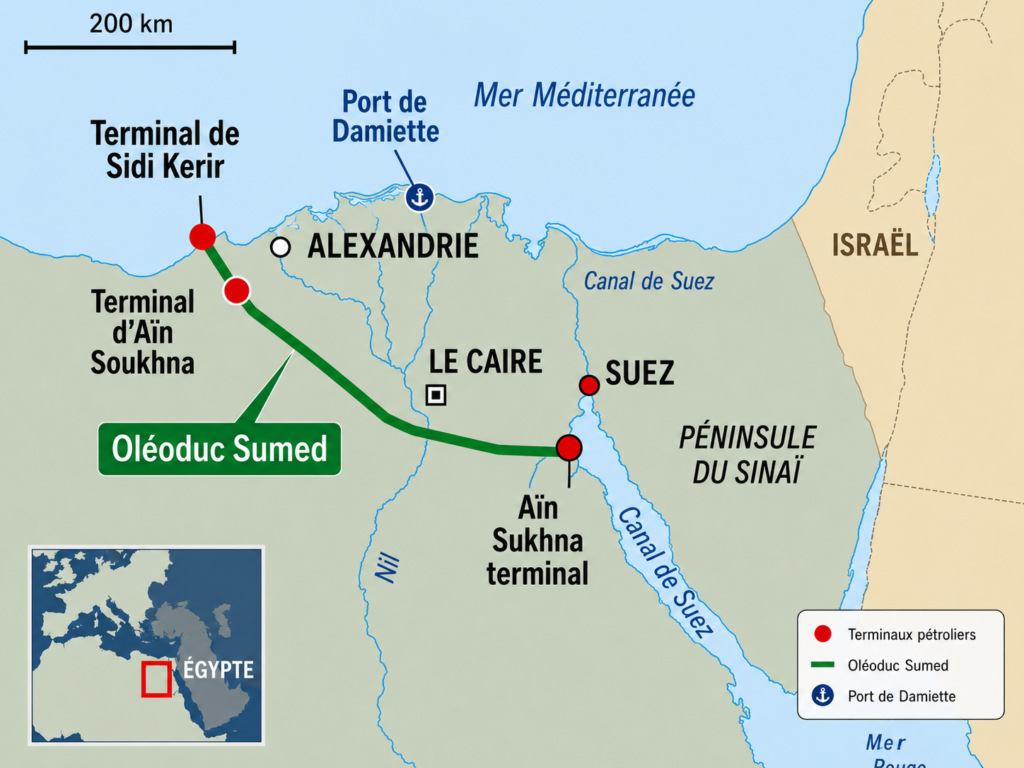
Since the start of the war in the Gulf, the region’s energy geography has been reorganised around bypass routes. The Strait of Hormuz remains Iran’s main lever over Gulf exports. Bab el-Mandeb and the Red Sea are under pressure from the Houthis. Producers have therefore sought alternative routes: pipelines to the Red Sea, the Suez Canal, the Sumed pipeline and Mediterranean terminals.
Damietta lies less than 65 kilometres from the northern entrance of the Suez Canal. The canal was not targeted, and there is nothing to suggest that shipping through it is directly threatened. But the attack shatters the notion that infrastructure located north of the Red Sea is automatically a safe haven.
The paradox is becoming clear: the more states multiply alternative routes to escape threatened straits, the more new pressure points they create. Terminals, pumping stations, FSRUs, loading ports and cross-border networks in turn become potential targets.
The significance of the signal extends beyond the Egyptian gas market. Suez and the Sumed pipeline have become essential for cargoes seeking to avoid Hormuz and the southern Red Sea; Damietta shows that Mediterranean installations close to this corridor can also be hit. Damietta thus adds a third theatre to the energy war. Hormuz makes it possible to threaten the passage of hydrocarbons. Bab el-Mandeb makes it possible to disrupt their flow to Europe. A strike on an FSRU targets a country’s ability to receive and process energy once the ships have arrived. It marks a further threshold.
Iranian trail grows stronger, but remains unproven
No organisation has claimed responsibility for the operation and the Egyptian government has issued no official attribution. Such caution remains essential. The model of the drone, its launch point, its trajectory and its chain of command have not yet been made public. Several reports nonetheless lend weight to the Iranian hypothesis. The New York Times reported, citing two Iranian sources familiar with security matters, that the attack was reportedly carried out by a kamikaze drone and was meant to be understood as a warning about the capacity to cause greater disruption to shipping and energy supplies.
The Wall Street Journal reports that Egyptian officials initially suspected Iran and interpreted the attack as an attempt to widen the conflict. Donald Trump also blamed Tehran, without presenting any public evidence. The strike came shortly after Iranian fire against US forces in Jordan and US-Saudi attacks on Tehran-aligned groups in Iraq. This timing proves nothing, but places Damietta within the sequence of regional escalation.
These statements do not amount to technical proof. They nonetheless show that the Iranian hypothesis is being examined within the governments concerned. Tehran may have opted for ambiguity: striking a US asset, showing that the Mediterranean is not out of reach and maintaining enough uncertainty to complicate any retaliation.
Egypt enters the impact zone
Cairo has so far sought to maintain a balancing act: protecting its interests, upholding freedom of navigation and taking part in mediation efforts without joining the confrontation directly. Damietta undermines that posture. For the first time in this war, Egyptian territory has been the scene of an attack on a strategic infrastructure asset linked to American interests. Egypt had kept channels of communication open with Tehran while remaining a strategic partner of the United States. Striking at Damietta therefore amounts to testing how far Cairo can remain neutral when its own infrastructure becomes vulnerable.
The distinction between the target and the territory remains crucial. If the Energos Winter was the main objective, the perpetrator may have sought to hit an American asset while avoiding a direct attack on the Egyptian state. If the gas terminal or Damietta’s role in the energy sector was the target, the message sent to Cairo would be far more serious.
Either way, Egypt will have to step up surveillance of Damietta, Sokhna, Idku, Sidi Kerir and the facilities near Suez. A low-cost drone has already forced inspections, the immobilisation of vessels, the rerouting of cargoes and the deployment of far more expensive means of protection. The official silence over who was responsible therefore reflects calculation rather than hesitation. Accusing Iran without sufficient evidence would oblige Egypt to retaliate or to admit that it is unable to do so. Conversely, saying nothing for too long would give the impression that a major infrastructure asset can be struck with impunity.
From a war of the straits to a war on infrastructure
Damietta does not yet prove the existence of a coordinated campaign against every energy route in the Middle East. It may have been a one-off attack on an American asset, an Iranian or pro-Iranian operation intended to open a Mediterranean front, or a provocation designed to drag Egypt into the war. The investigation must now establish four things: the type of drone and its payload, where it was launched from, the precise target and who gave the order. Analysis of the fragments, the electronic components and the guidance data will be more conclusive than anonymous statements.
A threshold has nevertheless been crossed. A Mediterranean regasification facility has been hit at a time when Hormuz and Bab el-Mandeb are already under pressure, and cargoes have begun to be diverted. The war is no longer targeting only the chokepoints, but also the infrastructure that makes it possible to bypass them. If a link to Iran or one of its proxies is established, Damietta will stand as the first demonstration of a strategy aimed at extending the energy war to the Mediterranean. If not, the incident will remain a major warning: no alternative route is safe when its ports, ships and facilities can be approached by a drone.
Further reading from La Tribune des Nations:
Hormuz: negotiation gives way to armed intimidation
After Hormuz, Bab el-Mandeb: the new front in the energy war
Iran–United States: war redraws the strategic architecture of the Middle East
External sources and further reading:
Reuters — Egypt confirms drone caused fire on two gas vessels at Damietta, 30 July 2026
The Wall Street Journal — Egypt Suffers First Drone Attack, Widening the Iran War, 30 July 2026
New York Post — IRGC warns “aggressor” will be “punished” as Iran hits Jordan, Kuwait, 30 July 2026
Translated from French. The French original prevails.