By Jean-René Belliard — 31 July 2026
| Meeting in Cairo, Egyptian, American, Qatari and Turkish mediators, together with Hamas officials, agreed the broad outlines of a roadmap providing for the gradual disarmament of the Islamist movement and of Gaza’s other armed groups. The process, under which Israel would not be directly responsible for collecting or neutralising the weapons, is to be carried out in stages. But its timetable and enforcement mechanisms will be drawn up only within the fourteen days following the approval of the text. Donald Trump is therefore proclaiming “complete disarmament” even though Israel, Hamas and the mediators already attach different meanings to the words and a different order to the stages. |
A “historic” deal whose instructions have yet to be written
Meeting in Cairo, Egyptian, American, Qatari and Turkish mediators, together with Hamas officials, agreed on a document setting out the principles of the second phase of the Gaza ceasefire. The roadmap provides for the transfer of civil administration and security functions to a Palestinian committee, the gradual withdrawal of Israeli forces and the handling of the weapons of Hamas and the other armed groups.
Donald Trump, however, did not wait for the details to be settled. In a triumphant statement, the US president announced that his Board of Peace had reached a “historic” agreement on the “complete disarmament” of Hamas and all other armed organisations present in the Gaza Strip. Reuters reports that the announcement comes even though Israel has not accepted the document in its current form.
| “When disarmament is complete, Israeli forces will withdraw, and the International Stabilization Force will work with a new Palestinian police force to take over responsibility for security in Gaza.” Donald Trump, 30 July 2026 |
An institutional clarification is in order: the Board of Peace is not a United Nations body. It was set up on Donald Trump’s initiative and he remains its chairman. The Security Council has recognised the transitional framework and authorised a temporary international force, but the arrangement is not to be confused with the UN. The official plan published by the Board provides for Gaza to become a demilitarised zone and for its military infrastructure to be destroyed. The 20-point plan is, however, a general objective; the new roadmap has yet to set out how it will be implemented.
Fourteen days to set the timetable and mechanisms
The broad outlines of the roadmap, published by the Board of Peace and reported by Ici Beyrouth, considerably temper the significance of the presidential announcement. The timetable and implementation mechanisms are to be drawn up within fourteen days of the parties approving the document.
At this stage, then, the participants have agreed on principles, but not yet on concrete operations. The text does not specify:
• the exact sequence of Israeli withdrawals and weapons handovers;
• the methods for inventorying, storing, neutralising or destroying weapons;
• the separate handling of heavy weapons, small arms, tunnels and workshops;
• the authority responsible for verifying each stage and the consequences of a violation.
The document states that Israel must fulfil its obligations under the Sharm el-Sheikh protocol without delay. Adopted in October 2025, the protocol serves as the reference framework for the entire roadmap and sets out the commitments that the parties must now implement.
Hamas and the Palestinian factions, for their part, undertake to end military operations and to transfer civil governance tasks and security functions to the National Committee for the Administration of Gaza, which is to have full independence in exercising its responsibilities.
The distinction is crucial: Trump announced the end result before the parties had agreed on the timetable, the checks and the reciprocal steps needed to achieve it. What exists today is a framework agreement; the operational agreement has yet to be negotiated.
Washington and Hamas describe different sequences
The US president presents a seemingly simple sequence: Hamas disarms completely, Israeli forces withdraw, and then international and Palestinian structures take over. Hamas, for its part, speaks of a reciprocal process. Ghazi Hamad, a member of the delegation in charge of the negotiations, confirmed that an agreement had been reached covering weapons and a gradual Israeli withdrawal. He warned, however, that the Palestinian movement would not carry out its commitments if Israel did not honour its own.
| “The agreement contains a clear provision stipulating that Israel must respect and implement its obligations. If Israel does not implement the agreement, we will not implement it either.”Ghazi Hamad, member of Hamas’s negotiating delegation, quoted by AFP |
Hamad also says that no step concerning weapons will be taken until Israeli forces have ceased their operations and fulfilled their earlier obligations. Reuters reports that Hamas is making implementation conditional on Israel returning to the positions set out in the Sharm el-Sheikh agreement and on the restoration of humanitarian commitments.
The difference is not merely semantic. It concerns the question that could derail the entire process: who will have to act first, and which move will trigger the next stage?
“Complete disarmament” or storage under Palestinian authority?
A second point of divergence concerns the very nature of the operation. Donald Trump speaks of the complete elimination of the military capabilities of Hamas and the other armed groups. Information emerging from the negotiations, however, describes a far more complex mechanism: the handover of weapons held by the Hamas police, the inventorying and storage of heavy weapons, the gradual collection of small arms, and the destruction of tunnels, depots and manufacturing facilities.
A Hamas official says that a Palestinian technical committee will oversee the storage of the weapons. Israel would therefore not be directly involved in recovering or neutralising them. Ici Beyrouth also reports that the movement’s leaders expect the mediators and the Board of Peace to guarantee that Israel honours its commitments.
The National Committee for the Administration of Gaza is expected to gradually take control of each sector. Ultimately, the new Palestinian police force would be meant to hold the legal monopoly on weapons in the enclave. But Hamas refuses to present this operation as a handover of its weapons to Israel. Its officials prefer to speak of “inventorying”, “storage”, “decommissioning” or a transfer to a Palestinian authority.
US officials have put the timeframe at between 200 and 350 days for heavy weapons, tunnels and key military infrastructure. The Associated Press notes, however, that these figures do not yet amount to an agreed timetable and that no detailed deadline has been set for Palestinian Islamic Jihad and the other armed organisations.
This distinction is crucial. An organisation can hand over its missiles and heavy weapons while covertly retaining small arms, command networks, financial resources and the capacity to exert political influence. Counting the rocket launchers or rifles collected will therefore not be enough. It will be necessary to determine who will actually control the men, the neighbourhoods, intelligence and financial channels once the weapons have been put into storage.
The map reveals four successive positions
The map accompanying the plan sheds light on the difference between Donald Trump’s wording and that of Hamas. According to its key, it distinguishes four positions:
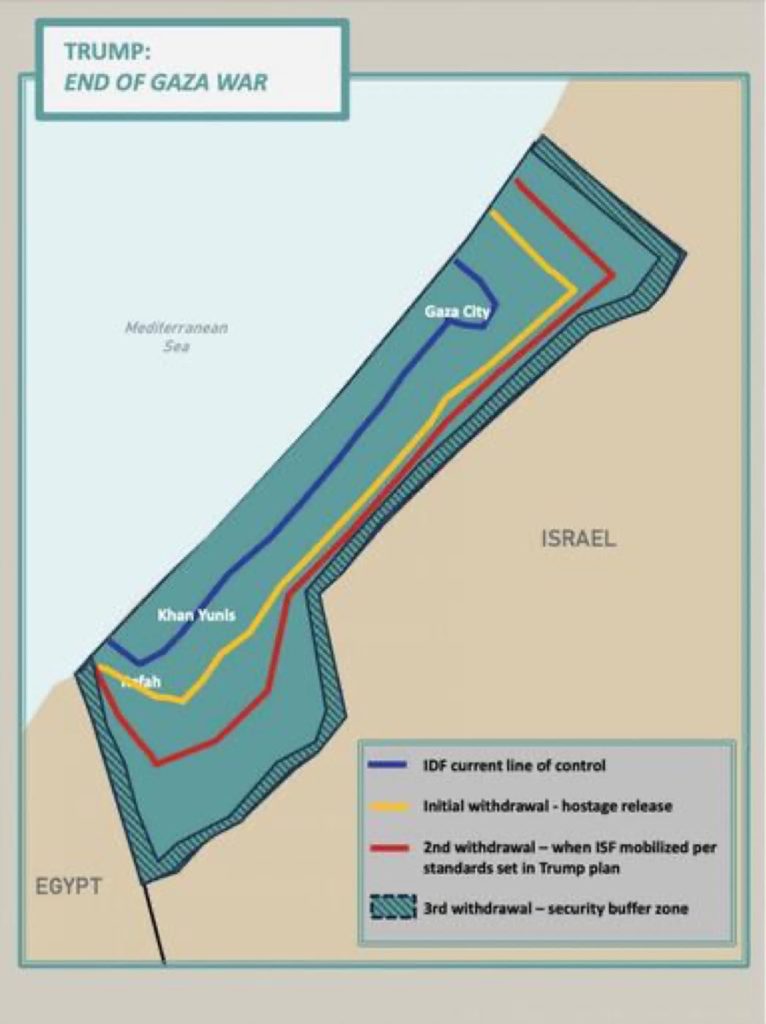
Map released with the plan: blue line (current IDF control), yellow line (first withdrawal linked to the release of the hostages), red line (second withdrawal with the deployment of the International Stabilisation Force), dark green hatched area (third withdrawal to a security buffer zone). Credit and reproduction rights to be confirmed.
• the blue line represents the IDF’s current line of control;
• the yellow line corresponds to the first Israeli withdrawal, linked to the release of the hostages;
• the red line corresponds to the second withdrawal, once the International Stabilisation Force has been deployed in accordance with the criteria of the Trump plan;
• the dark green hatched area corresponds to the third withdrawal and the retention of a security buffer zone along the borders.
When Donald Trump states that Israeli forces will withdraw once disarmament is “complete”, he therefore appears to be referring mainly to the withdrawals beyond the yellow line, or even to the move from the red line to the final buffer zone, rather than to the first redeployment linked to the release of the hostages.
Hamas, by contrast, insists that the two processes should advance in parallel: each stage in dealing with its weapons should be matched by a further Israeli pullback, from the blue line to the yellow line, then from the yellow line to the red line.
The difference between the two formulations therefore lies less in whether there will be a phased withdrawal than in when Israel will have to cross each of these lines.
Yellow line already at heart of Israeli disagreement
The Israeli reading appears far more restrictive. An Israeli official said that the 15-point document did not meet Israel’s demands. In his view, the complete disarmament of Hamas, the removal of weapons from Gaza and the total demilitarisation of the enclave must be a precondition for any new process.
| “Israel demands the complete disarmament of Hamas, including the removal of weapons from Gaza, and the complete demilitarisation of the Gaza Strip as a precondition for any process.” Israeli official quoted by Reuters |
The position expressed in Jerusalem is that no further withdrawal beyond the yellow line should take place until Hamas has been disarmed and Gaza has been fully demilitarised. The three readings can be summarised as follows:
• Hamas demands that Israeli withdrawals accompany each stage in dealing with its weapons;
• Israel demands proof of demilitarisation before any further withdrawal;
• Washington says it has built a simultaneous, gradual, reciprocal and verified process.
Benjamin Netanyahu’s government is said to have been consulted during the negotiations, but it has not publicly confirmed its acceptance of the latest arrangements announced by Donald Trump. This reservation considerably limits the immediate scope of the American proclamation: the government that is expected to withdraw its soldiers has not accepted the sequence that is supposed to lead to that withdrawal.
A prospect of Palestinian statehood that Trump did not highlight
The roadmap contains another politically explosive element. It states that the parties wish to establish a credible political process paving the way for self-determination and the creation of a Palestinian state.
Donald Trump did not dwell on this point in his announcement. For Hamas, this prospect allows the military concession to be presented as the price of a political horizon. In the eyes of Itamar Ben-Gvir, Israel’s Minister of National Security and leader of the far-right Otzma Yehudit party, of Bezalel Smotrich, the Minister of Finance and a figure of the religious far right, and of a substantial part of the Israeli coalition, however, it is likely to be almost as unacceptable as the withdrawal of the IDF.
This sentence may help to explain Benjamin Netanyahu’s immediate silence. Accepting the mechanism would mean not only discussing an Israeli withdrawal, but also allowing the demilitarisation of Gaza to be written into a process explicitly leading towards a Palestinian state.
Islamic Jihad’s silence is a major unknown
Donald Trump’s statement does not concern Hamas alone. It explicitly targets “all other armed groups in Gaza”. Palestinian Islamic Jihad, however, is a separate organisation, with its own leadership, its own Al-Quds Brigades, its own weapons stockpiles and historically closer ties with Tehran.
At the time of writing — 31 July 2026 at 2.45pm Paris time — no public, verifiable response from Ziyad al-Nakhalah, Mohammed al-Hindi or the leadership of the Al-Quds Brigades had been identified. Its acceptance therefore cannot be taken for granted.
The mediators say the “Palestinian factions” have accepted the general framework. But a collective formula attributed to the negotiators is no substitute for a public commitment from the organisations concerned. Disarming Hamas alone would not be enough to establish a Palestinian monopoly on the use of force.
One faction could accept the political handover of Gaza while leaving another organisation able to secretly retain missiles, explosives or armed cells. The lack of a specific timetable for Islamic Jihad is therefore one of the most visible weaknesses of the arrangement.
Hezbollah stays silent as Ben-Gvir rejects the deal in advance
Hezbollah has not issued any identifiable official response to the American announcement. It would be premature to interpret this silence as acceptance. The Lebanese Shia militia may be waiting for the position of Islamic Jihad, that of Iran, the publication of the full text or the formal response of the Israeli government.
In Israel, Itamar Ben-Gvir has not yet responded specifically to Donald Trump’s overnight announcement. A few hours earlier, however, he had rejected the very principle of an indirect agreement with Hamas, asserting that destroying the movement and encouraging Palestinians to emigrate was the only acceptable solution.
His statement cannot be presented as a response to the final text. It does, however, point to the fault line that would open up within the coalition if Benjamin Netanyahu accepted a phased withdrawal, the deployment of an international force, the transfer of Gaza to a Palestinian administration and the political horizon set out in the roadmap. The Financial Times reports that Israel’s far right is already pressing Netanyahu to reject the plan.
A possible rift between Hamas and Iran
The agreement could have geopolitical ramifications beyond Gaza. According to US officials quoted by the Associated Press, Iran reportedly advised Hamas leaders not to accept the proposal, while now being less able to support the movement because of its confrontation with the United States and Israel.
If this is confirmed, Hamas would have put the survival of Gaza and the guarantees offered by Egypt, Qatar and Turkey ahead of Tehran’s strategic interests. Three developments would then be possible:
• the Hamas leadership would consider that continuing the war now threatens the very existence of its organisation and of Gaza;
• Iran would no longer have the means to guarantee the movement sufficient military support;
• Egyptian, Qatari and Turkish mediators are reported to have gained more influence over Hamas’s political leadership than the Islamic Revolutionary Guard Corps.
Genuine disarmament of Hamas would be a major setback for Iran’s strategy of building up armed organisations around Israel capable of acting independently. It would also set a precedent watched with concern by Hezbollah and Tehran’s other proxies.
Why has Donald Trump put himself so firmly in the spotlight?
The US president’s eagerness may come as a surprise. The timetable has not been finalised, the mechanisms still have to be negotiated over fourteen days, Islamic Jihad has not taken a position and Israel remains sceptical that Hamas genuinely intends to give up its weapons.
Yet Donald Trump chose to speak of a breakthrough already achieved. This piece of stagecraft probably serves several purposes.
Turning a fragile convergence into a public commitment
By proclaiming that the agreement exists, Trump raises the political cost of rejecting it. If Hamas pulls out, it can be accused of having refused peace. If Israel blocks the planned withdrawals, Netanyahu’s government can be portrayed as responsible for the failure. The Egyptian, Qatari and Turkish mediators also find themselves bound by the US president’s public thanks.
Trump is therefore not merely noting an agreement: he is trying to make it harder to reject. The announcement itself becomes a negotiating tool.
Putting pressure on Netanyahu
The US administration says it has coordinated the negotiations with Israel and is asking Jerusalem only to carry out the commitments already tied to the 20-point plan. The implicit message to Benjamin Netanyahu is clear: Israel can discuss the details, but it can no longer claim that no proposal exists.
By making the roadmap public before Israel had approved it, Trump is presenting Netanyahu with a costly choice: accept a sequence that part of his coalition rejects, or be seen as the man who wrecked a chance to disarm Hamas.
Giving the Board of Peace a reason to exist
The arrangement is closely bound up with Donald Trump. He chairs the Board of Peace himself, his name is attached to the 20-point plan, and his administration presents the body as the vehicle for Gaza’s future governance and reconstruction.
Without progress on disarmament and an Israeli withdrawal, the Board risked looking like an institution unable to move the ceasefire into its second phase. The announcement allows the narrative to be turned on its head: it would no longer be a paralysed body, but the one that achieved what the war had failed to impose.
Donald Trump does not simply want to be seen as the president who backed a compromise negotiated by Qatar, Egypt and Turkey. He wants to be the one whose plan put an end to Hamas’s military power.
This personalisation is in keeping with his political method: announce a maximal victory, impose his own interpretive framework and force the other players to position themselves in relation to him.
Separating Hamas from the Iranian axis
In the context of the confrontation between Washington and Tehran, the announcement at last allows Iran to be portrayed as a player in retreat. If Hamas agrees to give up its military apparatus despite Iranian misgivings, the United States will be able to claim that the pressure brought to bear on Tehran is beginning to dismantle its regional network.
A failure of implementation would not necessarily wipe out all the immediate political benefit of the announcement. Trump could claim that he had secured Hamas’s agreement, mobilised the mediators and offered Israel a path guaranteeing its security, before one of the parties refused to carry out its obligations.
He is thus claiming credit for the breakthrough while already preparing the narrative that will assign blame for any failure.
An announcement used to manufacture reality
Donald Trump is undeniably taking a risk. If the process collapses quickly, his statement will look premature. But his exaggeration is not necessarily mere recklessness. It may be a method of diplomatic pressure.
| “By announcing an agreement whose essential terms remain disputed, Donald Trump is seeking less to describe reality than to manufacture it.” |
The publicity given to the roadmap turns a fragile convergence into a political commitment and makes it costlier for Hamas, Israel or the mediators to abandon it.
An agreement on a procedure, but not yet on its implementation
The breakthrough is real: for the first time, Hamas officials are publicly confirming the existence of an agreement dealing directly with the movement’s weapons, the transfer of security functions and its withdrawal from the running of Gaza.
But four unknowns remain:
• will Hamas really agree to lose all independent military capability?
• Will Israel agree to withdraw its forces in step with disarmament rather than after it has been fully completed?
• Will Islamic Jihad and the other armed groups follow suit?
• Will the International Force and the new Palestinian police have the manpower and authority needed to verify and enforce the commitments?
The text announced by Donald Trump is therefore not yet a finished agreement on the disappearance of weapons from Gaza. It is an agreement on a procedure that each party is already interpreting differently.
The American formula speaks of “complete disarmament”. Hamas speaks of a gradual Israeli withdrawal and of weapons being stored under Palestinian authority. Israel demands that demilitarisation precede any abandonment of the yellow line. Islamic Jihad and Hezbollah have so far remained silent. Donald Trump has declared the problem solved. In reality, the battle over the meaning of the agreement has only just begun.
Further reading from La Tribune des Nations
• Gaza: the second phase of the ceasefire, between promise and reality
• The Qatari paradox: how Doha became an indispensable player in the Middle East
• Will Iran revive the “axis of resistance” after sanctions relief?
• Hezbollah raises the spectre of civil war
Main external sources
• Board of Peace — Donald Trump’s Comprehensive Plan for Gaza
• Ici Beyrouth — Palestinian technical committee to oversee weapons storage (31 July 2026)
Translated from French. The French original prevails.