Energy, infrastructure, diplomacy, strategic partnerships and new trade routes: in the space of two decades, China has established itself as an indispensable player in the Middle East. Without the network of military alliances enjoyed by the United States, Beijing is gradually extending its influence through its economic might, its massive investments and a diplomacy founded on balancing often rival actors. From the Persian Gulf to the Eastern Mediterranean, by way of Pakistan, Israel and Turkey, China’s strategy is helping to redraw the geopolitical balance of the 21st century.
For a long time, the Middle East was one of the main bastions of American influence. Military presence, security alliances and direct interventions enabled Washington to play a decisive role in regional affairs. Since the beginning of the 21st century, however, another power has been gradually advancing its interests in the region: China.
Initially driven by its energy needs, Beijing has gradually developed a more ambitious strategy combining trade, investment, diplomacy and security cooperation. Its aim is clear: to secure its supplies, protect its trade routes and strengthen its status as a world power.
Energy, the foundation of China’s presence
The Middle East remains essential to China’s energy security. As the world’s largest importer of oil, China depends heavily on hydrocarbons from Saudi Arabia, Iraq, Iran, the United Arab Emirates and Kuwait.
This dependence explains the attention Beijing pays to regional stability. A closure of the Strait of Hormuz or a lasting deterioration in security in the Gulf would have direct consequences for the Chinese economy.
To secure its supplies, China maintains close relations with all the region’s major energy producers, without ideological distinction or exclusive political alignment. This pragmatic approach allows it to protect its interests while steering clear of the rivalries that pit certain Middle Eastern states against one another.
The Belt and Road Initiative at the heart of regional strategy
The Belt and Road Initiative is the main instrument of China’s expansion in the Middle East. Ports, railway infrastructure, power stations, industrial zones and digital networks form a vast network designed to link China with markets in Asia, Africa and Europe.
These investments offer countries in the region opportunities for modernisation while strengthening Beijing’s economic influence. The Gulf monarchies, engaged in economic diversification programmes, are among the main partners in this strategy.
Beyond infrastructure, China is also expanding its presence in high technology, telecommunications, artificial intelligence and renewable energy. Beijing is thus seeking to embed itself durably in regional economies while securing the trade routes essential to its prosperity.
Pakistan, Beijing’s geostrategic pivot
Of all China’s regional partners, Pakistan holds a special place.
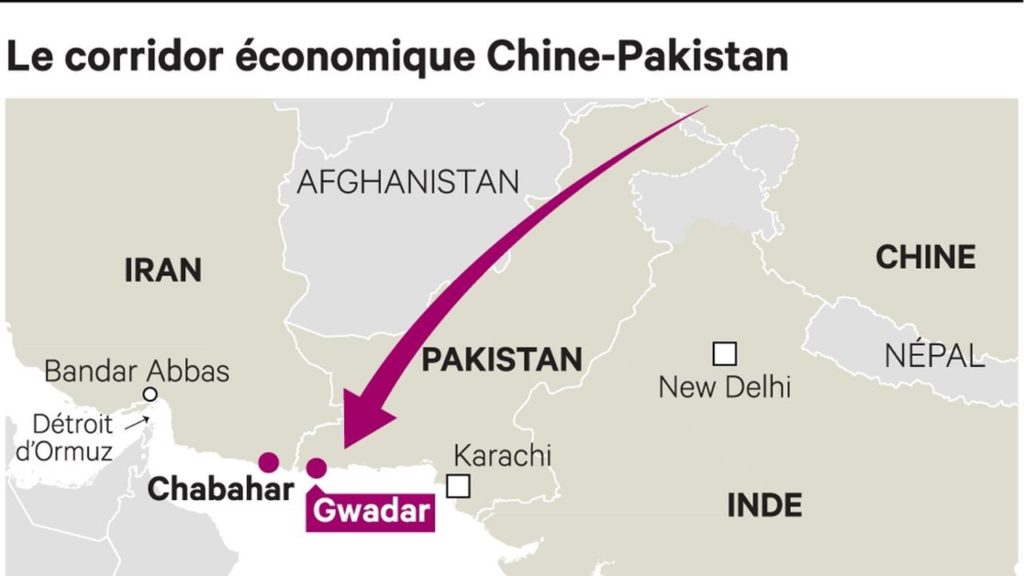
The China-Pakistan Economic Corridor (CPEC), launched under the Belt and Road Initiative, is one of the most ambitious projects in Chinese foreign policy. This infrastructure network links Xinjiang province to the Arabian Sea and gives Beijing direct access to the Indian Ocean.
For China’s leaders, Pakistan is far more than a mere economic partner. It is an essential link in their strategy to secure trade routes and reduce their dependence on traditional sea lanes.
This cooperation extends well beyond infrastructure. The two countries maintain close military, technological and diplomatic ties. Pakistan is today one of China’s main strategic partners in Asia.
Gwadar, China’s gateway to the Indian Ocean
At the heart of this cooperation lies the Pakistani port of Gwadar. Located close to the Gulf of Oman and the world’s main energy routes, the port, developed with Chinese financing, has become one of the symbols of Beijing’s presence in the region.
Although officially intended for trade, Gwadar also has a strategic dimension. It allows China to strengthen its maritime presence close to the Middle East while facilitating the transport of goods and energy resources to its territory.
For some analysts, Gwadar could eventually play a role comparable to that of certain major international logistics hubs. While not a Chinese military base, it nonetheless represents a major foothold in Beijing’s maritime strategy.
A balancing act between regional rivals
One of the main strengths of Chinese diplomacy lies in its ability to engage with actors who are often at odds with one another. Beijing thus maintains close relations with the Gulf monarchies while developing a strategic partnership with Iran. This balancing act allows it to safeguard its economic interests with all the regional powers.
The mediation that led to the restoration of diplomatic relations between Saudi Arabia and Iran in 2023 marked an important milestone in China’s diplomatic assertiveness in the Middle East.
This success bolstered its image as a power capable of fostering dialogue in a region beset by rivalries and conflicts. Unlike the United States or certain European powers, Beijing seeks to present itself as a pragmatic actor more concerned with stability than with ideological alliances.
Israel: a diplomatic edge over the United States
The Israeli-Palestinian question is another key element of China’s strategy.
Unlike the United States, whose alliance with Israel remains one of the pillars of its regional policy, China seeks to maintain a more balanced position. Beijing has significant economic and technological ties with Israel while officially supporting the creation of a Palestinian state and regularly calling for a negotiated settlement to the conflict.
This approach gives China a diplomatic edge with many Arab and Muslim countries. Whereas Washington is often seen as an actor firmly on Israel’s side, Beijing appears more as a pragmatic partner capable of engaging with all parties.
This position does not give it the same security clout as the United States, but it strengthens its political credibility with many governments in the region and bolsters its image as a non-interventionist power.
Turkey: an indispensable partner and an emerging rival
Beyond its relations with the traditional regional powers, China must also reckon with Turkey’s growing influence. Although the two countries have significant economic ties, their ambitions intersect in several strategic arenas stretching from Central Asia to the Middle East.
Central Asia is the main meeting point of Chinese and Turkish interests. Beijing regards the region as a vital link in the New Silk Roads and is investing heavily there in infrastructure, energy and transport. At the same time, Ankara is building its influence with the region’s Turkic-speaking states through historical, linguistic and cultural ties.
The rivalry remains chiefly economic and diplomatic. China wields considerable financial power, while Turkey benefits from a cultural proximity that gives it particular influence with several Central Asian states.
The Uyghur question is also a sensitive issue in Sino-Turkish relations. The Turkish authorities have gradually adopted a more cautious stance in order to protect their economic interests with Beijing.
In the Middle East, the two countries’ objectives generally differ. Turkey seeks to project its political and military influence in Syria, Iraq, the Caucasus and the eastern Mediterranean. China, for its part, prioritises regional stability, energy security and the growth of trade.
Competition is also playing out over transport corridors. Ankara aspires to become an indispensable crossroads between Asia and Europe, while Beijing is developing several logistics routes linking China to European markets via Central Asia and the Middle East.
A still limited military influence
Despite its growing economic and diplomatic clout, China maintains a relatively modest military presence in the Middle East. Its only officially acknowledged overseas military base is in Djibouti, at the entrance to the Red Sea. Commissioned in 2017, it hosts some 1,000 to 2,000 military personnel responsible for logistical support to naval operations, the protection of trade routes and anti-piracy missions.
Beijing is also developing military cooperation with several regional partners, notably Pakistan. There are also exchanges with Iran in the naval and security fields.
However, China still favours an approach based on protecting its economic interests rather than on military power projection comparable to that of the United States.
The limits of China’s strategy
Beijing’s growing influence brings numerous challenges. China must maintain a delicate balance between partners that are sometimes rivals, protect its investments in unstable areas and contend with strategic competition from Washington.
It also remains vulnerable to regional crises. A major war involving Iran or a lasting disruption of the Gulf’s sea lanes could directly threaten its energy supplies and slow its economic ambitions.
Finally, rising tensions between China and the United States are gradually turning the Middle East into yet another arena of competition between the world’s two leading powers.
Towards a more multipolar Middle East
China’s growing influence does not mean that the United States is withdrawing, nor that its central role in regional security is disappearing. Washington retains military bases, solid alliances and unrivalled capacity for intervention.
However, China’s rise is gradually altering the regional balance of power. The states of the Middle East now have a credible economic, diplomatic and technological alternative to traditional Western partnerships.
Thanks to its economic might, its massive investments, its strategic partnership with Pakistan and its ability to engage with Israel as readily as with the Arab countries, Iran and Turkey, Beijing has established itself as an indispensable player in the Middle East.
The question is no longer whether China has become an influential power in the region, but how far that influence can extend in the decades to come. Its ability to maintain simultaneous dialogue with actors that are often rivals could prove one of its main assets in an increasingly multipolar Middle East.
Against a backdrop of tensions between Israel and Iran, Turkey’s regional ambitions, the economic transformation of the Gulf monarchies and the growing rivalry between Beijing and Washington, China now appears to be one of the principal architects of the new geopolitical balance taking shape in the Middle East.
Translated from French. The French original prevails.