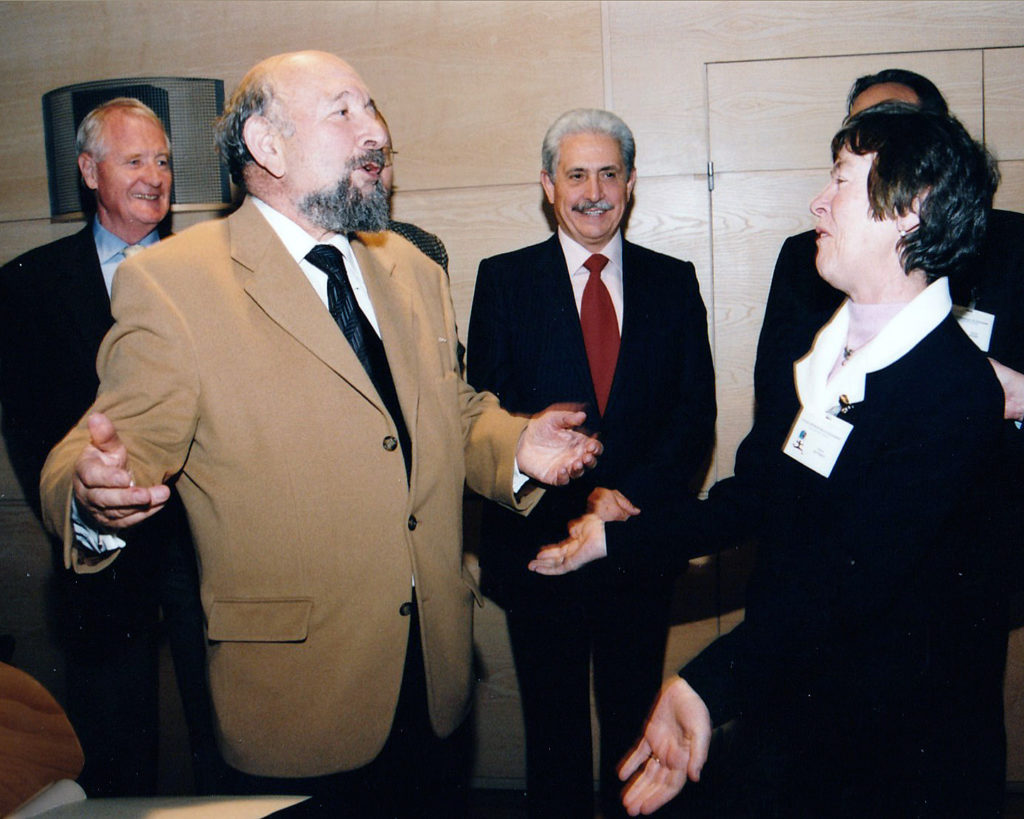
Yves Lacoste receiving the Vautrin-Lud Prize at the International Geography Festival in 2000 (Saint-Dié-des-Vosges)
The father of French geopolitics, Yves Lacoste, died on 20 June 2026. Throughout his career, he worked to restore the political dimension of geography and to rehabilitate the term “geopolitics” after decades in which it had been sidelined in French academic circles. A committed geographer, a convinced Marxist and anti-colonialist, he stood out for his abiding interest in the struggles and challenges of the countries of the global South, which made him a singular and subversive voice in the landscape of the humanities and social sciences.
Today, as the world goes through a period of growing instability, his work and his method continue to guide those seeking to understand the power relations that shape our world.
Between North Africa and Paris: the making of a geographer
Born to a geologist father and a librarian mother, Yves Lacoste grew up in Morocco before continuing his studies in France. He came top in the agrégation in geography in 1952.
While teaching in Algiers between 1952 and 1955, and then a member of the French Communist Party (which he would leave in 1956), he became involved in the struggle for Algerian independence, moving in anti-colonialist circles. He prepared his doctorat d’État in Algeria under the supervision of Jean Dresch, a Marxist and anti-colonialist geographer whose convictions he shared.
What emerged was a deeply committed geographer, convinced that geography could not be separated from politics and power relations. This stance, born of his Algerian years and his political engagement, would be the common thread running through his career as a geographer.
While teaching in Algiers, Lacoste joined the Algerian Communist Party, where his associates included the mathematician Maurice Audin (1932–1957) and the doctor Sadek Hadjerès (1928–2022), who introduced him to the work of Ibn Khaldun (1332–1406), the founder of historical and social science. This political commitment and his new closeness to pro-independence activists led to his being repatriated and transferred to metropolitan France in 1955. He left the Communist Party the following year, having disagreed with the Communist deputies’ vote to grant the Mollet government special powers in Algeria.
Back in France, he became a member of the executive board of the Committee for the Independence of Europe. He continued his research in geography and taught at university.
From 1968, he taught at the University of Paris VIII (the University of Vincennes) from its very foundation. In the wake of the May 1968 movement, the centre became a hub of innovation open to the contemporary world, in which many of the leading intellectual figures of the day were involved.
Opposition to Paul Vidal de la Blache
Lacoste firmly opposed Paul Vidal de La Blache, the founder of the French school of geography, accusing him of having deliberately depoliticised the discipline. Vidal, he argued, had intentionally set out to obscure any political question.
For Lacoste, this was no mere omission. Vidal de La Blache was well aware that geographical knowledge carries considerable strategic potential. That, he argued, is precisely why Vidal chose not to popularise it: to prevent the people from seizing it and using it against the interests of the ruling class to which Vidal belonged.
The democratisation of geography
Yves Lacoste saw the democratisation of geography as a means of preventing a minority from monopolising this knowledge. As the title of his landmark work puts it, “La géographie ça sert d’abord à faire la guerre” (“Geography is first and foremost for waging war”) – but not only that. For Lacoste, geography was initially invented for war, but that is not its main purpose: it is a tool of power. It is a field of study that informs strategists and provides spatial justification.
Maps can also be instruments of propaganda, particularly in territorial disputes. Examples include Indian maps that incorporate Kashmir into the national territory, a region also claimed on Pakistani maps. Although most people regard maps as scientific, and they lend particular legitimacy to the territory they depict, all the territories they represent are artificial, political and laden with representations.
Geography is not neutral; it is also a combative science that conceals ideological stakes.
Rehabilitating the term “geopolitics“
Yves Lacoste is notably credited with rehabilitating the term “geopolitics” in France, after it had long been shunned because of its abuse for imperialist ends. From 1982, the journal Hérodote adopted a new subtitle: “Revue de géographie et de géopolitique” (“Journal of geography and geopolitics”). Yves Lacoste justified his decision to use a term that “automatically calls to mind the arguments of Hitlerite expansionism”. Although the term may have served imperialist ambitions, he saw in it an invitation to reclaim it and turn it against those who had abused it.
“Admittedly, there are imperialist geopolitical discourses that justify annexation, domination and territorial ambitions. But to these discourses (…) can and must be opposed anti-imperialist arguments that justify independence and autonomy, libertarian arguments that are every bit as much geopolitics “. (Yves Lacoste, “D’autres géopolitique” (Hérodote, 25, May–July 1982, pp. 4-5.)
Yves Lacoste places emphasis on defining geopolitics as a method rather than a science, which is also a way of breaking with the dark legacy of the term. For Yves Lacoste, geopolitics is a method for analysing rivalries of power over or for territory.
Lacoste’s geopolitical method rests on three instruments: geography (through a multi-scale approach and by means of a diatope), history (the chronology of events), and actors (along with their representations). It is a method without constants but with tools. Even today, it is this very method that is taught to young researchers at the French Institute of Geopolitics at Paris VIII University.
Lacoste also traces geopolitics back to Herodotus, a historian who lived from around 484 BC to 425 BC and who drew on the lessons of his travel accounts and his observations of the wars between the Greeks and the Persians. Herodotus was convinced at the time that after the two Persian Wars there would be a third.
A legacy of excellence: from the journal Hérodote to IFG Lab
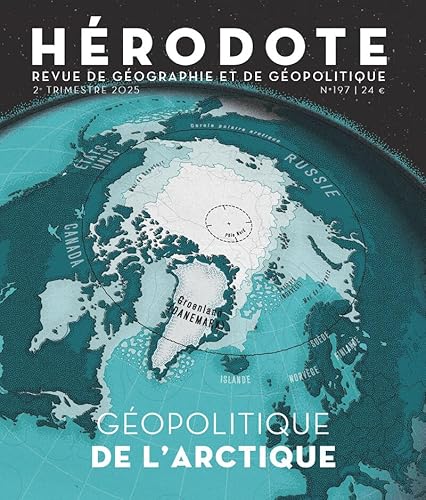
In 1976, Yves Lacoste took the initiative of founding a French school of geopolitics, rooted in the humanities and social sciences, thereby breaking completely with the nationalist geopolitics of the 19th century and turning it into a fully fledged academic discipline.
Together with other geographers, including Béatrice Giblin, he founded the academic journal Hérodote in 1976. By 1981, geopolitics had become a central focus of the journal. In using the term “geopolitics”, the editors adopted a geographical approach that placed the emphasis on political issues. The journal also played an important role in the creation of the Institut Français de Géopolitique (IFG), founded in 2002. Based on the Paris VIII campus in Saint-Denis, the IFG stands out as a pioneer in two emerging fields: the geopolitics of the digital sphere, through the GEODE centre, and the geopolitics of the environment. In 1989, Yves Lacoste also took part in setting up the CRAG (Centre de recherches et d’analyses géopolitiques) at Paris VIII, since renamed IFG Lab. This centre would become the first in France to award doctorates in geopolitics.
Élisée Reclus and Yves Lacoste
Élisée Reclus, an anarchist and humanist geographer, was sidelined by his peers because of his strong involvement in the Paris Commune (18 March – 28 May 1871). Exiled in Brussels, he taught at the Université nouvelle. His work, long regarded as too speculative, was rehabilitated thanks to Lacoste and is today recognised in academia.
Lacoste sees in Reclus’s work proof that geography cannot be separated from political engagement. Attempting to do so would, in his view, be an anti-political approach and an epistemological regression. He criticises geographers who have “narrowed their gaze” by erasing the strategic and subjective dimension of the discipline. In particular, he accuses the followers of Vidal de la Blache of having knowingly obscured Reclus’s great Géographie Universelle. Lacoste also supervised the thesis on Reclus by Béatrice Giblin, editor of the journal Hérodote since 2006, in 1971.
Yves Lacoste leaves behind a considerable body of work and a living academic legacy. By refusing to let geography hide behind a false neutrality, he brought a new way of thinking about territory, power and conflict. From his years in Algeria to the founding of the journal Hérodote, from the rehabilitation of Élisée Reclus to the creation of the French Institute of Geopolitics, he never ceased to champion a founding conviction: geography is political knowledge, and it is precisely for that reason that it belongs to everyone. In a world where territorial rivalries, struggles for influence and digital issues are constantly redrawing the map of the world, the geopolitical method he forged remains an indispensable tool for making sense of current events.
Translated from French. The French original prevails.