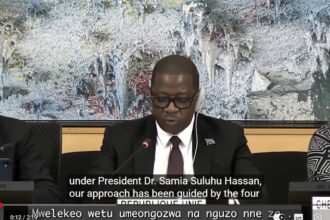
The UN Human Rights Council met in Geneva for its 55th session.UN Photo/Elma Okic
Created to guarantee fundamental freedoms, the United Nations Human Rights Council is celebrating its twentieth anniversary in Geneva against a backdrop of widespread and brazen human rights violations. According to the UN chief, human rights are “under threat, being progressively called into question, strategically and without any scruple”.
In 2006 the Human Rights Council replaced the former Commission on Human Rights, which had come under criticism. Marking the Council’s 20th anniversary, the UN Secretary-General described, in a video message, human rights abuses that are increasingly visible and in many cases committed with complete impunity.
António Guterres highlighted their profoundly destructive effects on individuals, communities and societies as a whole. In this context, “this makes the work of the Council more essential than ever”, he said.
Speaking out when others stay silent
The UN chief highlighted one of its most important instruments: the Universal Periodic Review, which enables every member state to report, before its peers, on how it is fulfilling its human rights obligations and commitments. Such a process thus helps to establish a culture of dialogue and to encourage legal reforms, the strengthening of public institutions and better protection of fundamental rights.
At the same time, the Council’s commissions of inquiry and fact-finding missions document abuses, preserve evidence and acknowledge victims, thereby helping to promote accountability and combat impunity.
While the independent experts “shine a light where darkness reigns”, the working groups shape human rights norms and standards.
The Council’s engagement with civil society, human rights defenders and victims also helps “to enable those on the front line to make their voices heard in global decision-making processes”. It was a way of urging the members of this Geneva-based body “to keep speaking out when others fall silent, to stand firm when principles are challenged and to make the voices of the most vulnerable heard”.
Voices of young people, victims and Indigenous peoples
In keeping with this commitment to inclusion and to the participation of those working on the ground, this approach is also hailed within the United Nations system as a distinctive feature of the Human Rights Council.
For his part, the UN High Commissioner for Human Rights, Volker Türk, believes that one of the Council’s successes lies in its model of participation, compared with other bodies in the UN system.
The Council involves civil society. “One could always wish for more,” he acknowledges, but this participation by organisations is “very important”. The Human Rights Council also ensures that Indigenous peoples are represented and holds numerous interactive panel discussions bringing together children, young people, survivors and victims.
For Mr Türk, this is a model that the UN must “$defend and deepen”, and “one of the Council’s major strengths”.
From the Commission to the Council
In keeping with this gradual opening of the Council to civil society and the drive to strengthen its legitimacy, its first leaders look back on the circumstances of its creation and the challenges involved in setting it up.
On this point, Luis Alfonso de Alba Góngora, the first President of the Human Rights Council, recalls that civil society previously took part in the Commission on Human Rights only once a year. “We opened our doors to the participation of all these essential actors from day one,” said the former Mexican ambassador, who believes that building trust and inclusiveness proved “extremely useful”.
He adds that the Council also seeks to reduce polarisation, selectivity and double standards, an objective for which the Universal Periodic Review is an important tool.
Looking back on the creation of the Council, the former Mexican ambassador stresses that it was no easy task, owing to differences among member states and an unfavourable international climate, with some opposing its establishment.
Translated from French. The French original prevails.