Roads, railways, ports, airports and waterways: climate change is no longer a future risk but a structural reality that infrastructure will now have to contend with. In an unprecedented report, the United Nations is calling on states to fundamentally rethink their transport policies before the costs of inaction become unsustainable.
For a long time, climate policies applied to transport focused on cutting greenhouse gas emissions. Now another challenge is asserting itself with growing force: adapting the infrastructure itself to a climate that has become deeply unstable.
Published by the United Nations Economic Commission for Europe (UNECE), the report Assessment of Climate Change Impacts and Adaptation for Inland Transport marks a significant shift in international thinking. For almost five years, experts from several disciplines analysed the consequences of climate disruption on inland transport networks in order to identify the most critical vulnerabilities and possible responses. Their conclusion is unambiguous: the infrastructure underpinning today’s economies was not designed to withstand the climate conditions expected by the middle of the century.
A proliferation of extreme events
Climate change can no longer be reduced to a gradual rise in average temperatures. Above all, it is manifesting itself in a succession of extreme events whose frequency and intensity are already disrupting the functioning of transport networks.
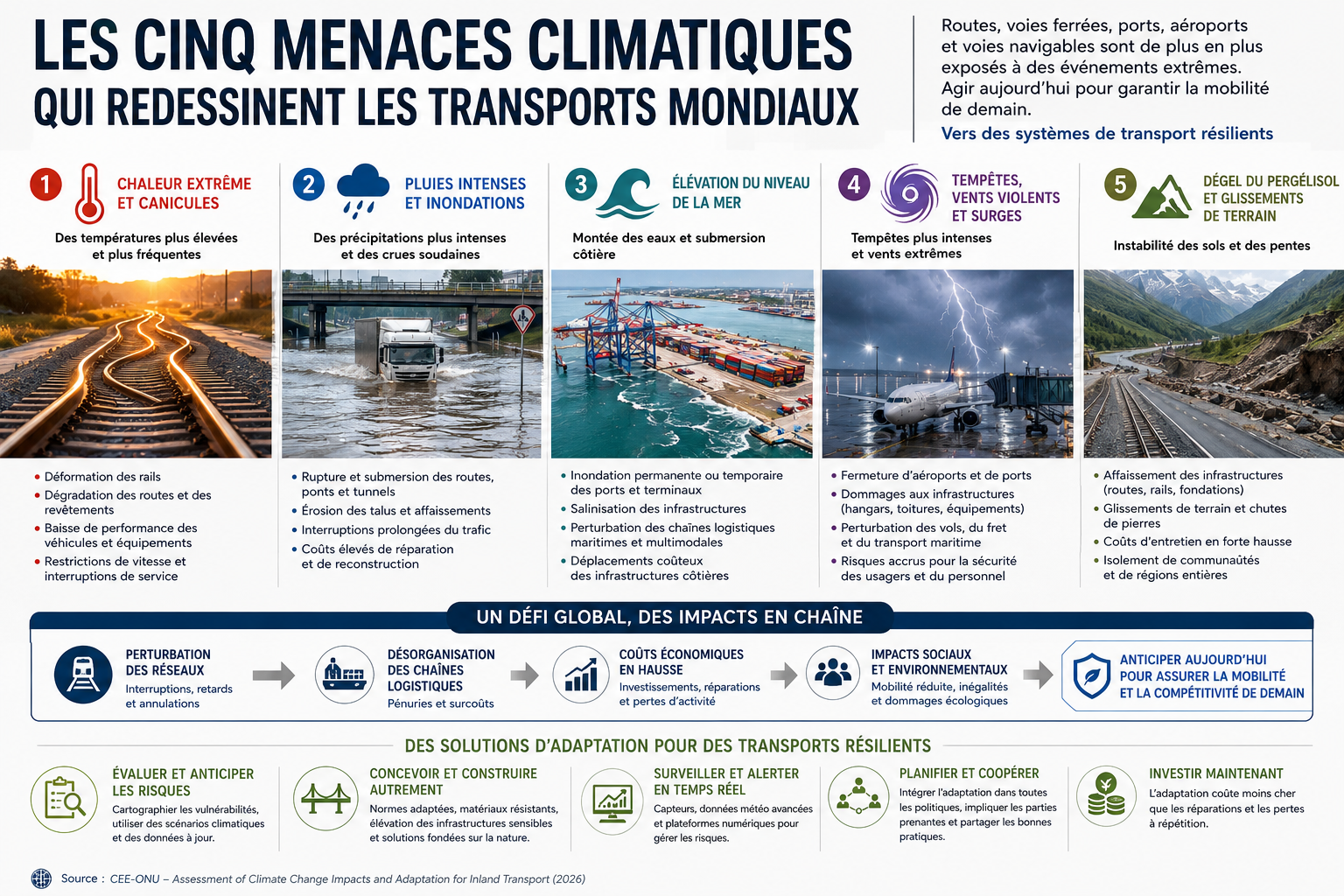
Prolonged heatwaves, torrential rain, flash floods, droughts, violent winds, rising sea levels, accelerated glacier melt and thawing permafrost are now all factors capable of disrupting international supply chains.
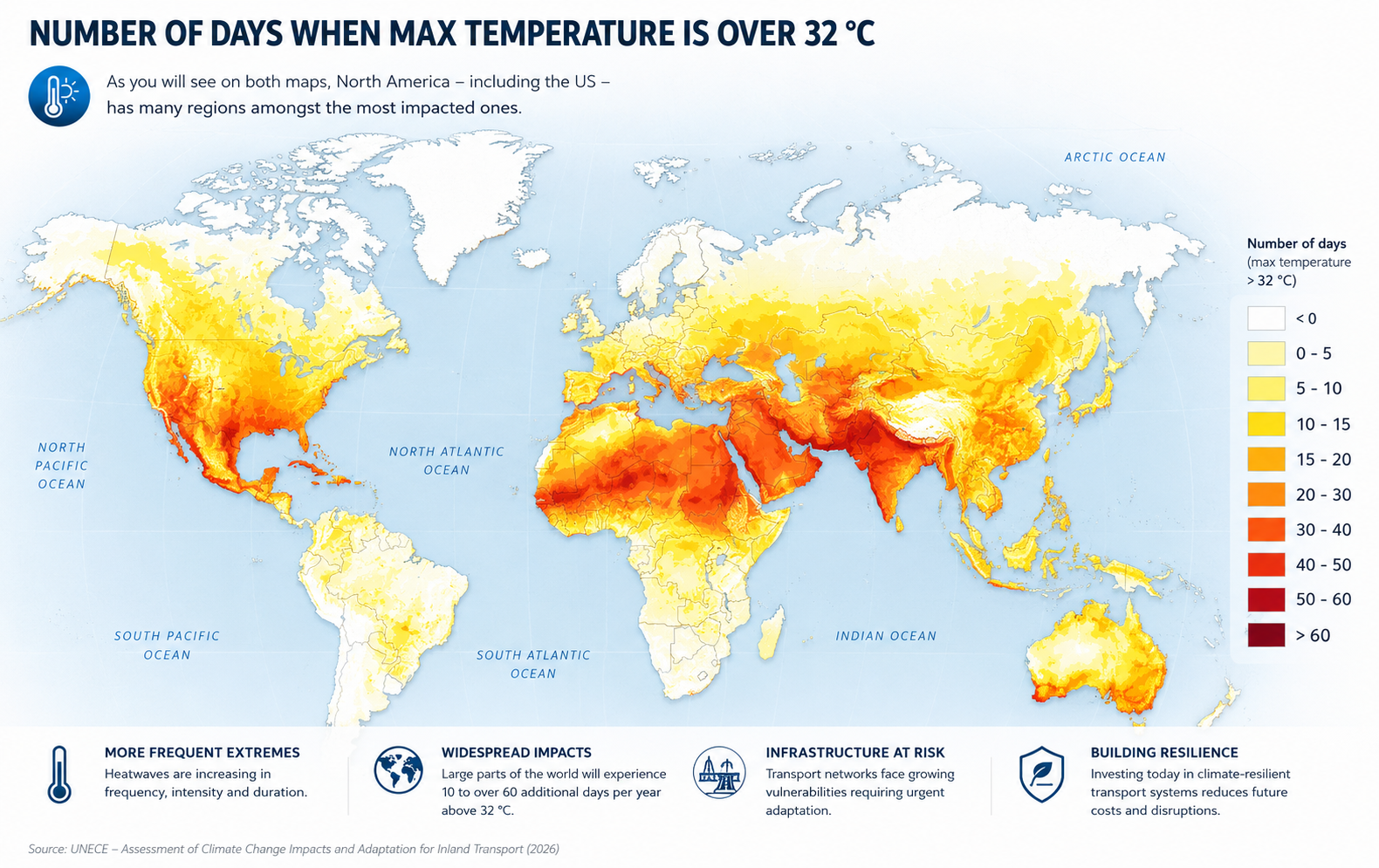
According to the projections used in the report, many regions covered by the UNECE will face an additional 10 to 50 days a year above 25°C by 2050, while some areas could experience up to 200 days a year above that threshold. This represents a radical change for infrastructure whose materials, construction standards and operating procedures were developed in a climate context that no longer exists.
A global economy increasingly dependent on networks
This vulnerability goes far beyond the question of physical infrastructure alone.
Roads, railways, ports, logistics hubs, freight terminals and airports now form an interdependent system in which the failure of a single link can trigger cascading disruption across several continents.
The authors of the report stress this systemic dimension. A railway line cut by a mudslide, a port paralysed by a storm or a flooded motorway do not merely cause local delays. They affect industrial supply chains, international trade and daily travel, and also, in crisis situations, the delivery of humanitarian aid.
Recent experience of flooding in Germany, of droughts that disrupted inland navigation in Europe and of extreme heatwaves that slowed rail traffic shows that these phenomena are no longer theoretical scenarios but a reality that can already be observed.
From repair to anticipation
One of the report’s main innovations lies precisely in shifting the focus. Rather than repairing infrastructure after each disaster, the experts propose building climate adaptation into all transport-related public policy from now on. This approach rests on several principles. First, accurately assessing the vulnerabilities of each network using increasingly detailed climate data. Second, drawing up adaptation strategies that can evolve as new scientific knowledge emerges, rather than locking in investments over several decades. Finally, treating the cost of inaction as an economic variable in its own right.
The report stresses that postponing adaptation investment often means multiplying future spending on repairs, traffic disruptions and economic losses caused by natural disasters.
A new culture of resilience
Beyond the infrastructure itself, the United Nations is calling for a deeper transformation of transport governance. The document emphasises the need to strengthen cooperation between engineers, climate scientists, operators, public authorities, insurers and policymakers. Infrastructure must no longer be designed solely on technical or economic criteria, but also according to its ability to keep functioning in a profoundly altered climate.
This approach favours tools that are still little used in the sector: climate stress tests, scenario analyses, vulnerability mapping, digital monitoring of infrastructure, digital twins and nature-based solutions.
To that end, the report brings together several dozen case studies from Europe, Asia, North America and Australia illustrating the first adaptation policies already being implemented.
A shift on a par with the energy transition
Implicitly, the document reveals a paradigm shift. For some fifteen years, transport policy has been geared chiefly towards decarbonising mobility. The coming decade could be dominated by a second imperative: ensuring that networks keep functioning in the face of the now unavoidable consequences of global warming.
This shift will require considerable investment, but also a thorough overhaul of planning, construction and maintenance standards. For the authors, the question is no longer whether transport will be affected by climate change, but to what extent societies will be able to anticipate these transformations.
For behind rails buckled by heat, bridges weakened by floods and ports facing rising waters lies a far broader question: the resilience of modern economies in the face of a climate whose rules have already begun to change.
Translated from French. The French original prevails.