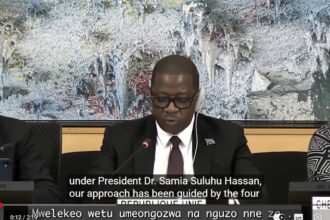
As the war in Sudan continues to spread far beyond the main military front lines, a fresh warning has been brought before the United Nations. On the occasion of the 62nd session of the Human Rights Council, the Paris Integration Forum (PIF) submitted a report calling for an independent international investigation into the alleged bombing of artisanal gold-mining sites in the north of the country, near the Egyptian border.
The organisation says it has gathered testimony reporting air strikes that killed and wounded miners working in the North Wadi, Jebel Al-Aqidat and Al-Ansari areas. The document stresses, however, that the exact number of victims remains uncertain, and acknowledges that no independent investigation has so far been able to establish with certainty the circumstances of the incident or to identify those responsible.

The report refers to accusations levelled at Egypt by several political actors and local organisations, while stressing that these allegations cannot be regarded as established without independent verification. The PIF believes that the priority must now be the search for the truth, rather than an exchange of accusations between the various parties.
Beyond this episode, the organisation seeks to draw attention to a broader shift in the Sudanese conflict. Artisanal gold-mining areas, which have become essential to the economic survival of thousands of families since the collapse of much of the national economy, are now reportedly exposed to the direct consequences of the war. According to the report, these territories have become a focal point for economic, security and geopolitical stakes, in which resource exploitation, trafficking, territorial control and regional influence intertwine.
The document also highlights the particular vulnerability of civilians working in these remote regions, which lack medical infrastructure, early-warning systems or institutional protection. If the reported events were confirmed, they would raise questions about respect for the fundamental principles of international humanitarian law, notably those of distinction between civilian and military objectives, proportionality and precaution in the use of force.
Through this advocacy initiative, the Paris Integration Forum is calling on the United Nations, the Human Rights Council and member states to support the establishment of an independent investigation, to obtain clarification from both the Sudanese and Egyptian authorities, to strengthen the protection of civilians in mining areas and to provide assistance to the victims.
The move comes as the crisis in Sudan, now in its fourth year, continues to cause one of the gravest humanitarian disasters of our time. Since fighting broke out between the Sudanese Armed Forces and the Rapid Support Forces in April 2023, several million people have been displaced, while humanitarian access remains extremely limited in many parts of the country.
Although the United Nations continues to sound the alarm regularly about the scale of the humanitarian disaster, its ability to act remains largely hampered by diplomatic deadlock and divisions within the international community. In the absence of political consensus and sufficiently robust investigative mechanisms, many incidents reported on the ground remain without any judicial response or clear attribution of responsibility.
Against this backdrop, the report presented in Geneva does not constitute proof of the events it describes, but forms part of a strategy of international mobilisation aimed at securing an independent investigation capable of establishing any responsibility. For its authors, only an impartial clarification of the circumstances of these bombings would prevent further civilian areas, hitherto relatively distant from the front lines, from becoming permanent theatres of war in turn.
Translated from French. The French original prevails.